


TL;DR - Key Takeaways
- Under 49 CFR 392.22, a commercial truck stopped on a highway or shoulder for anything other than a necessary traffic stop must turn on its hazard flashers immediately and set out warning devices within 10 minutes.
- The flashers have to stay on until the warning devices are out, so a truck sitting with neither is breaking the federal rule from the moment it stops.
- Washington's RCW 46.37.450 adds a state duty for large trucks disabled outside city or town limits when headlights are required: one warning device immediately and three in place within 15 minutes.
- Inside Seattle city limits, RCW 46.37.450 does not apply, but the federal rule does. Its one carve-out covers warning devices in business and residential districts, where they're required only when headlights are required and street lighting can't make the truck clearly visible at 500 feet.
- A jury can treat a missed flasher or warning-device duty as evidence of negligence under RCW 5.40.050, though it isn't negligence per se.
- Washington's pure comparative fault statute, RCW 4.22.005, reduces your award by your share of fault but does not bar recovery.
- Camera footage, ELD and telematics data, and scene photos show when the truck stopped and what the driver did next, and camera footage can be recorded over.
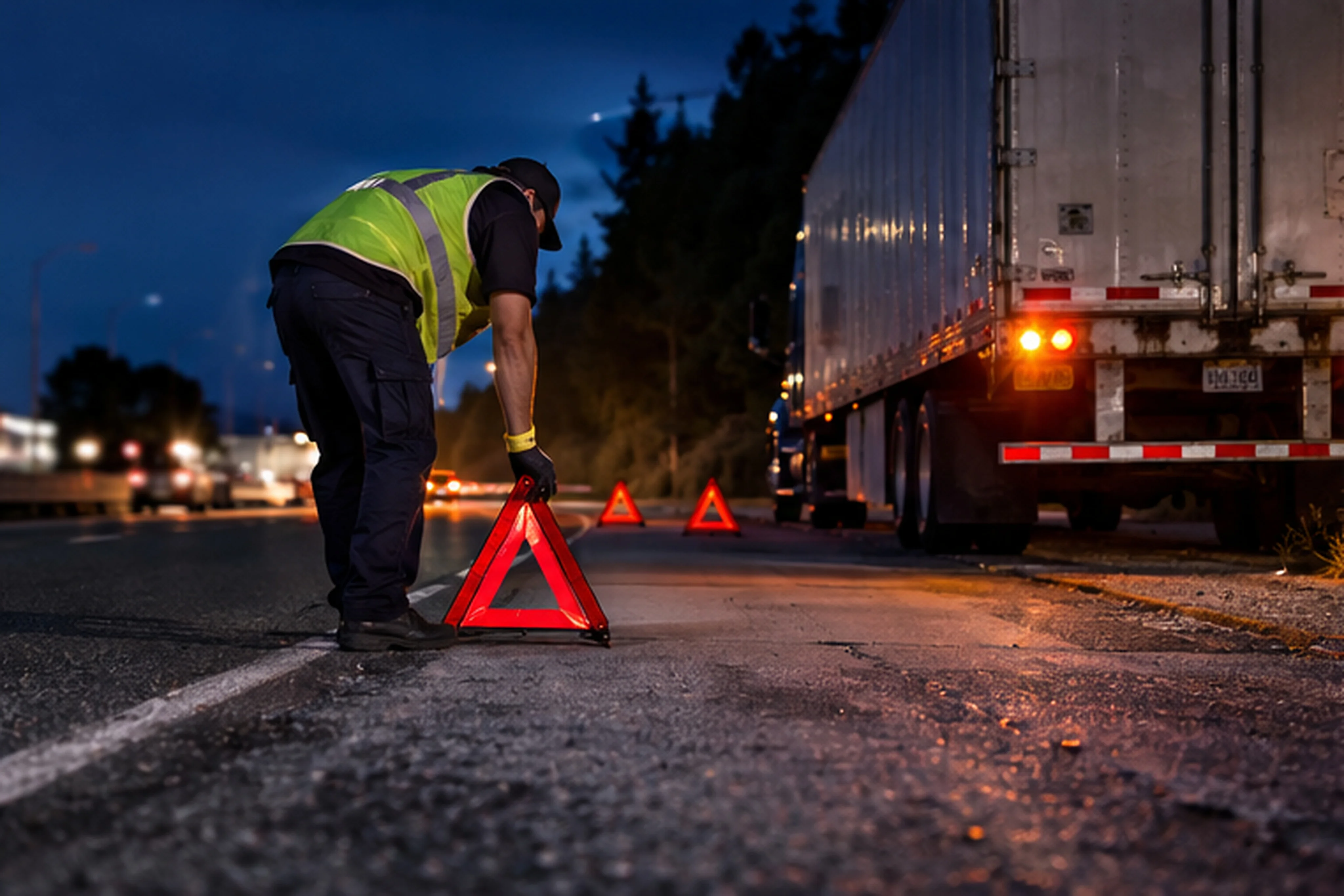
A tractor-trailer sits on the shoulder after dark with no flashers on and no triangles behind it, and an approaching driver sees it too late. The carrier's insurer then says the truck was parked and the driver should have seen it. If you hit a parked semi truck in Seattle or elsewhere in King County, that argument skips the truck driver's own duties, because federal and Washington law require a stopped semi to warn approaching traffic within a set deadline.
"I went through truck driver training and earned my Class A CDL, and part of that training is what a driver does after the truck stops," says Mike Chaloupka, Managing Partner at Metier Law Firm. "Federal rules spell out what a driver has to do in the first 10 minutes after stopping. The truck's own data can show whether it happened."
What Federal Rules Require When a Semi Stops
The core rule is 49 CFR 392.22. Under WAC 446-65-010, the Washington State Patrol adopts Parts 392 and 393 for intrastate carriers too, so the rule covers trucks that never leave the state.
When a commercial truck stops on a highway or its shoulder for anything other than a necessary traffic stop, the driver must turn on the hazard flashers immediately and keep them on until the warning devices are in place. Those devices must go out "as soon as possible, but in any event within 10 minutes." One goes on the traffic side about 10 feet from the truck, toward approaching traffic. The second goes about 100 feet back in the center of the truck's lane or shoulder, and the third goes about 100 feet in the other direction.
Within 500 feet of a curve, hillcrest, or other obstruction to view, the device in that direction goes 100 to 500 feet out. On a divided or one-way highway, devices go 100 and 200 feet behind the truck, with a third on the traffic side within 10 feet of the rear.
Trucks must carry three bidirectional reflective triangles or at least six fusees under 49 CFR 393.95(f). Since October 7, 2026, an FMCSA exemption has let qualifying carriers use cab-mounted beacons instead on Level 4 automated trucks.

Washington's Disabled-Truck Rule Outside City Limits
RCW 46.37.450 adds a state duty for semis and other large trucks and trailers disabled on a highway or its shoulder outside any municipality when lighted lamps are required. RCW 46.37.020 sets that window: a half hour after sunset to a half hour before sunrise, plus any time people and vehicles can't be clearly seen at 1,000 feet.
The driver must immediately put a lighted fusee, red lantern, or red reflector on the traffic side of the truck. Within the fusee's 15-minute burning period, three devices must be out: about 100 feet behind the truck, about 100 feet in the other direction, and one on the traffic side at least 10 feet to the front or rear. Within 500 feet of a curve or hillcrest, the device in that direction goes at least 500 feet out, farther than the federal 100-foot minimum. When both rules apply, the federal 10-minute deadline is the shorter one.
RCW 46.37.440 requires large trucks to carry these devices outside city limits. RCW 46.61.560 also bars stopping in the travel lanes outside incorporated cities and towns unless a breakdown makes it impossible to avoid, and even then the driver must arrange prompt removal.

What Changes Inside Seattle City Limits
Seattle is an incorporated city, so RCW 46.37.450(1), which applies only outside a municipality, doesn't cover a semi that breaks down inside city limits.
The federal rule has no city-limits condition, and its flasher duty applies anywhere a truck stops on a highway or shoulder. The warning-device duty has one exception: devices aren't required in a municipality's business or residential district unless lighted lamps are required and street lighting can't make the truck clearly visible at 500 feet. Outside those districts, the full rule applies in the city too. Either way, a semi stopped at night on a Seattle street too dark to see it from 500 feet needs warning devices out.
When a Missing Warning Becomes Evidence of Negligence
Under RCW 5.40.050, breaking a duty set by a statute or administrative rule is not negligence per se in Washington, but the jury may consider it as evidence of negligence. The statute's four exceptions, such as driving under the influence, don't include warning-device rules. The carrier can try to explain the violation, and the jury decides what weight it gets.
Carriers also argue the injured driver was partly at fault, for example for driving too fast for conditions. RCW 4.22.005 reduces your award in proportion to your own fault but does not bar recovery. Our post on Washington's pure comparative fault rule covers how fault gets divided in Seattle truck cases.
A Worked Example
Assume a jury finds $400,000 in damages after a car hits a semi on a dark shoulder outside city limits. Telematics show the truck stopped 25 minutes before the crash, and scene photos show no warning devices. The jury assigns 70% of the fault to the truck driver and carrier and 30% to the car's driver for speed, so the car's driver recovers $280,000. At 60% fault, that driver would still recover $160,000.
If you or a loved one was injured in a crash with a commercial truck, call us at 866-377-3800 or schedule a free consultation at www.metierlaw.com.
Evidence That Shows What the Driver Did After Stopping
The carrier controls the truck's camera footage and electronic data, and looping cameras record over old footage. We look for:
- Dash camera video from the truck and nearby vehicles.
- ELD and telematics data that time-stamp the stop and test the 10-minute rule.
- Photos showing where each triangle or flare sat before the scene was cleared.
- 911 call times and tow records showing when the truck was reported and removed.
- Witness statements about flashers, triangles, and lighting.
We send preservation demands early, as our spoliation letter guide explains. If a blowout disabled the truck, our semi-truck tire blowout guide covers that cause. The general deadline for a Washington personal injury lawsuit is three years under RCW 4.16.080(2), but carriers only have to keep duty-status records and supporting documents for six months under 49 CFR 395.8(k)(1).
Frequently Asked Questions
Is it my fault if I hit a truck parked on the shoulder?
Not automatically. A jury may treat the truck driver's missed flasher or warning-device duty as evidence of negligence under RCW 5.40.050, and if you share fault, RCW 4.22.005 reduces your recovery without barring it.
Do truckers have to put out triangles inside Seattle city limits?
Yes, unless the federal business-district exception applies. RCW 46.37.450(1) covers only breakdowns outside a municipality, but 49 CFR 392.22 has no city-limits condition. In a business or residential district, devices are required only when lighted lamps are required and street lighting can't make the truck clearly visible at 500 feet.
Can I sue if the truck had no hazard lights on?
Yes, if the missing flashers helped cause the crash. Section 392.22(a) requires a stopped commercial truck to turn on its hazard flashers immediately, other than at a necessary traffic stop, and keep them on until warning devices are out. That duty has no business-district exception.
Find Out What Happened in the First 10 Minutes
After you hit a parked semi truck in Seattle, we start with what the driver did once the truck stopped. We collect the video, telematics data, and scene photos and measure the carrier's choices against § 392.22 and RCW 46.37.450. Our Seattle truck accident lawyers review stopped and disabled truck crashes in a free consultation.
Call Metier Law Firm at 866-377-3800 or schedule your free consultation today at www.metierlaw.com.
Disclaimer: Past results discussed should not be considered a guarantee of your results as the factors of every case are individually unique. This content is for informational purposes only and does not constitute legal advice. Consult a qualified attorney from Metier Law Firm regarding your individual situation for legal advice.
Related Blog Posts
Tell Us About Your Case – Free Case Review with a Personal Injury Lawyer
(866) 377-3800Our Locations

Do I have a Case?
How Much Should I Be Offered?
Do I Need an Attorney?
If these questions have crossed your mind, let us help. You may need a little direction or may not need an attorney at all, but you deserve to be confident knowing your options. We can provide you with information about our Attorneys of the West® accident investigations and legal services. Your confidential consultation with us is totally free.
Keep up with us!
