.svg)

.png)
TL;DR:
● A spoliation letter is a legal notice that forces trucking companies to preserve crash evidence like black box data, driver logs, and maintenance records
● Critical evidence disappears fast: black box data overwrites in 30 days or less, and companies routinely purge records after federal retention periods expire
● Trucking companies that destroy evidence after receiving a spoliation letter face court sanctions, adverse jury instructions, and potential case dismissal
● Time is critical: the faster you hire an attorney to send an evidence preservation letter, the stronger your case becomes
● Metier Law Firm sends spoliation letters as fast as possible after taking truck accident cases to lock down evidence before it vanishes
When a commercial truck crashes into your vehicle, the evidence that proves what really happened starts disappearing almost immediately. Some of it vanishes on purpose. Some of it gets erased by routine data overwrites. Either way, victims who wait too long to act often discover the critical proof they need is gone forever.
"Trucking companies know what evidence will hurt their case, and they have entire teams dedicated to making that evidence difficult to find or even disappear," says Todd Ingram, Partner at Metier Law Firm and experienced truck accident attorney. "A spoliation letter is our first line of defense against evidence destruction. It puts companies on notice that we're watching, and if they destroy evidence after receiving our letter, they'll answer to a judge."
This is where a spoliation letter becomes one of the most powerful tools in your case. At Metier Law Firm, we send these letters as soon as possible after taking on a truck accident case. Our team understands the trucking industry's tactics and knows exactly what evidence exists, where it lives, and how quickly it can disappear.
Understanding Spoliation Letters in Truck Accident Cases
A spoliation letter in a truck accident is a formal legal notice sent to trucking companies, drivers, and insurers immediately after a crash. The letter puts them on notice that you intend to pursue a claim and that they have a legal obligation to preserve all evidence related to the collision.
Think of it as locking down the evidence before anyone can touch it. The spoliation letter identifies specific documents, electronic files, physical evidence, and data that must be preserved. Once the trucking company receives this evidence preservation letter, they can no longer claim they didn't know litigation was coming.
Under federal law, parties must preserve evidence once they reasonably anticipate a lawsuit. A spoliation letter creates a paper trail proving the trucking company knew about your claim and had a duty to preserve crash evidence.
Why Time Matters More Than You Think
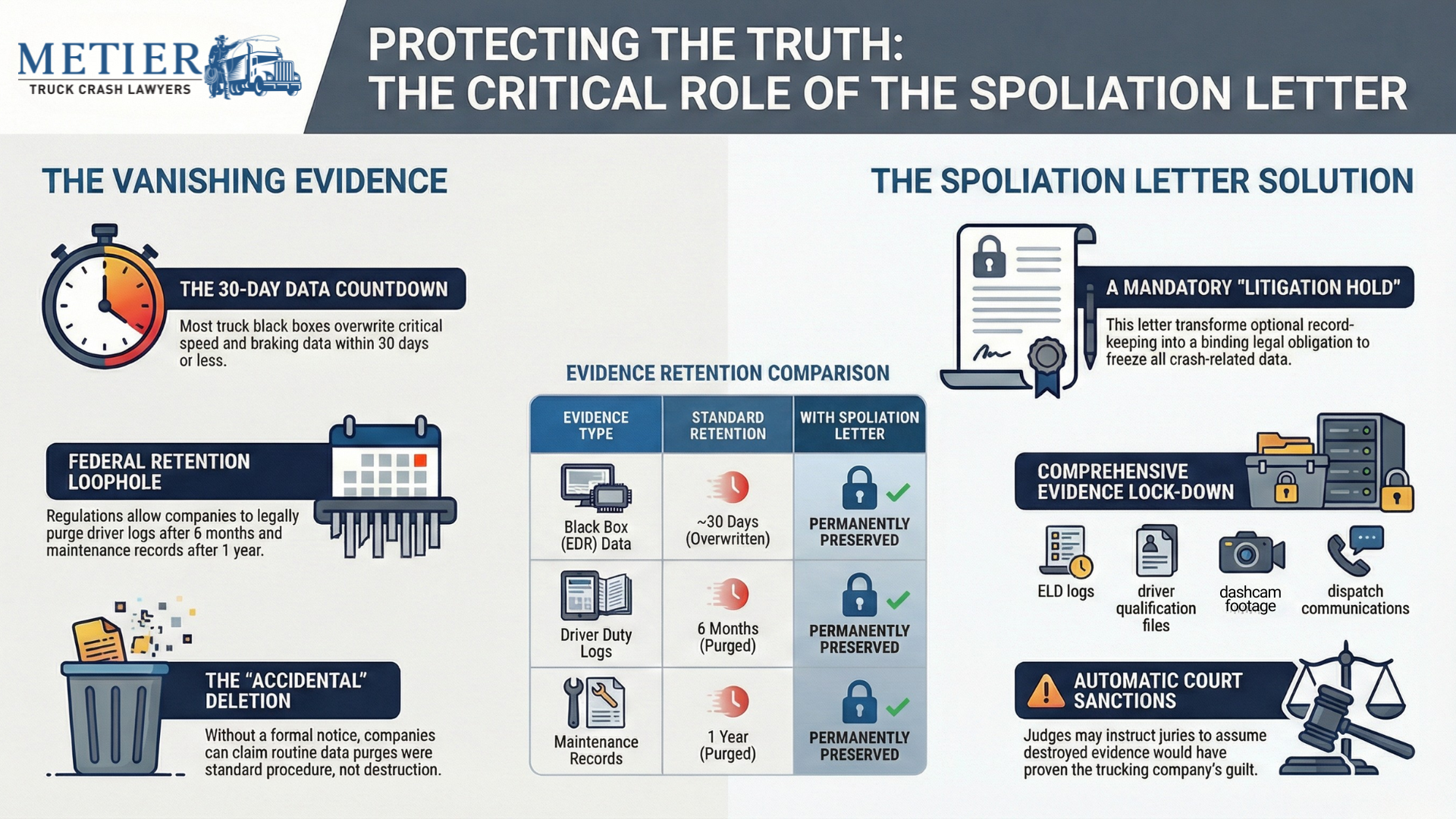
Federal regulations allow trucking companies to destroy many records after specific time periods. Under 49 CFR 395.8(k)(1), motor carriers only need to retain records of duty status for six months. Maintenance records under 49 CFR 396.3 must be kept for one year, then six months after the vehicle leaves their control.
But here's the bigger problem. Black box data preservation becomes critical because most commercial trucks overwrite their event data recorders every 30 days or less. Some older systems erase data within days. That means the digital record of the truck's speed, braking, engine performance, and driver actions in the moments before impact can vanish before you even finish recovering from your injuries.
Without a litigation hold letter in place, trucking companies face no penalty for following their routine data purge schedules. They can honestly say they didn't know they needed to preserve the evidence. A spoliation letter removes that excuse.
What Evidence Gets Protected
When we send a spoliation letter truck accident notice to a trucking company, we list every piece of evidence that might matter to your case. This includes:
Electronic logging device data
This shows the driver's hours of service, rest breaks, and compliance with federal regulations. These records reveal whether fatigue played a role in the crash.
Black box information
Event data recorder capturing the truck's speed, throttle position, brake application, hard braking events, and engine diagnostics in the seconds before impact. This objective data can contradict driver statements and prove dangerous driving.
Driver qualification files
This should contain the trucker's employment history, training records, any previous violations, drug and alcohol test results, and performance reviews. These files show whether the company hired someone with a dangerous driving record.

Maintenance and inspection records
These show documented repairs, scheduled maintenance, brake inspections, tire replacements, and safety violations. Poor maintenance often contributes to crashes, and these records prove negligence.
Dispatch communications
This will include messages, route instructions, delivery deadlines, and pressure to meet schedules. These records can reveal whether the company pushed drivers to violate hours of service rules.
Dashcam and surveillance footage
These are from the truck's cameras or from other vehicles and nearby businesses. Video evidence disappears quickly as cameras overwrite old recordings.
Drug and alcohol testing results
Post-accident screening and random testing programs as required by federal law.
GPS tracking data
This shows the truck's location, speed, stops, and route history.
Loading and cargo documents
including bills of lading, weight tickets, and securement records. Overloaded or improperly secured cargo causes many serious crashes.
Post-crash inspection reports
and photographs taken by the trucking company's accident response team.
If you or a loved one was injured in a crash with a commercial truck, call us at 866-377-3800 or schedule a free consultation at www.metierlaw.com.
What Happens If Evidence Gets Destroyed
Trucking companies that ignore a spoliation letter truck accident notice face serious consequences. Courts can impose sanctions ranging from fines to what's called a "spoliation inference instruction."
This instruction tells the jury they can assume the destroyed evidence would have been harmful to the trucking company's case. In other words, the jury gets to conclude the missing data proved the company's liability.
In extreme cases, courts have dismissed trucking companies' defenses entirely, essentially handing the victim a win on the liability question. Judges don't look kindly on companies that destroy evidence after receiving formal notice to preserve it.
We've seen cases where trucking companies claimed their black box data "malfunctioned" or maintenance records were "accidentally deleted." When we can show they received our evidence preservation letter and destroyed the evidence anyway, judges tend to believe the destruction was intentional.
The Federal Rules That Make Spoliation Letters Work
The Federal Motor Carrier Safety Administration regulates the trucking industry through detailed recordkeeping requirements. These rules exist because trucking companies have a history of cutting corners on safety to maximize profits.
Trucking companies must maintain driver qualification files, hours of service logs, vehicle inspection reports, maintenance schedules, and drug testing records. But those requirements only extend for limited periods. After that, companies can legally destroy records unless a litigation hold letter extends their preservation duty.
A spoliation letter transforms optional record retention into a mandatory legal obligation. It creates liability where none existed before. That's why trucking companies often fight back when they receive these letters. They know preserved evidence usually proves their negligence.
FAQ Section
How quickly should a spoliation letter be sent after a truck accident?
Immediately. We typically send spoliation letters within days, sometimes even hours of signing a client. Black box data can be overwritten in 30 days or less, and companies begin their accident investigation within hours. The faster we lock down evidence, the stronger your case becomes.
Can I send a spoliation letter myself without a lawyer?
You could, but you shouldn't. These letters require specific legal language and must identify the exact evidence to preserve. Miss something important, and that evidence can legally be destroyed. An experienced truck crash lawyer knows what to request based on the type of accident.
What if the trucking company ignores the spoliation letter?
If they destroy evidence after receiving our litigation hold letter, they face court sanctions, adverse inference instructions, and potential dismissal of their defenses. We document everything and hold them accountable for spoliation of evidence.
Does a spoliation letter mean I'm filing a lawsuit?
Not necessarily. The letter notifies the trucking company that litigation is anticipated, which triggers their duty to preserve evidence. You can still settle the case without filing suit, but the evidence will be protected either way.
How is a spoliation letter different from a demand letter?
A spoliation letter focuses solely on evidence preservation. It's not a settlement demand or claim for damages. It exists to protect truck crash evidence before the company can make it disappear. Demand letters come later in the process.
Why Experience with Trucking Cases Matters

At Metier Law Firm, our truck crash lawyers focus on these types of cases because we understand the unique challenges these cases present. The trucking industry operates under complex federal regulations, and companies have sophisticated legal teams ready to fight claims.
When we send a litigation hold letter, it's not a generic template listing "all relevant documents." We identify specific systems, file locations, and data sources based on years of handling these cases. We request black box downloads from the exact data ports where information is stored. We ask for specific dispatch software records, not just "communications."
Trucking companies recognize when an attorney understands their business. They know they can't bluff us with claims that certain evidence doesn't exist or that data has been routinely purged. Our experience tells us better.
This expertise matters in spoliation cases because judges evaluate whether evidence requests were reasonable. A lawyer who asks for "everything" looks desperate and uninformed. A lawyer who requests specific, targeted evidence demonstrates knowledge and credibility. Courts take those requests more seriously.
Evidence Preservation in Multi-State Truck Crashes
Metier Law Firm’s truck crash lawyers represent truck accident victims across Colorado, Washington, Oregon, Wyoming, and Nebraska. Interstate trucking means evidence can be scattered across multiple states, stored on servers in different locations, and held by numerous parties including the trucking company, leasing companies, maintenance contractors, and cargo brokers.
Our spoliation letters cover all these entities. We trace the chain of custody for evidence and ensure every party with relevant information receives formal notice to preserve crash evidence. This comprehensive approach prevents companies from claiming they didn't know about the litigation or weren't directly notified.
Interstate commerce rules under federal law mean our evidence preservation letters carry weight regardless of where the trucking company is based. The FMCSA regulations apply to all motor carriers operating in interstate commerce, giving us leverage to demand compliance even from out-of-state companies.
The Connection Between Spoliation and Settlement Value
Insurance companies for trucking companies know that preserved evidence usually tells the truth. When they see we've secured all the critical data through a spoliation letter truck accident notice, they understand we can prove liability.
That reality changes settlement negotiations. Insurers can't lowball offers hoping we lack proof. They can't claim the driver followed all regulations when we have their own electronic logging device records showing violations. They can't argue mechanical failure when maintenance records prove neglected repairs.
Strong evidence secured early through spoliation letters leads to better settlements. Trucking companies would rather pay fair compensation than risk a jury seeing proof of their negligence.
Don't Let Critical Evidence Disappear
Every day you wait, evidence disappears. Black box data gets overwritten. Security camera footage gets deleted. Witnesses' memories fade. Trucks get repaired or sold. Documents get shredded.
A spoliation letter stops that process. It freezes the evidence in place and creates legal consequences for anyone who destroys it. But we can only protect evidence we know exists, and we can only send preservation letters if you contact us while the evidence still exists.
Call Metier Law Firm at 866-377-3800 or schedule your free consultation today at www.metierlaw.com. Speak with an experienced Denver truck accident lawyer serving Colorado Springs, Fort Collins, Seattle, Portland, and Cheyenne.
Disclaimer: Past results discussed should not be considered a guarantee of your results as the factors of every case are individually unique. This content is for informational purposes only and does not constitute legal advice. Consult a qualified attorney from Metier Law Firm regarding your individual situation for legal advice.
Tell Us About Your Case – Free Case Review with a Truck Accident Lawyer
Tell Us About Your Case – Free Case Review with a Personal Injury Lawyer
(866) 377-3800Our Locations
.webp)
Do I have a Case?
How Much Should I Be Offered?
Do I Need an Attorney?
If these questions have crossed your mind, let us help. You may need a little direction or may not need an attorney at all, but you deserve to be confident knowing your options. We can provide you with information about our Attorneys of the West® accident investigations and legal services. Your confidential consultation with us is totally free.
Keep up with us!
