



TL;DR: Key Takeaways
- Under C.R.S. § 42-4-1007(1)(a), a driver on a road with marked lanes can't leave a lane until first confirming the move can be made safely.
- A turn signal doesn't satisfy that duty. C.R.S. § 42-4-903(1) requires a reasonably safe move and a signal, and the Colorado Supreme Court has held the signal must come before the vehicle starts to change lanes.
- With limited exceptions, federal rules require two outside rear-vision mirrors on every truck and truck tractor (49 CFR 393.80) and require drivers to use them when needed (49 CFR 392.7).
- A blind-spot defense is a comparative fault argument. Under C.R.S. § 13-21-111, your damages are reduced by your share of fault, and a finding that you were 50% or more at fault bars recovery.
- The claim doesn't depend on a traffic ticket. C.R.S. § 42-4-1713 keeps traffic conviction records out of civil cases, so the case rests on the driving evidence.
- We send preservation demands for camera footage and truck data early because many dash cam systems automatically overwrite older video.
A tractor-trailer moves right on a multi-lane arterial in a Fort Collins commercial district, and the sedan traveling beside its trailer is pushed toward the curb. The carrier's insurer responds that the car was in the truck's blind spot. In a Fort Collins truck lane change accident, that response raises two separate questions. Did the truck driver confirm the next lane was clear before moving over, and does any share of the fault belong to the driver who was already there?
"When a carrier tells us our client was in the blind spot, it's describing a hazard its own driver had to manage," says Emily N. Benight, a Partner at Metier Law Firm whose practice centers on commercial truck crashes and brain injuries. "Colorado puts the duty to confirm the next lane is clear on the driver who moves. A truck driver who knows the trailer hides part of that lane has to account for it before turning the wheel."
What Colorado Law Requires Before a Truck Changes Lanes
On any roadway divided into two or more clearly marked lanes, C.R.S. § 42-4-1007(1)(a) requires a vehicle to be driven as nearly as practicable entirely within a single lane. It can't be moved from that lane until the driver "has first ascertained that such movement can be made with safety."
Signaling Is a Separate Requirement
C.R.S. § 42-4-903(1) bars a driver from moving right or left until the move can be made with reasonable safety, and then only after an appropriate signal. In People v. Gutierrez, 2020 CO 60, the Colorado Supreme Court held that § 42-4-903 doesn't allow a driver to signal and move into another lane at the same time. The signal comes first, and the move itself still has to be reasonably safe.
Federal Mirror and Operating Rules
For interstate carriers, federal rules add to Colorado law (49 CFR 390.3(a)). 49 CFR 392.2 requires every commercial motor vehicle to be operated according to the laws of the place where it's driven, and the federal rule controls when it sets a higher standard of care. With limited exceptions, 49 CFR 393.80 requires trucks and truck tractors to carry two outside rear-vision mirrors, one on each side, that show the highway to the rear and meet Federal Motor Vehicle Safety Standard No. 111. Section 392.7(a) bars driving unless the driver is satisfied the mirrors are in good working order, and it requires the driver to use them when and as needed.
When a Traffic Violation Becomes Evidence of Negligence
Under Lyons v. Nasby, 770 P.2d 1250 (Colo. 1989), violating a statute adopted for public safety is negligence per se when the violation caused the injury, the injured person belongs to the class the statute was meant to protect, and the injury is the kind the statute was enacted to prevent. A truck moving into a car already in the next lane is the collision § 42-4-1007(1)(a) is written to prevent.
The claim doesn't depend on a ticket, either. C.R.S. § 42-4-1713 keeps traffic conviction records out of civil cases, so we prove the violation with the driving evidence.
How Fault Is Divided in a Fort Collins Truck Lane Change Accident
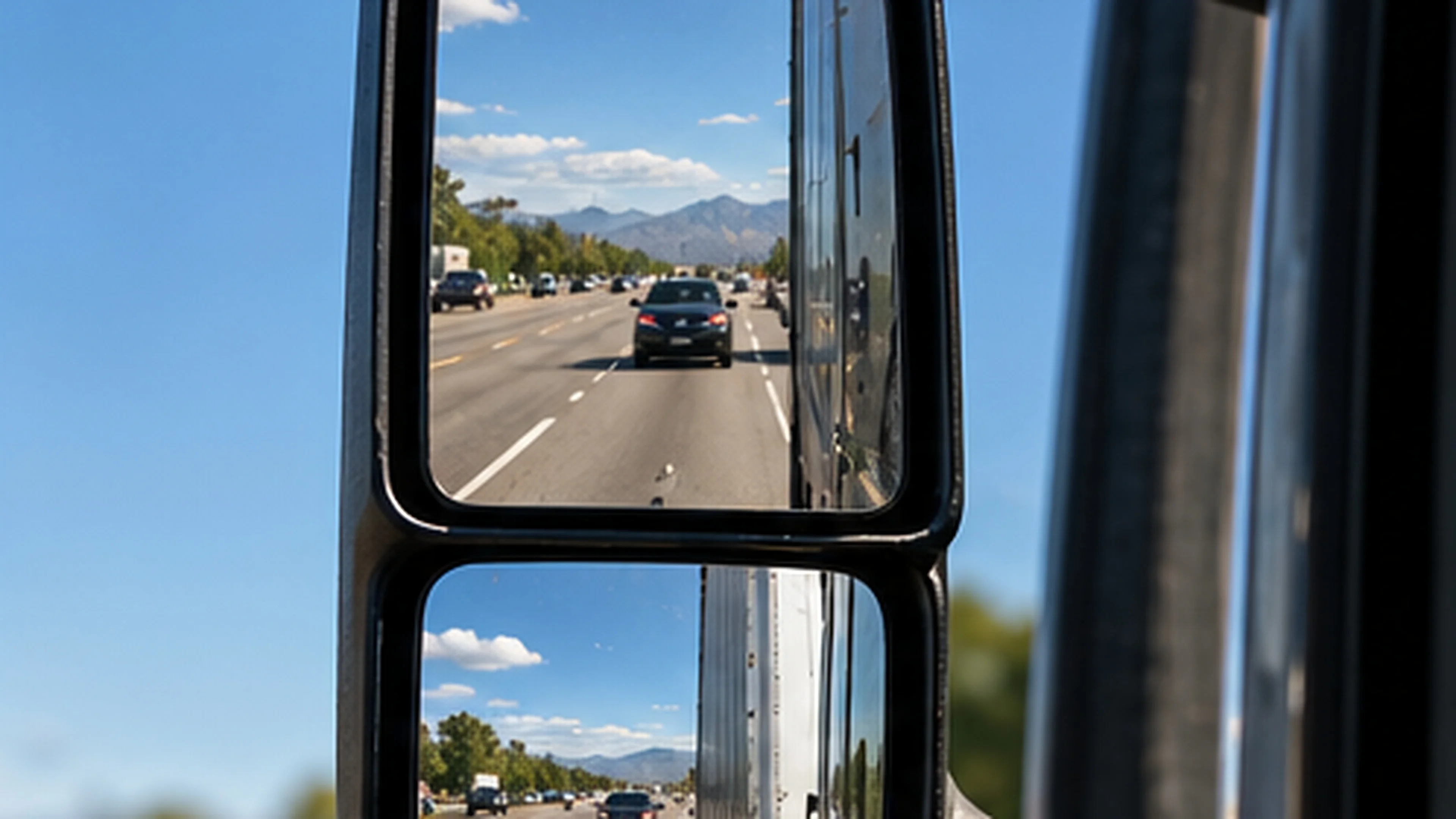
Our post on what the no-zone is in trucking explains where a tractor-trailer's blind spots sit. In a truck blind spot accident in Colorado, the carrier's position becomes a comparative fault claim: the car driver was also careless, for example by staying beside the trailer longer than traffic required.
C.R.S. § 13-21-111 sets out how that argument is resolved. The jury states the full damages and assigns each party a percentage of negligence, and the court reduces the award by the injured driver's share. If that share is equal to or greater than the negligence of the party being sued, the court enters judgment for the defendant, so a driver found 50% or more at fault recovers nothing.
A Worked Example
Suppose a jury finds $250,000 in damages after a tractor-trailer moves into a sedan on a four-lane Fort Collins street. It assigns 20% of the fault to the sedan driver for staying beside the trailer and 80% to the trucking side, so the court reduces the award to $200,000. With a 50/50 split, § 13-21-111(3) requires judgment for the trucking side, and the sedan driver recovers nothing.
If you or a loved one was injured in a crash with a commercial truck, call us at 866-377-3800 or schedule a free consultation at www.metierlaw.com.
The Evidence We Gather After a Semi Sideswipes a Car
In a lane-change case, we look for:
- Photos of both outside mirrors taken before any repair, showing whether each was intact and aimed at the lane beside the trailer.
- Video from the truck's cameras, nearby businesses, and other drivers' dash cams.
- Engine control module and telematics data showing the truck's speed and braking around the lane change.
- Witness accounts and video showing whether the turn signal came on before the truck left its lane.
- Paint transfer and damage location on both vehicles, which help show which vehicle crossed the lane line.
- The driver's statements to police and to the carrier about checking the mirrors before moving over.
Many dash cam systems record on a loop and overwrite the oldest unprotected footage once storage fills, so we send preservation demands to the carrier early. Our posts on what a spoliation letter is and semi truck dash cam laws explain that step, and our FMCSA Part 392 guide for Colorado truck crashes covers the broader federal driving rules. C.R.S. § 13-80-101(1)(n)(I) allows three years to sue for bodily injury from the use or operation of a motor vehicle, but a looping camera can record over the crash long before then.

Frequently Asked Questions
Is a lane-change crash automatically the truck driver's fault?
No. The driver who moves has the duty to confirm the lane change is safe, and proof a truck driver skipped that check is strong evidence of negligence. The carrier can still argue you shared fault, and the jury assigns each side a percentage under C.R.S. § 13-21-111.
What if I was driving in the truck's blind spot?
Your position doesn't remove the truck driver's duty to confirm the lane was clear, though the carrier can use it to argue you were partly at fault. If the jury agrees, your damages drop by your percentage of fault, and you still recover as long as that percentage is 49% or less.
The trucking company says its driver signaled. Does that end the claim?
No. Under C.R.S. § 42-4-903(1) and Gutierrez, the signal has to come before the truck starts into the next lane, and the move still has to be reasonably safe. Section 42-4-1007(1)(a) separately requires the driver to confirm the lane is clear.

Talk to a Larimer County Truck Crash Lawyer Before the Truck Is Repaired
The strongest evidence in a semi merge crash is on the truck and in the carrier's data systems, and both can change once the truck returns to service. We inspect the mirrors and secure the camera and electronic data early so the blind-spot defense can be tested against what Colorado law requires. If you were sideswiped by a semi in Larimer County, our Fort Collins truck accident lawyers offer a free consultation.
Call Metier Law Firm at 866-377-3800 or schedule your free consultation today at www.metierlaw.com.
Disclaimer: Past results discussed should not be considered a guarantee of your results as the factors of every case are individually unique. This content is for informational purposes only and does not constitute legal advice. Consult a qualified attorney from Metier Law Firm regarding your individual situation for legal advice.
Related Blog Posts

Tell Us About Your Case – Free Case Review with a Personal Injury Lawyer
(866) 377-3800Our Locations

Do I have a Case?
How Much Should I Be Offered?
Do I Need an Attorney?
If these questions have crossed your mind, let us help. You may need a little direction or may not need an attorney at all, but you deserve to be confident knowing your options. We can provide you with information about our Attorneys of the West® accident investigations and legal services. Your confidential consultation with us is totally free.
Keep up with us!
