.svg)


TL;DR - Key Takeaways
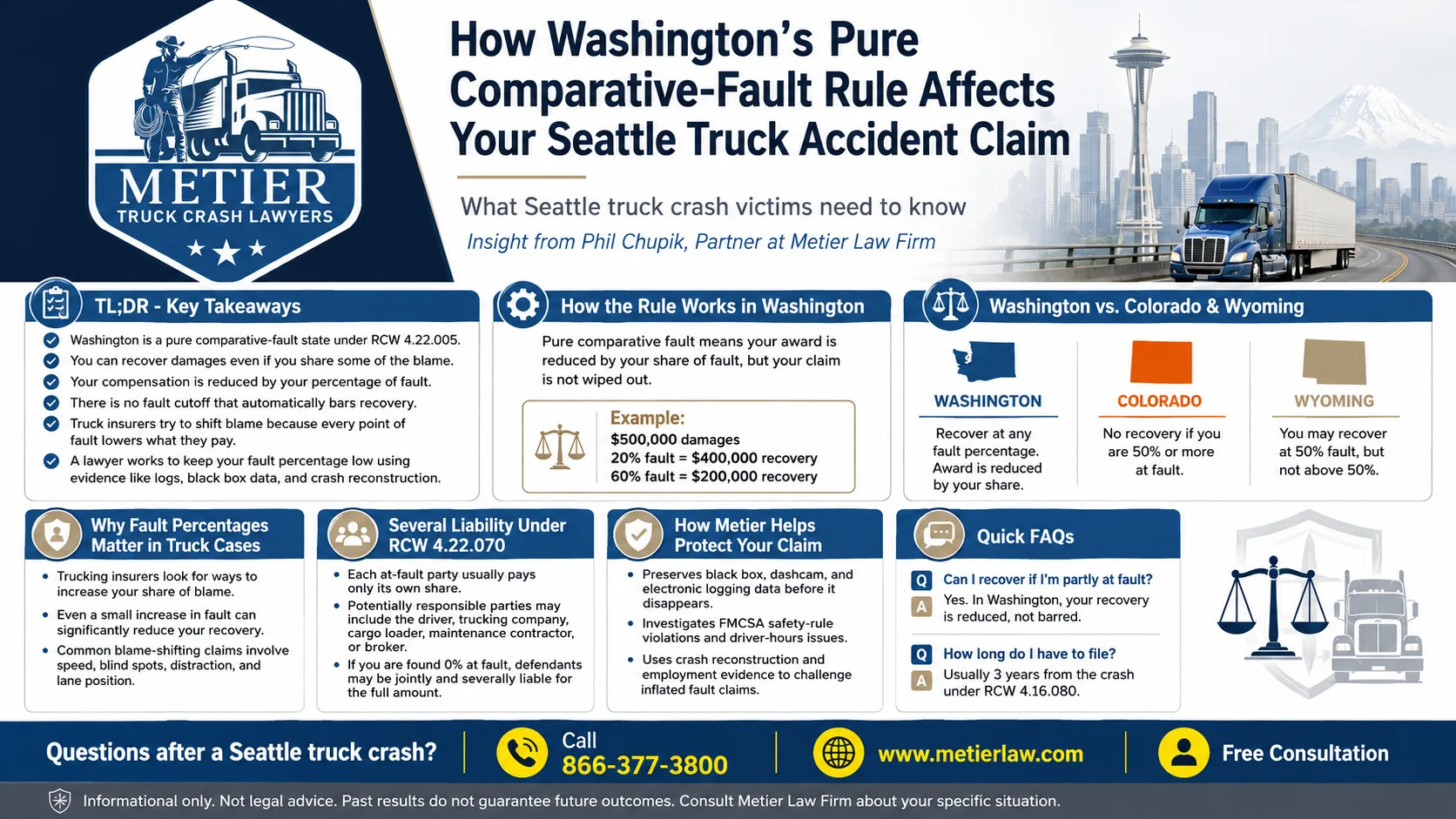
- Washington is a pure comparative-fault state under RCW 4.22.005, so a Seattle truck crash victim can recover money even if they share part of the blame.
- Your recovery drops by your percentage of fault, but no cutoff wipes out the claim, even at high fault percentages.
- That is different from Colorado, where being 50% or more at fault bars recovery, and Wyoming, where recovery ends only once your fault passes 50%.
- Truck insurers know this and work to pin extra fault on you, because every point they shift lowers what they pay.
- Washington also uses several liability under RCW 4.22.070, so each at-fault party usually pays only its own share.
- A Seattle truck accident lawyer fights the fault percentage itself, using driver logs, black box data, and crash reconstruction to keep your share of responsibility low.
After a wreck with an 80,000-pound truck on I-5 or I-405, one of the first things the trucking company's insurer looks for is a way to blame you. Not because you caused the crash, but because in Washington, every percentage point of fault they hang on you comes straight out of your recovery. That one feature of state law shapes almost every serious Seattle truck accident claim we handle, whether the crash happened north of downtown or along the freight route toward Tacoma.
I'm Phil Chupik, a partner at Metier Law Firm. I've spent more than 20 years representing people hurt by commercial trucks. Here is how Washington's fault rule works, why it hits truck cases harder than most people expect, and what it means if you think you share some blame.
Washington Is a Pure Comparative-Fault State
Washington follows pure comparative negligence, a rule most drivers never think about until they need it. It lives in RCW 4.22.005, which says a victim's own fault reduces the amount awarded but does not bar recovery.
In plain terms, your compensation drops by your share of fault, and nothing more. If a jury sets your damages at $500,000 and finds you 20% at fault, you recover $400,000. At 60% fault, you still recover $200,000. There is no line where your claim disappears. It applies to every commercial truck case in the state, from a Seattle freeway collision to a logging truck crash on a rural highway.
How This Differs From Modified Comparative Fault States Like Colorado and Wyoming
This is where Washington stands apart from two other states where we practice. Colorado and Wyoming both put a hard ceiling on fault. In Colorado, you recover nothing if you are 50% or more at fault, so you have to be 49% or less to collect under C.R.S. 13-21-111. Wyoming draws the line one point higher: under Wyo. Stat. 1-1-109 you can be exactly 50% at fault and still recover, and you lose that right only once your fault passes 50%. Washington has no such ceiling. Whether a Seattle crash leaves you 10% or 70% responsible, the door to recovery stays open.
Why Fault Percentages Decide Truck Cases
Truck wrecks draw more fault-shifting than ordinary car crashes. Carriers and their insurers have money, seasoned defense lawyers, and a strong reason to move blame onto you. Under a pure comparative-fault rule, they do not have to prove you caused the crash, only that you contributed to it.
So they comb through everything: a few miles over the limit on the ship canal bridge, a little too long in the truck's blind spot on 405, a glance at your phone near the Port of Seattle. Each point becomes an argument to raise your number and shrink their check. These blame-shifting tactics are common defenses used by trucking companies, and they show up early.
Partial Fault Does Not End Your Claim
People call us convinced they have no case because they think they did something wrong. A partial fault truck crash Seattle victims assume is hopeless is usually still a strong claim. The question is not whether you were perfect. It is how the fault splits, and whether the carrier is inflating your share to dodge its own. If you have wondered whether you can recover if partly at fault, the answer in Washington is yes. What matters is keeping your percentage honest and low.
Several Liability: Your Fault Percentage Changes Who Pays
Washington pairs its comparative-fault rule with a second statute that trips people up. Under RCW 4.22.070, fault is assigned to every party as a percentage, and in most cases each defendant pays only its own share. Lawyers call this several liability. It means you generally cannot collect the whole award from whichever defendant has the deepest pockets.
That matters in truck cases, where blame often spreads across the driver, the carrier, a cargo loader, a maintenance contractor, and sometimes a broker. If a loader is 15% at fault, that loader is usually on the hook for 15%, no more.
When the Driver and Carrier Act as One
One exception helps truck victims. A trucking company is legally responsible for its driver acting on the job, so the driver's fault and the company's fault work as a single responsible unit, with the carrier's insurance behind the driver's share. That is why pinning down the employment relationship early is a core part of any Seattle truck accident lawyer's job.
When Defendants Are Jointly Liable
RCW 4.22.070 carries another exception that rewards a clean case. If you are found entirely fault-free, the at-fault defendants can be held jointly and severally liable, so you may collect the full amount from any one of them. That is a strong reason to fight even a small slice of blame. Going from 5% at fault to zero can change who you are allowed to collect from.
How We Keep Your Fault Percentage Low
Because the fault split drives everything, the real work in a Washington comparative fault truck accident case is evidence. We move fast to preserve the truck's black box data, the electronic logging records, and dashcam footage before they are overwritten, then map the crash against the driver's federal duty limits.
Commercial trucks answer to federal safety rules, and a violation can move fault back where it belongs. The Federal Motor Carrier Safety Administration tracks the toll from large truck crashes every year, and its rules set the baseline for what a careful driver and carrier must do. This kind of shared fault truck accident Washington analysis is often the difference between a client being blamed and the carrier being held accountable, and it shapes how fault gets decided once a lawsuit is filed.
If you or a loved one was injured in a crash with a commercial truck, call us at 866-377-3800 or schedule a free consultation at www.metierlaw.com.
Frequently Asked Questions
Is Washington a pure comparative negligence state?
Yes. Under RCW 4.22.005, Washington uses pure comparative negligence, so an injured person can recover damages even when they share most of the blame. The award is reduced by their own percentage of fault, with no hard cutoff like some neighboring states use.
Can I recover if partly at fault for a Seattle truck crash?
Yes. A shared fault claim still allows recovery in Washington. If you are found 30% at fault, you lose 30% of your damages and keep the rest. A Seattle truck accident attorney works to keep that percentage low, because the trucking company's insurer will push it as high as it can.
How long do I have to file a truck accident claim in Washington?
Most personal injury claims in Washington must be filed within three years of the crash under RCW 4.16.080. Evidence like dashcam footage and electronic logs can disappear far sooner, so talk to a lawyer quickly.
What This Means for Your Case
Washington's fault rule cuts both ways. It keeps the courthouse door open even when you carry part of the blame, and it gives the trucking company a reason to pin as much on you as it can. The victims who do best treat the fault percentage as the main event, not an afterthought. That is where we focus, and it is why having a Seattle truck accident lawyer who knows how carriers build these arguments makes such a difference.
You do not have to sort out the statutes or argue with an adjuster alone. Call Metier Law Firm at 866-377-3800 or schedule your free consultation today at www.metierlaw.com.
Disclaimer: Past results discussed should not be considered a guarantee of your results as the factors of every case are individually unique. This content is for informational purposes only and does not constitute legal advice. Consult a qualified attorney from Metier Law Firm regarding your individual situation for legal advice.
Tell Us About Your Case – Free Case Review with a Personal Injury Lawyer
(866) 377-3800Our Locations
.webp)
Do I have a Case?
How Much Should I Be Offered?
Do I Need an Attorney?
If these questions have crossed your mind, let us help. You may need a little direction or may not need an attorney at all, but you deserve to be confident knowing your options. We can provide you with information about our Attorneys of the West® accident investigations and legal services. Your confidential consultation with us is totally free.
Keep up with us!
