.svg)


FMCSA Approves Safety Exemption for Driverless Trucks: What Happens When an Autonomous Semi Breaks Down?
TL;DR - Key Takeaways
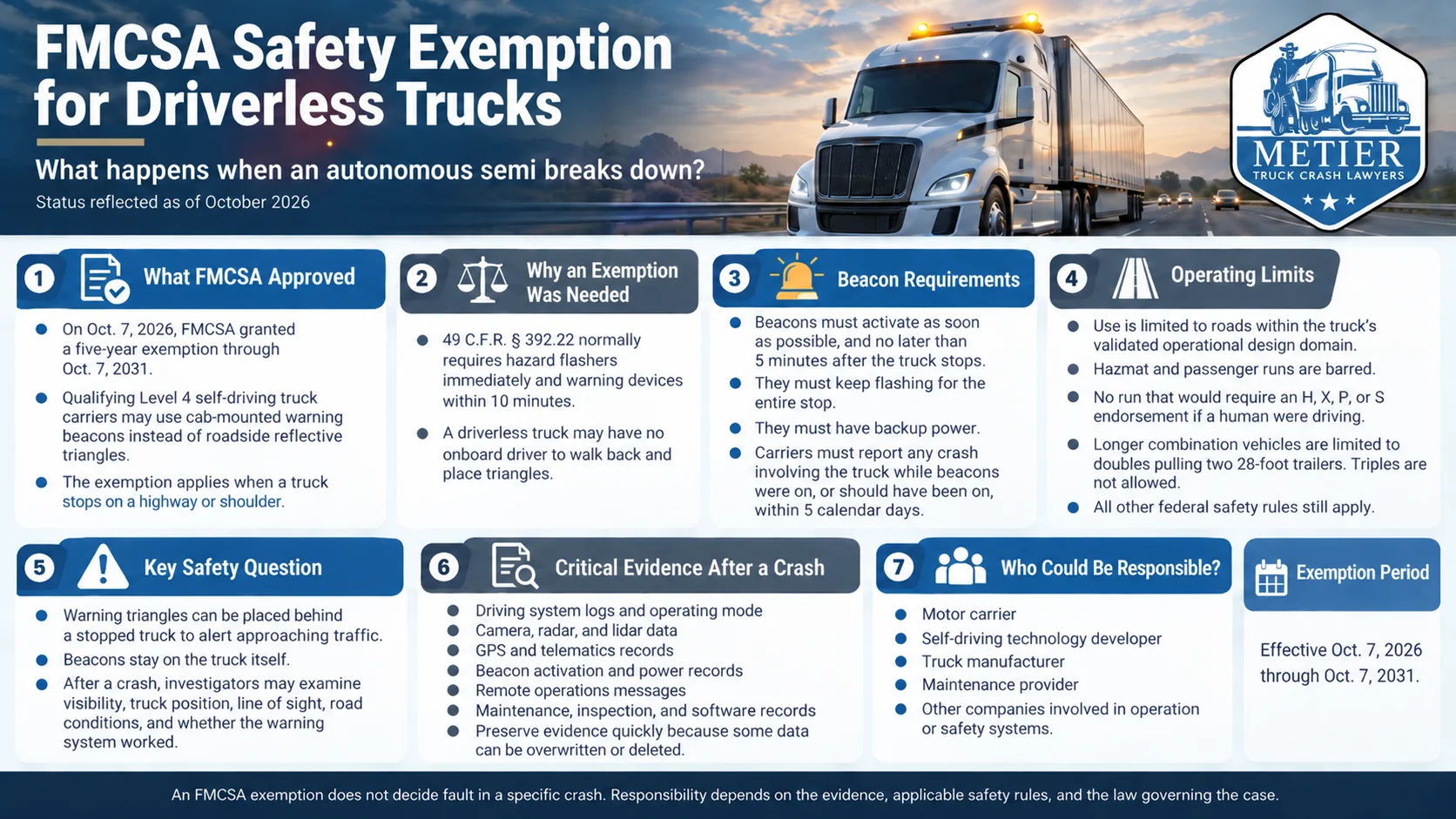
- On October 7, 2026, FMCSA gave Aurora Operations and other carriers that run Level 4 self-driving trucks a five-year exemption. They can use warning beacons mounted on the cab instead of setting out reflective triangles when a truck stops on a highway or its shoulder. The exemption ends October 7, 2031.
- Under 49 C.F.R. § 392.22, a truck driver who stops on a highway or shoulder has to turn on the hazard flashers right away and set out warning devices within 10 minutes. A truck with no human driver has nobody to walk back and place triangles.
- The beacons must turn on within five minutes, run on backup power, and keep flashing for the whole stop. Carriers have five calendar days to report any crash involving the truck while its beacons were on, or should have been on.
- Not every driverless truck qualifies. Carriers other than Aurora have to notify FMCSA in writing first, and trucks can only use the exemption on roads their self-driving system is validated to handle. Hazmat and passenger runs are barred, and all other federal safety rules still apply.
- Federal rules put triangles up to 200 feet behind a truck on a divided highway, and as far as 500 feet back near a curve or hill. Beacons stay on the cab. Groups that opposed the exemption, including the Truck Safety Coalition and OOIDA, questioned whether beacons warn drivers well enough in every road condition.
- FMCSA found the beacons will likely match or beat triangles on safety. That finding doesn’t decide who’s at fault in a specific crash. Depending on the facts, the motor carrier, the self-driving tech developer, the truck maker, or a maintenance provider could be responsible.
- Driving system logs, sensor data, beacon records, and remote operations messages can show what happened before a crash. Some of that data can be erased or written over, so it needs to be saved quickly.
Driverless semi-trucks are moving from testing to hauling real freight on American highways. That raises a basic safety question. What happens when one breaks down on the side of the road and there’s no driver on board to warn other traffic?
On October 7, 2026, the Federal Motor Carrier Safety Administration (FMCSA) granted a five-year exemption that answers part of that question. It lets qualifying operators of Level 4 self-driving trucks use warning beacons mounted on the truck. The beacons take the place of the reflective triangles normally set out around a stopped truck.
The exemption was published in the Federal Register on October 9, 2026. It runs through October 7, 2031, and carriers have to meet its conditions to use it.
FMCSA found the beacons will likely provide the same or a higher level of safety. Even so, the decision leaves open questions about visibility, road hazards, electronic evidence, and who’s responsible when a self-driving truck is in a crash.
Why Do Commercial Trucks Have to Use Warning Triangles?
Federal rules require a commercial truck that stops on a highway or its shoulder to put out warning signals. The only exception is a necessary traffic stop.
Under 49 C.F.R. § 392.22, the driver must turn on the hazard flashers right away. The driver then has to place warning devices around the truck as soon as possible, and no later than 10 minutes after stopping. The rule has its own specific conditions and exceptions.
The required devices are three bidirectional reflective triangles or at least six fusees. They’re set out to warn drivers coming toward the truck.
The point is to tell other drivers that a large truck is stopped ahead and may be blocking part of the road. That warning matters most at night, in poor visibility, on fast highways, and anywhere a stopped tractor-trailer is hard to see.
Why Do Driverless Trucks Need an Exemption?
The warning rules assume a human driver can climb out of the cab and set the devices out. Level 4 trucks don’t work that way.
A Level 4 automated driving system can drive the truck with no human help inside its operational design domain, which is the set of roads and conditions it’s built to handle. Depending on the truck and how it’s being run, there may be no one inside at all. If one of these tractor-trailers breaks down, nobody may be there to walk behind it and place triangles. Aurora Operations asked FMCSA to let it use a different warning system to solve that problem.
FMCSA turned down an earlier request from Aurora and Waymo in December 2024. The agency said that request was too open-ended to back up its safety claims, since it would have covered unnamed carriers using unspecified equipment on unspecified trucks. Aurora sued the agency, and FMCSA later gave Aurora a narrower waiver that took effect October 10, 2025. Aurora has run under four of these three-month waivers since then. The new five-year exemption replaces them and keeps the same kinds of limits.
The October 2026 decision lets qualifying operators use cab-mounted beacons in place of roadside warning devices, as long as they follow the exemption’s terms. It doesn’t free self-driving trucks from the rest of the federal safety rules.
What Safety Requirements Apply to the New Warning Beacons?
FMCSA didn’t just drop the warning rules. It put conditions on the beacons:
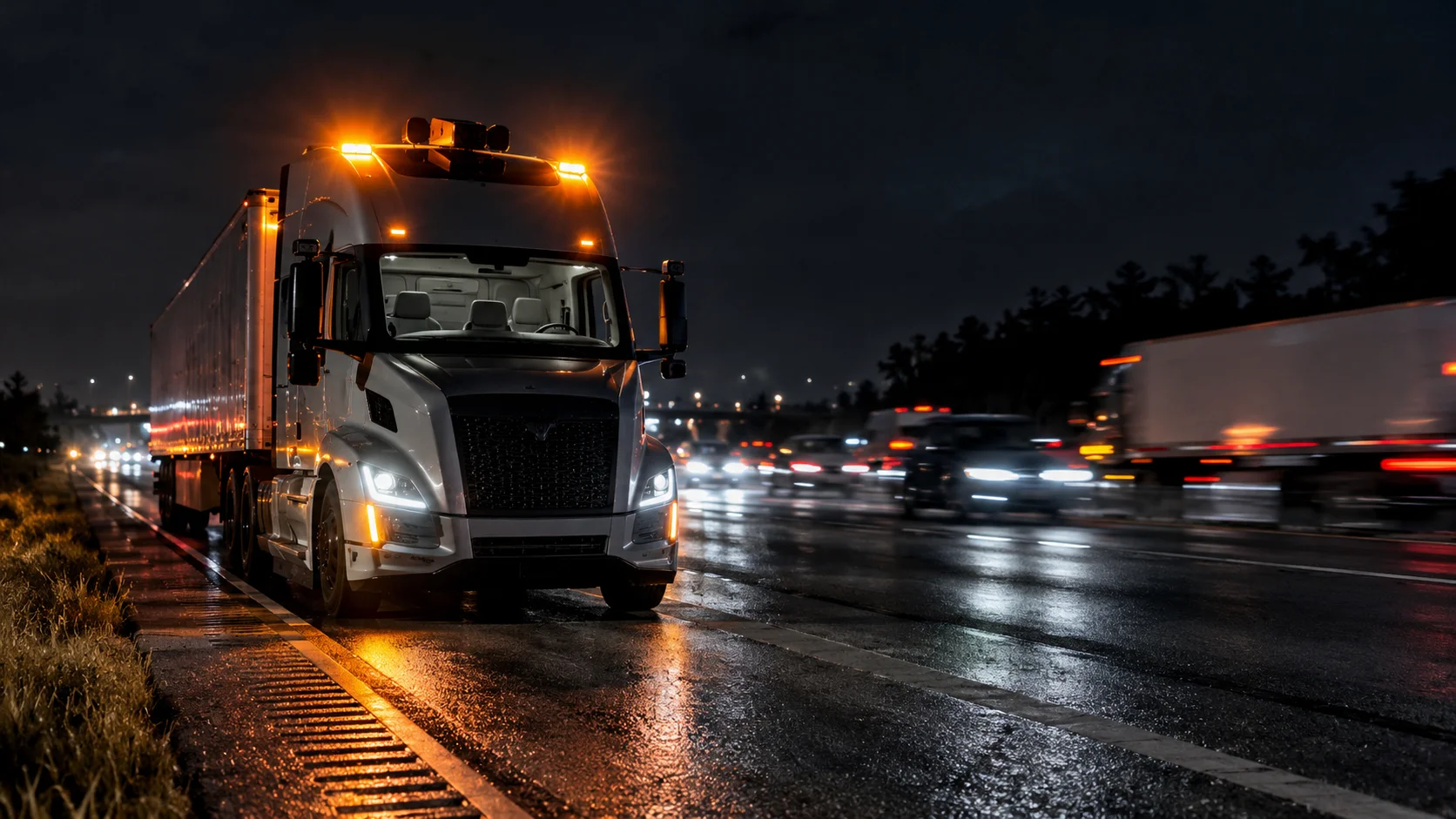
- Warning activation: The beacons must turn on as soon as possible, and no later than five minutes after the truck stops on a travel lane or shoulder for any reason other than a necessary traffic stop. They must keep flashing for the whole stop.
- Redundant power: The beacons need backup power, so a single electrical failure can’t shut them off.
- Operating limits: Trucks can only use the exemption on roads within their validated operational design domain. Hazardous materials and passenger runs are barred. So is any run that would need an H, X, P, or S endorsement if a human were driving. Longer combination vehicles are limited to doubles pulling two 28-foot trailers, and triples aren’t allowed.
- Crash reporting: Carriers must report to FMCSA within five calendar days any crash involving the truck while its beacons were on, or should have been on.
- Carrier notice: Other qualifying self-driving truck companies must notify FMCSA before they use the exemption.
These conditions are meant to cover the safety gaps that open up when no driver is on board. Still, a beacon on the truck isn’t the same as a triangle placed back down the road. Most of the safety debate comes down to that difference.
Are Flashing Warning Beacons as Safe as Roadside Triangles?
FMCSA concluded that, with its conditions in place, the exemption will likely provide the same or a higher level of safety than the current rules. That’s the agency’s finding. It doesn’t promise the beacons will prevent every crash.
Triangles can be set out away from a stopped truck, which gives drivers earlier notice of the hazard. Beacons stay on the truck itself. That can matter when a truck is stopped near a curve, just past the top of a hill, behind another large vehicle, or anywhere drivers can’t see far ahead.
Safety groups raised concerns that beacons mounted on the truck won’t be visible enough in some road conditions. After a crash, investigators have to answer a specific question: Did the beacons give approaching drivers enough warning under the conditions at the scene?
What Happens if a Driverless Truck Breaks Down on a Highway?
A disabled self-driving truck creates several safety risks. The truck has to recognize it can’t keep driving safely, respond to the problem, and act within what its driving system can do. Depending on the situation, it may need to pull over to a safe spot, turn on its warning equipment, contact a remote operations center, or wait for help. A stopped tractor-trailer is a serious hazard even with advanced technology on board.
After a crash with a disabled self-driving truck, we look at questions like these:
- Where did the truck stop, and why?
- Was it fully out of the travel lane?
- Did its warning beacons turn on?
- How long was it stopped before the crash?
- Was the warning system working properly?
- Did the approaching driver have a clear view of the truck?
- Did road conditions limit visibility?
- Did the truck’s operator follow the exemption’s terms?
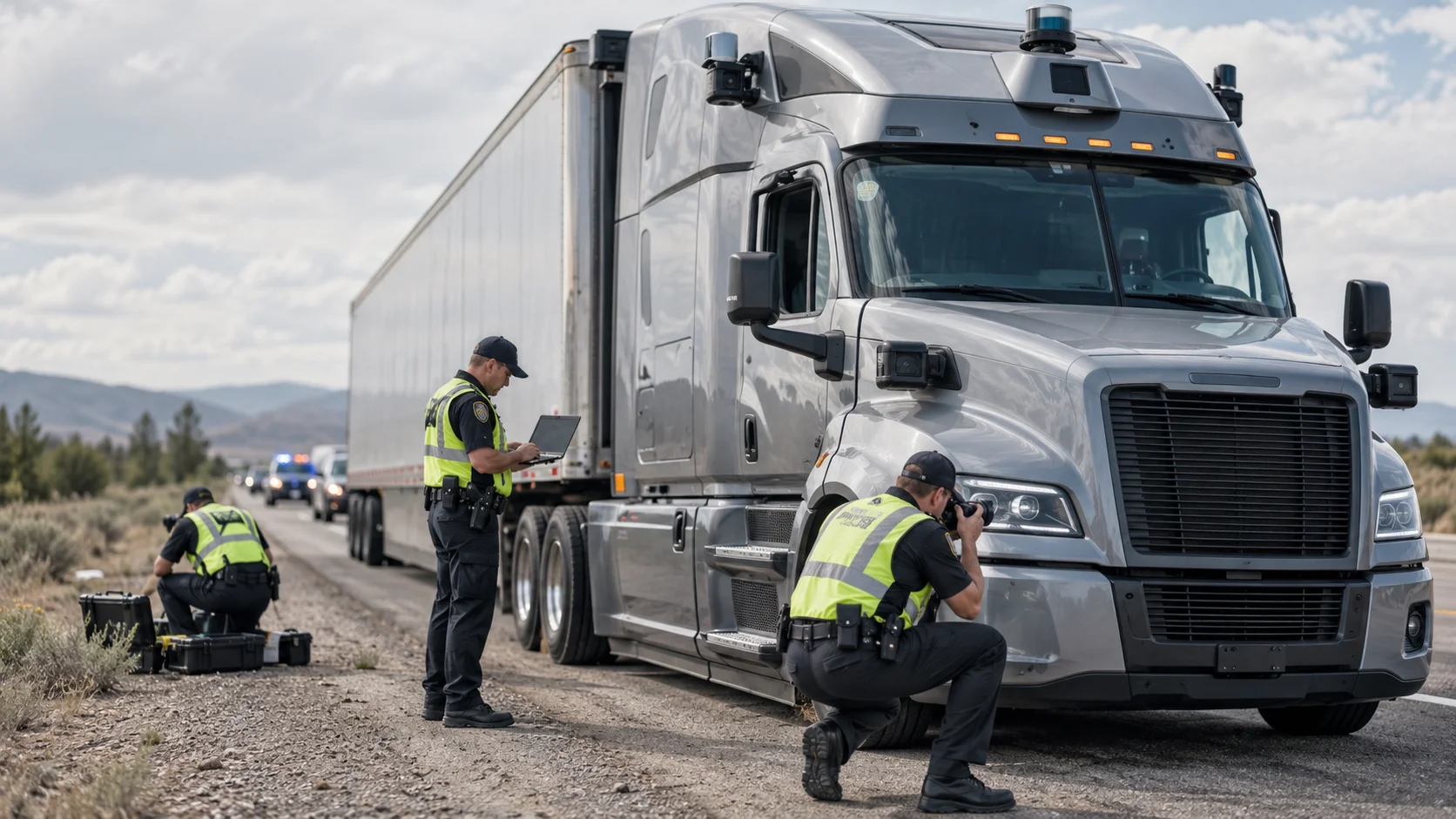
Answering them can take data from the truck’s driving system, its onboard cameras, its electronic records, and the people at the remote operations center.
What Electronic Evidence Matters After an Autonomous Truck Accident?
Self-driving trucks record a lot of data about how the truck moved, how its systems performed, and what decisions it made. Depending on the truck, the evidence can include:
- Driving system data. This shows the truck’s operating mode, the objects it detected, the moves it planned, and how it responded.
- Camera, radar, and lidar data. These sensor records can show what the truck detected before the crash.
- Location and movement records. GPS, telematics, and similar data track the truck’s route, speed, and where it stopped.
- Warning system records. These show when the beacons turned on, whether they failed, and whether backup power was available.
- Remote operations messages. These are records of what the truck and the people monitoring or helping it sent each other.
- Maintenance and inspection records. These show the condition of the warning equipment and other safety systems.
- Software and system records. These cover the driving software, its operating limits, and system events tied to the crash.
Not every self-driving truck collects or keeps the same data. Preserving that evidence quickly matters, because some of it can be written over, deleted, or kept for only a short time.
Reports filed with FMCSA count too. Every carrier using the exemption must send FMCSA a yearly report by November 1. It has to list each beacon malfunction, power problem, or other failure to work the way the exemption requires. Carriers can mark those reports, and their crash reports, as confidential business information. FMCSA then keeps that information from the public as far as the Freedom of Information Act allows. In a lawsuit, we request those reports from the carrier through discovery.
Who Could Be Responsible for an Accident Involving a Disabled Autonomous Truck?
Sorting out fault after a self-driving truck crash can be harder than in a crash with a human truck driver. Depending on the facts and the law that applies, several companies could be responsible. They include the motor carrier, the developer of the self-driving technology, the truck maker, and the maintenance provider. Other companies tied to the truck’s operation or safety systems can be involved too.
We look at whether the truck stopped in an unsafe place. We also check whether the warning system worked the way it was required to, and whether the driving system reacted correctly to the road conditions.
An FMCSA exemption doesn’t prove a company acted reasonably in every situation. A crash with a self-driving truck also doesn’t prove the truck or its technology caused it. Fault turns on the evidence, the safety rules that apply, and the law that governs the case.
Does the FMCSA Exemption Allow All Driverless Trucks to Operate Without Warning Triangles?
No. The exemption only covers qualifying operators and trucks that follow its terms. It doesn’t erase the federal warning rules for trucks in general, and it isn’t a blanket exemption from trucking safety rules. It covers one specific alternative to placing warning devices on the road. Every other safety rule still applies unless a separate legal exception or exemption covers it.
The exemption also overrides conflicting state rules for interstate trucking. While it’s in effect, no state can enforce a conflicting law or regulation against a carrier using the exemption in interstate commerce. That includes Colorado, Washington, Oregon, and Wyoming. States can adopt the same exemption for trucking that stays inside their borders, but they don’t have to.
What Does This Mean for Motorists Sharing the Road With Autonomous Trucks?
The federal government is working out how today’s trucking rules apply to trucks with no human driver. This exemption shows that the change reaches safety steps people have always handled, like warning other drivers about a disabled truck.
FMCSA has signaled that the same question applies to trucks with human drivers. In the exemption notice, the agency said beacons also offer a safety benefit for regular trucking, since drivers wouldn’t have to walk along a highway with traffic moving past to set out triangles. It added that updating the warning rules for all commercial trucks may be ripe for future rulemaking. FMCSA has also commissioned its own on-road study, run by the Virginia Tech Transportation Institute. The study will measure whether warning devices change how drivers act around a stopped truck, and by how much.
Metier Law Firm Investigates Complex Commercial Truck Accidents
At Metier Law Firm, our truck accident lawyers look into the technology, the federal rules, the truck’s systems, and the business decisions that can lead to serious truck crashes. Self-driving truck cases can require us to examine complex electronic evidence, automated driving systems, warning equipment, maintenance, and the duties of several companies. Finding out why a catastrophic truck crash happened often means looking well past the police report.
If you or a family member was seriously injured in a crash with a commercial truck, contact Metier Law Firm to learn about your legal options.
This article is for informational purposes only and reflects the status of the FMCSA exemption as of October 12, 2026. It is not legal advice.
Government sources: 49 C.F.R. § 392.22 - Emergency Signals for Stopped Commercial Motor Vehicles | FMCSA Federal Register Documents
Tell Us About Your Case – Free Case Review with a Personal Injury Lawyer
(866) 377-3800Our Locations
.webp)
Do I have a Case?
How Much Should I Be Offered?
Do I Need an Attorney?
If these questions have crossed your mind, let us help. You may need a little direction or may not need an attorney at all, but you deserve to be confident knowing your options. We can provide you with information about our Attorneys of the West® accident investigations and legal services. Your confidential consultation with us is totally free.
Keep up with us!
