


TL;DR - Key Takeaways
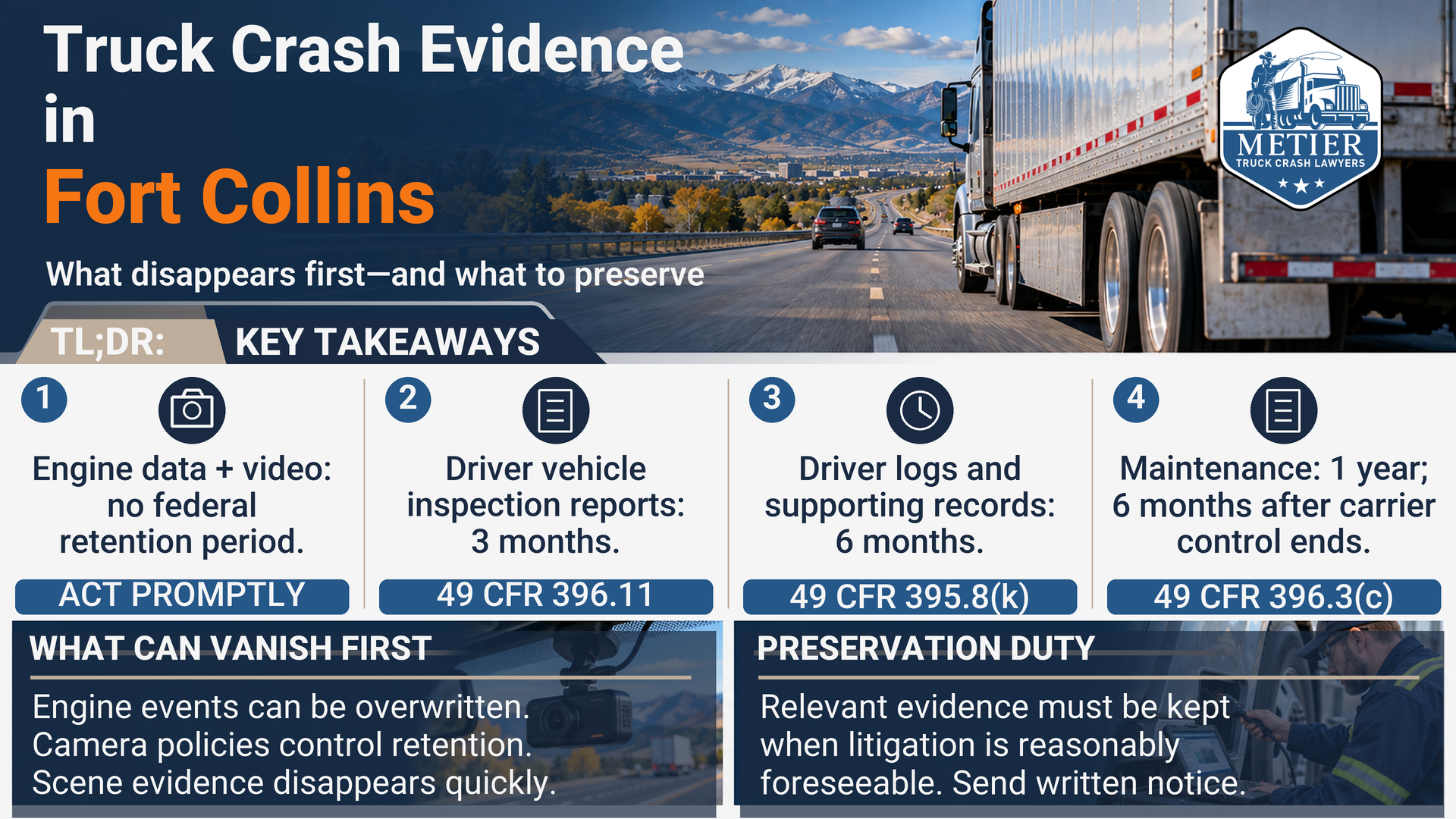
- A semi's engine control module saves only a limited number of event records, and no federal rule requires the carrier to keep that data.
- Federal trucking rules set no retention period for dash camera video, so the carrier's policy decides how long footage lasts.
- Carriers must keep driver logs, ELD records and supporting documents for six months and driver vehicle inspection reports for three months.
- Maintenance records must be kept for one year, and for six months after the truck leaves the carrier's control. Driver qualification files have a longer minimum: the length of employment plus three years.
- A carrier must stop attempting a post-crash alcohol test after eight hours and a drug test after 32 hours.
- In Colorado, the duty to preserve evidence begins once a lawsuit is reasonably foreseeable, and a preservation letter gives the carrier written notice of the claim.
- Colorado gives you three years to file suit, six times longer than a carrier has to keep the driver's logs.
The records that show how a semi was driven, maintained and staffed belong to the trucking company. Federal law lets the company discard many of them on a fixed schedule. The schedule starts the day of the crash, whether the truck hit you on I-25 near the Harmony Road exit or on College Avenue.
Mike Chaloupka, managing partner of Metier Law Firm and a Class A CDL holder, explains: "I went through the same CDL training other commercial drivers do, so I know the logs and inspection reports drivers have to fill out. On a new case, we start by identifying which of those records the company can legally discard soonest."
What disappears first after a Fort Collins truck crash
When we review Fort Collins truck accident evidence, we sort it by how fast it can be lost. Three categories are at risk first, and no federal retention rule protects any of them.
The engine control module, or "black box"
A 2001 FMCSA report to Congress describes how a truck's engine module records speed, braking and throttle data on a loop that is overwritten every few minutes. It keeps a lasting record only when an event like a hard brake triggers one. A draft industry standard in the report set the minimum at two stored events.
The carrier has no federal obligation to keep that data. NHTSA's event data recorder regulation covers only vehicles rated at 8,500 pounds or less, which excludes tractor-trailers and other heavy trucks. To protect truck black box data after a crash, we ask the carrier in writing to keep the truck out of service until an independent expert downloads the module.
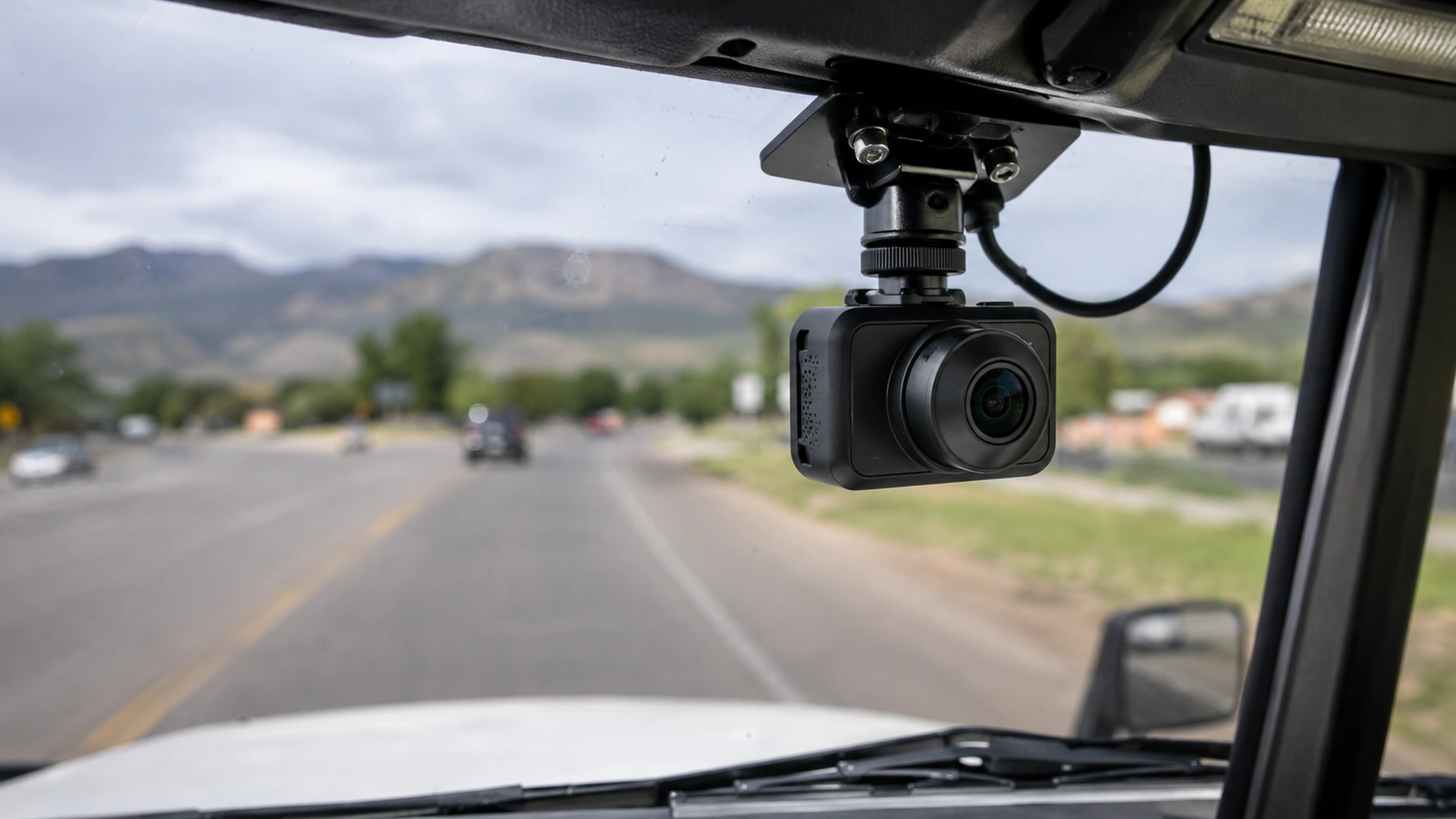
Camera footage
Federal trucking rules set no retention period for truck camera footage, whether the camera faces the road or the driver. The carrier's policy and its vendor's settings control how long it's kept, so semi truck dash cam footage goes in our first preservation request.
The scene
Debris, gouges in the pavement and the vehicles' resting positions are gone once crews reopen the road.
Federal retention periods that start with the crash
Most trucking records have a minimum federal retention period. After a period ends, federal law doesn't require the carrier to keep the file.
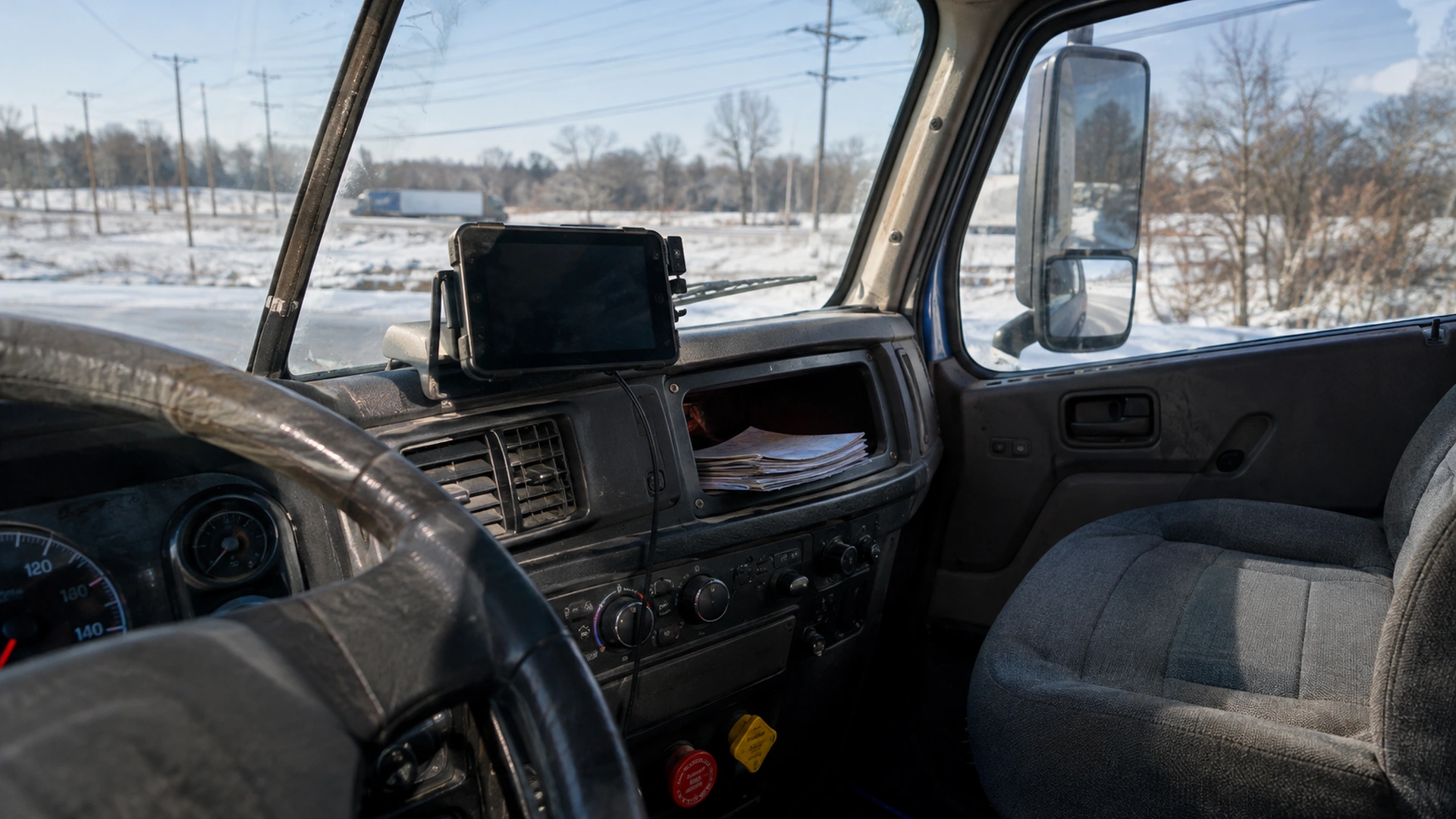
- Driver logs and supporting documents must be kept for six months under 49 CFR 395.8(k)(1). That includes ELD records and up to eight supporting documents per driver per day, such as bills of lading. A back-up copy of ELD records must be stored on a separate device for six months.
- Carriers must keep driver vehicle inspection reports for three months, and a driver doesn't have to write one when no defect is found or reported.
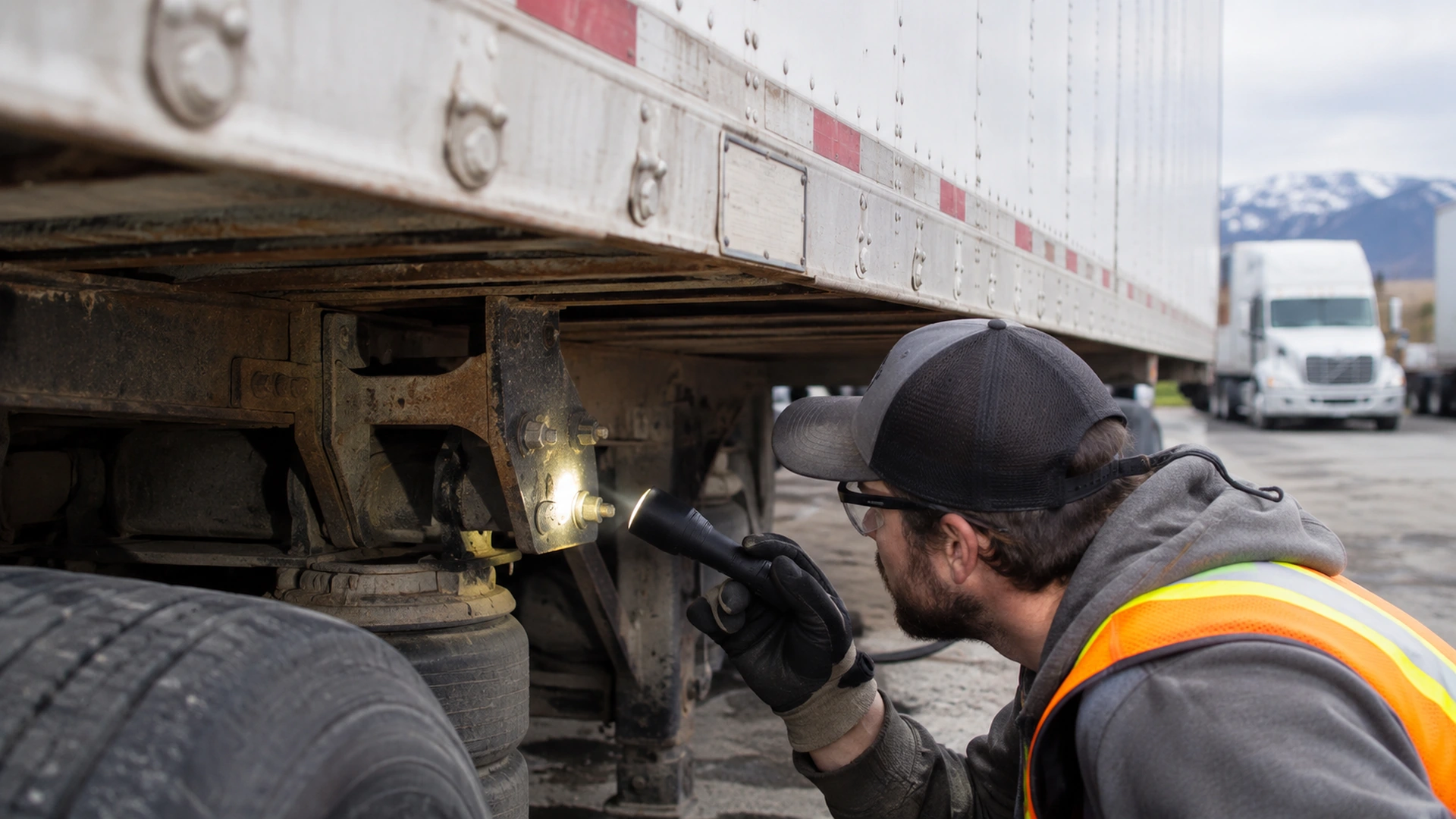
- Inspection, repair and maintenance records must be kept for one year, and for six months after the truck leaves the carrier's control, under 49 CFR 396.3(c).
- A carrier has to retain each driver's qualification file for the length of employment plus three years. Some items, like the annual driving record review, can be removed three years after they're created.
- Each accident stays in the carrier's accident register for three years, along with copies of any accident reports a state agency or insurer required.
- Post-crash drug and alcohol tests are required after a death. They're also required when the truck driver is cited for the crash and someone is treated away from the scene or a vehicle is towed with disabling damage. Under 49 CFR 382.303, the carrier must stop attempting an alcohol test after eight hours and a drug test after 32 hours. Negative results must be kept for at least one year.
Colorado State Patrol rules apply these federal rules to trucks that never leave the state, with limited exceptions. The state rules reach trucks rated at 16,001 pounds or more, including a gravel truck that works only in Larimer County.
If you or a loved one was injured in a crash with a commercial truck, call us at 866-377-3800 or schedule a free consultation at www.metierlaw.com.
How a preservation letter protects the records
In Terra Management Group v. Keaten, 2025 CO 40, the Colorado Supreme Court held that the duty to preserve evidence begins when a party knows or should know two things. Litigation is pending or reasonably foreseeable, and the evidence is relevant. After that point, destroying relevant evidence can lead to sanctions, including an instruction that lets the jury infer the lost evidence was unfavorable to the company.
Our preservation letter gives the company written notice of the claim. It names each record to keep, including the module download, camera footage, driver logs and dispatch messages. We send it to the carrier, any camera vendor and the owner of a leased tractor or trailer, since the company on the door may not own or maintain the equipment.
Engine data has no federal retention period, so we send this letter, also called a spoliation letter, as soon as we take a case. It's the first step in truck accident evidence preservation.

Fort Collins truck accident evidence you can protect in the first few days
You can preserve evidence after a truck accident with a few steps that cost nothing:
- Photograph both vehicles, your injuries, the scene and the truck's cab door. Interstate trucks must show the carrier's name and USDOT number on both sides.
- Write down witnesses' names and phone numbers.
- Save your own dash cam footage, and don't repair your vehicle until it's photographed.
- If Fort Collins Police Services worked the crash, request the report through the portal on its Police Services page.
- Get medical care and keep every record of it.
Colorado gives you three years to file a lawsuit over a motor vehicle crash under C.R.S. 13-80-101(1)(n)(I). The driver's logs only have to be kept for six months, so we request records in the first days of a case.
Frequently asked questions
How long do trucking companies keep records after a crash?
Federal minimums are three months for inspection reports, six months for driver logs, at least one year for maintenance files and three years for the accident register. Once litigation is reasonably foreseeable, Colorado law requires the company to keep relevant records past those dates.
Does every semi have a black box?
No federal rule requires a dedicated crash recorder on heavy trucks. The black box in trucks is the engine control module, which FMCSA reported in 2001 could already record speed, braking, throttle and cruise control data on new trucks.
Can I get the truck's ELD records myself?
The carrier controls them. We secure ELD records in a truck accident through a preservation letter, then through discovery once a lawsuit is filed. An ELD logs the date, time, location, engine hours and miles at each duty status change, and we check those entries against dispatch messages.
What evidence is needed to prove negligence in a truck accident?
Engine data and video establish how the truck was driven. The logs are where we look for hours-of-service violations, and the maintenance file shows whether a known defect went unrepaired. A truck accident investigation ties those records to the police report, photos and witness statements.
Request the records before the first retention period ends
Our Fort Collins truck accident lawyers work from our South College Avenue office and know which records to request before their retention periods run out. For the statewide process, see how a Colorado truck accident attorney helps after a crash.
Call Metier Law Firm at 866-377-3800 or schedule your free consultation today at www.metierlaw.com.
Disclaimer: Past results discussed should not be considered a guarantee of your results as the factors of every case are individually unique. This content is for informational purposes only and does not constitute legal advice. Consult a qualified attorney from Metier Law Firm regarding your individual situation for legal advice.


Tell Us About Your Case – Free Case Review with a Personal Injury Lawyer
(866) 377-3800Our Locations

Do I have a Case?
How Much Should I Be Offered?
Do I Need an Attorney?
If these questions have crossed your mind, let us help. You may need a little direction or may not need an attorney at all, but you deserve to be confident knowing your options. We can provide you with information about our Attorneys of the West® accident investigations and legal services. Your confidential consultation with us is totally free.
Keep up with us!
