.svg)


TL;DR - Key Takeaways
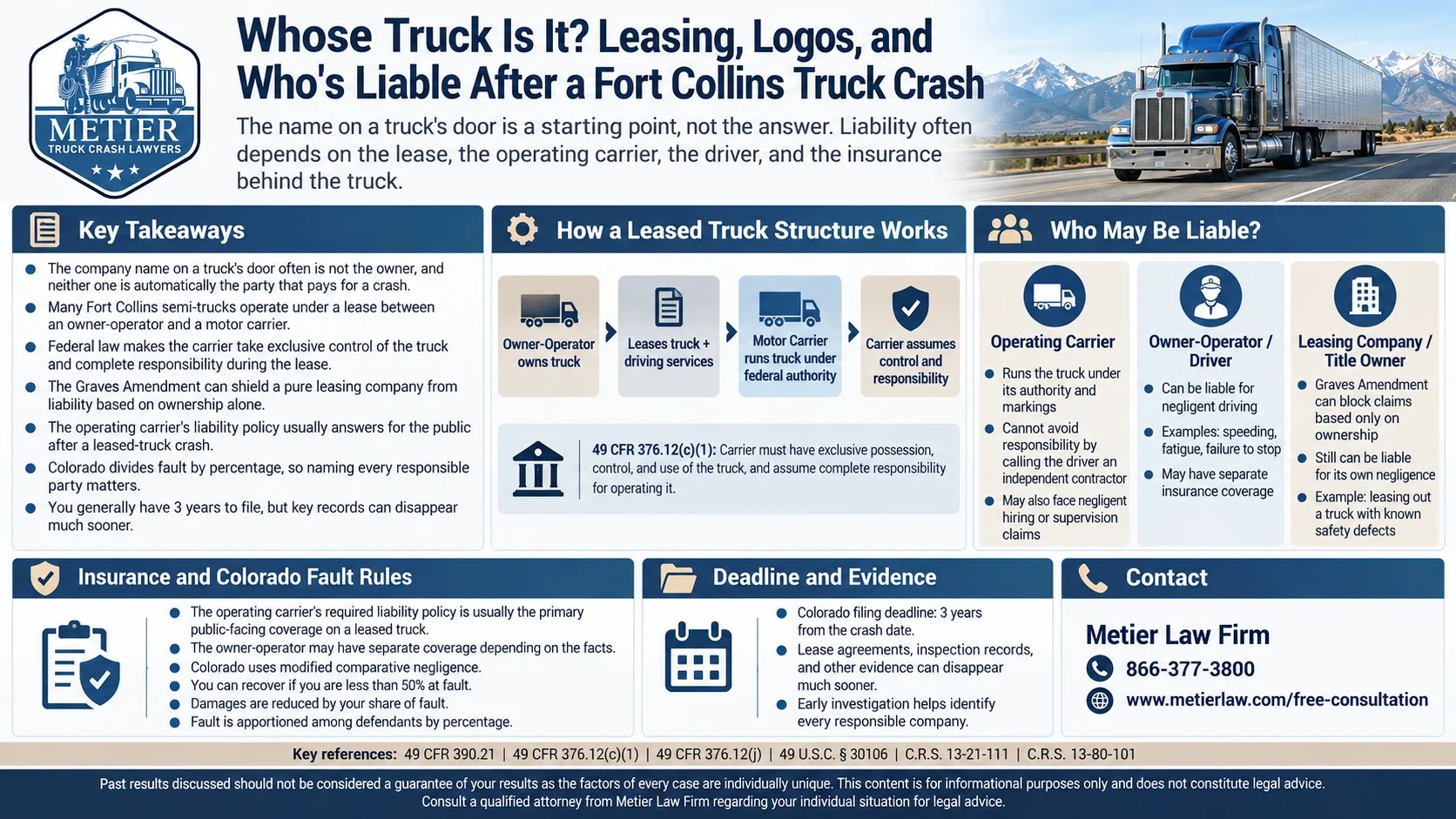
- The company name on a truck's door often isn't the company that owns the truck, and neither one is automatically the party that pays for your crash.
- Many semi-trucks running through Fort Collins operate under a lease, where an owner-operator's truck is leased to a motor carrier that runs it on its own federal authority.
- Federal law makes that carrier take exclusive control of the truck and complete responsibility for how it's driven during the lease.
- The Graves Amendment shields a pure leasing company from being sued just for owning the truck. It does not shield the carrier running the truck or a lessor that was careless itself.
- The operating carrier's federally required liability policy is the coverage that answers for the public when a leased truck causes a crash.
- Colorado splits fault by percentage, so naming every responsible party, driver, carrier, and owner, decides what you recover.
- You have three years to file, but the lease and inspection records that prove who's responsible start disappearing much sooner.
The name on the side of a semi rarely tells you who's responsible for a crash. A truck rolling south on I-25 through Fort Collins might carry one company's logo, sit on another company's title, run with a third company's driver, and answer to a fourth company's insurer. Working out who is liable in a Fort Collins truck accident means reading the paperwork behind that logo instead of trusting the logo itself. I'm Mike Chaloupka, Managing Partner at Metier Law Firm. I hold a Class A commercial driver's license, and I've spent years pulling lease agreements apart to find every company that owes an injured client answers.
The name on the door is a starting point, not the answer
Federal rules require a working truck to display the operating carrier's legal name and USDOT number on both sides of the cab (49 CFR 390.21). That placard tells you which carrier is running the truck under its authority that day. It says nothing about who holds the title, who employs the driver, or whose insurer will pay. On a leased truck, those are usually separate answers. A single crash can pull in a whole roster of responsible parties, and the door only points toward them.
How a leased truck actually works
Many of the trucks moving freight along US-287 and the Harmony Road corridor aren't owned by the company whose name they wear. They're leased. In the common arrangement, an owner-operator owns the truck and leases it, along with their driving services, to a motor carrier that holds the federal operating authority. The carrier books the load, the owner-operator drives, and the truck runs under the carrier's markings.
Federal leasing rules govern that arrangement, and they carry real weight when someone gets hurt. Under 49 CFR 376.12(c)(1), the written lease has to give the carrier exclusive possession, control, and use of the truck for the length of the lease, and it has to make the carrier assume complete responsibility for operating it.
The carrier that runs the truck
That "complete responsibility" clause is where motor carrier liability in Colorado attaches on a leased truck. A carrier can't take a truck under lease, run it under its own authority and markings, and then call the driver an "independent contractor" to duck the wreck. The responsibility it accepted under the lease follows the crash. Identifying the carrier whose authority the truck ran under is one of the first moves we make in a leased truck accident liability case, and a carrier that also cut corners hiring or vetting the driver can face its own negligence claim on top of it.
The owner-operator
The driver who owns the truck can carry responsibility too, for their own negligence behind the wheel: speeding, fatigue, a blown stop sign. Owner-operator crash liability doesn't disappear because the driver leased on with a bigger carrier. Often the driver and the carrier both answer through separate policies, which is one more reason to map the full structure early.
The Graves Amendment and the "I just own the truck" defense
In some structures the company that owns the truck is neither the driver nor the operating carrier. It's a finance or leasing company whose only role is holding title and renting out equipment. When that's the arrangement, a federal law called the Graves Amendment (49 U.S.C. § 30106) blocks a claim that would hold that owner responsible for the driver's negligence based on ownership alone, as long as the company is in the leasing business and did nothing negligent itself.
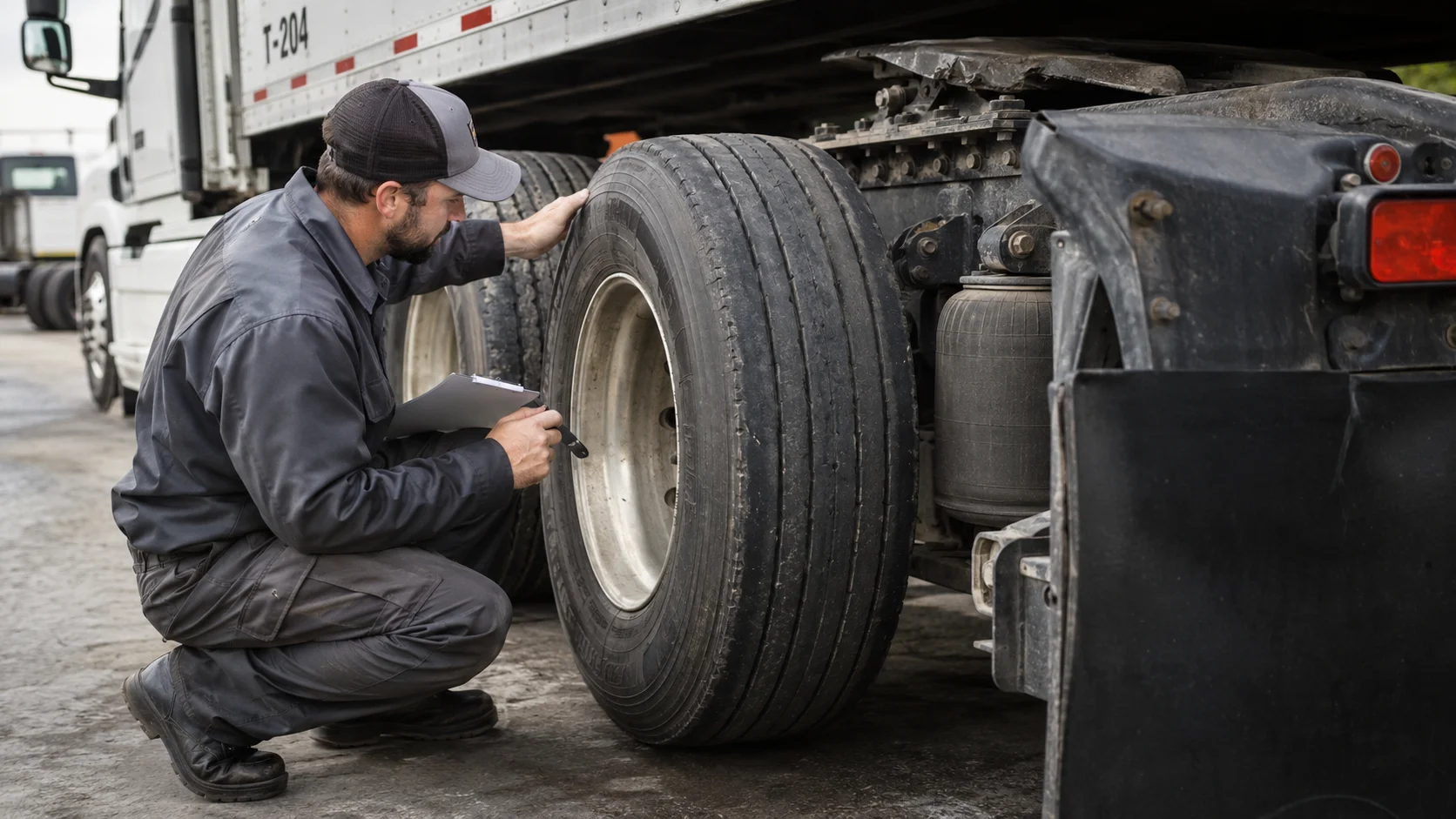
Two limits decide how much that shield matters. It does nothing for an owner that was careless on its own, like one that leased out a rig with worn brakes or bald tires. That's direct negligence, and it stays in the case. It also doesn't reach the motor carrier running the truck under its authority, because that carrier's responsibility comes from the lease and the federal rules rather than from owning the truck. Defense lawyers reach for Graves early, so knowing exactly who it covers keeps a legitimate defendant from slipping out of your claim.
Whose insurance pays, and how Colorado divides it up
On a leased truck, the carrier's federally required liability policy is the coverage that responds to the public, because the leasing rules make the carrier hold that policy while it runs the truck (49 CFR 376.12(j)). Working out whose insurance pays after a truck crash starts with confirming which carrier held the truck under lease that day. The owner-operator may carry separate coverage that matters when the driver's own negligence is at issue.
From there, Colorado decides how to divide the responsibility. The state uses modified comparative negligence, so you can recover as long as you're less than 50 percent at fault, with your award cut by your share (C.R.S. 13-21-111). Fault also gets apportioned among defendants by percentage rather than dropped entirely on one party, so leaving a responsible company off the claim can cost you the portion of your damages that company caused. We walk through that math in our breakdown of Denver truck accident liability, and our Fort Collins truck accident lawyer team applies the same approach to Larimer County truck accident claims.
Frequently Asked Questions
Who is liable in a Fort Collins truck accident involving a leased truck?
It turns on the lease. The motor carrier running the truck under its federal authority carries responsibility because federal law makes it take full control of the truck during the lease. The owner-operator can also be liable for their own driving, and a pure leasing company can be reached when it was negligent itself.
Does the logo on the truck tell me who's responsible?
No. The name on the door is the operating carrier's required marking. It doesn't establish who owns the rig, who the driver works for, or where the insurance sits. On a leased rig those are often separate companies, and the paperwork is what sorts them out.
Can I still sue the leasing company that owned the truck?
You can when the company was negligent itself, like one that leased out a truck with known safety defects. The Graves Amendment blocks claims that target a leasing company purely for owning the vehicle, but it doesn't cover the company's own carelessness.
Whose insurance pays after a leased truck crash?
The operating carrier's federally required liability policy, since federal leasing rules put that obligation on the carrier for the length of the lease. The driver may hold separate coverage that applies depending on the facts.
How long do I have to file after a Larimer County truck accident?
Colorado gives you three years from the date of a motor vehicle crash to file (C.R.S. 13-80-101). The lease agreements and inspection records you need disappear much faster, so waiting works against you.
Let's find every name that belongs on your claim
Truck leasing stacks up layers that make responsibility hard to see, and that difficulty is often the point. We read these arrangements for a living, and the logo on the door is our first lead. On a leased truck case, we follow the paper trail from the placard through the lease, the operating authority, and the insurance until every responsible company is named and accountable. If a truck wearing another company's name hurt you on I-25 or anywhere around Fort Collins, we'll find out who owes you.
Call Metier Law Firm at 866-377-3800 or schedule your free consultation today at www.metierlaw.com.
Disclaimer: Past results discussed should not be considered a guarantee of your results as the factors of every case are individually unique. This content is for informational purposes only and does not constitute legal advice. Consult a qualified attorney from Metier Law Firm regarding your individual situation for legal advice.
Tell Us About Your Case – Free Case Review with a Personal Injury Lawyer
(866) 377-3800Our Locations
.webp)
Do I have a Case?
How Much Should I Be Offered?
Do I Need an Attorney?
If these questions have crossed your mind, let us help. You may need a little direction or may not need an attorney at all, but you deserve to be confident knowing your options. We can provide you with information about our Attorneys of the West® accident investigations and legal services. Your confidential consultation with us is totally free.
Keep up with us!
