.svg)


TL;DR: Key Takeaways
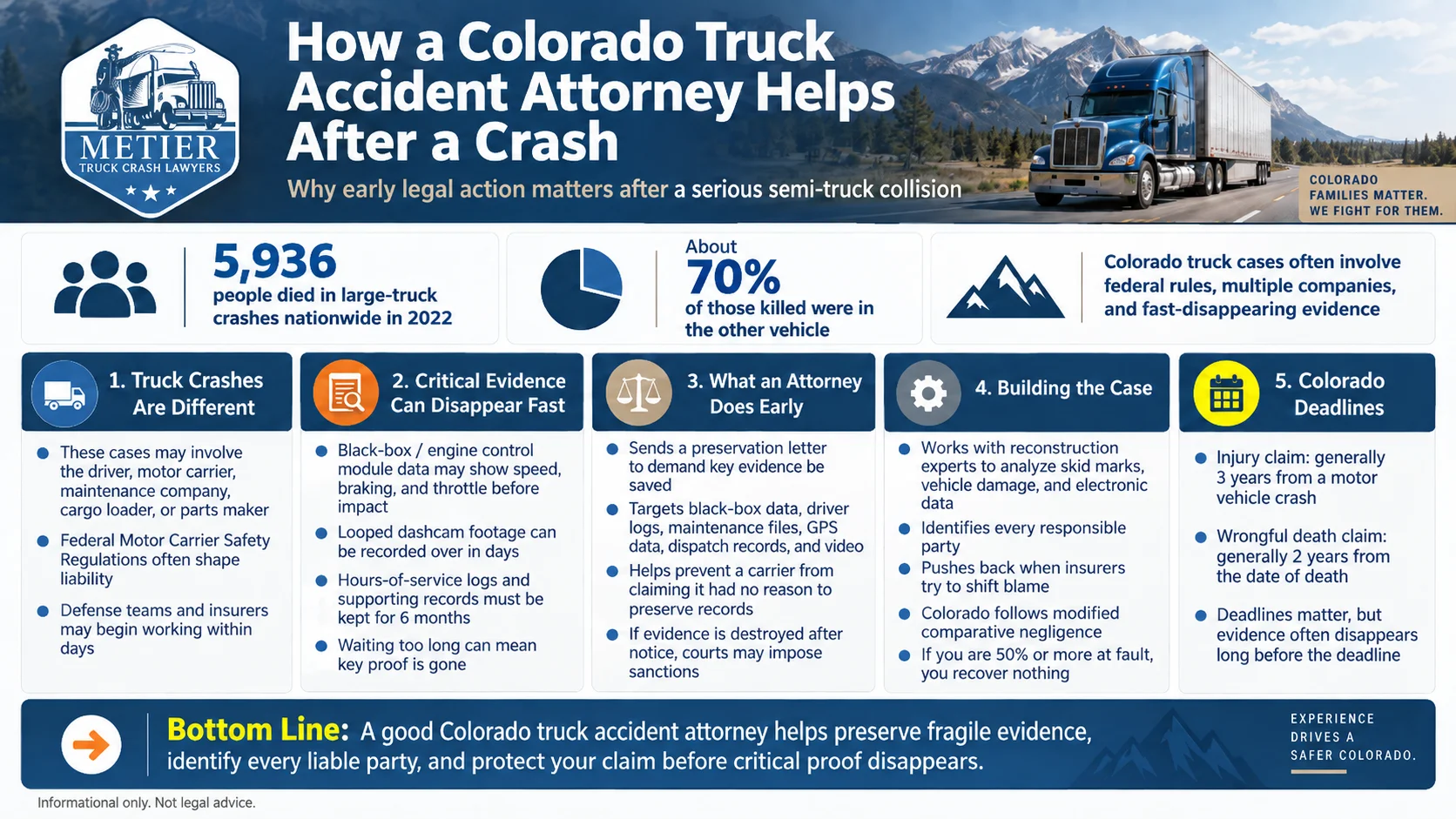
- In 2022, 5,936 people died in large-truck crashes nationwide, and about 70% were in the other vehicle, not the truck (NHTSA).
- A truck case runs on federal rules, several responsible companies, and evidence the carrier controls, so it is not a routine car-crash claim.
- Fragile proof like engine control module data and looped dashcam video can be overwritten fast, because no federal rule requires a carrier to save it.
- Driver hours-of-service logs must be kept six months under 49 CFR 395.8(k)(1), and a preservation letter forces a company to hold that evidence.
- Colorado allows three years to file a motor vehicle injury claim and generally two years for wrongful death.
Most people picture the truck driver after a semi crash, but the data points elsewhere. In 2022, 5,936 people were killed in crashes involving large trucks nationwide, and roughly 70% were riding in the smaller vehicle (NHTSA). On our roads that danger concentrates on the I-25 freight corridor along the Front Range and the steep grades of I-70 through the mountains, where a loaded tractor-trailer can weigh 20 to 30 times what your car does.
I'm Emily Benight, a partner at Metier Law Firm, and my work centers on serious truck crashes and catastrophic injuries. From my experiences, I can tell you that the pattern after a serious crash rarely changes: the trucking company gets to work within hours, and the family learns how much is at stake later. What a Colorado truck accident attorney does in those first days often decides what proof survives.
A truck crash is not a car crash with a bigger vehicle
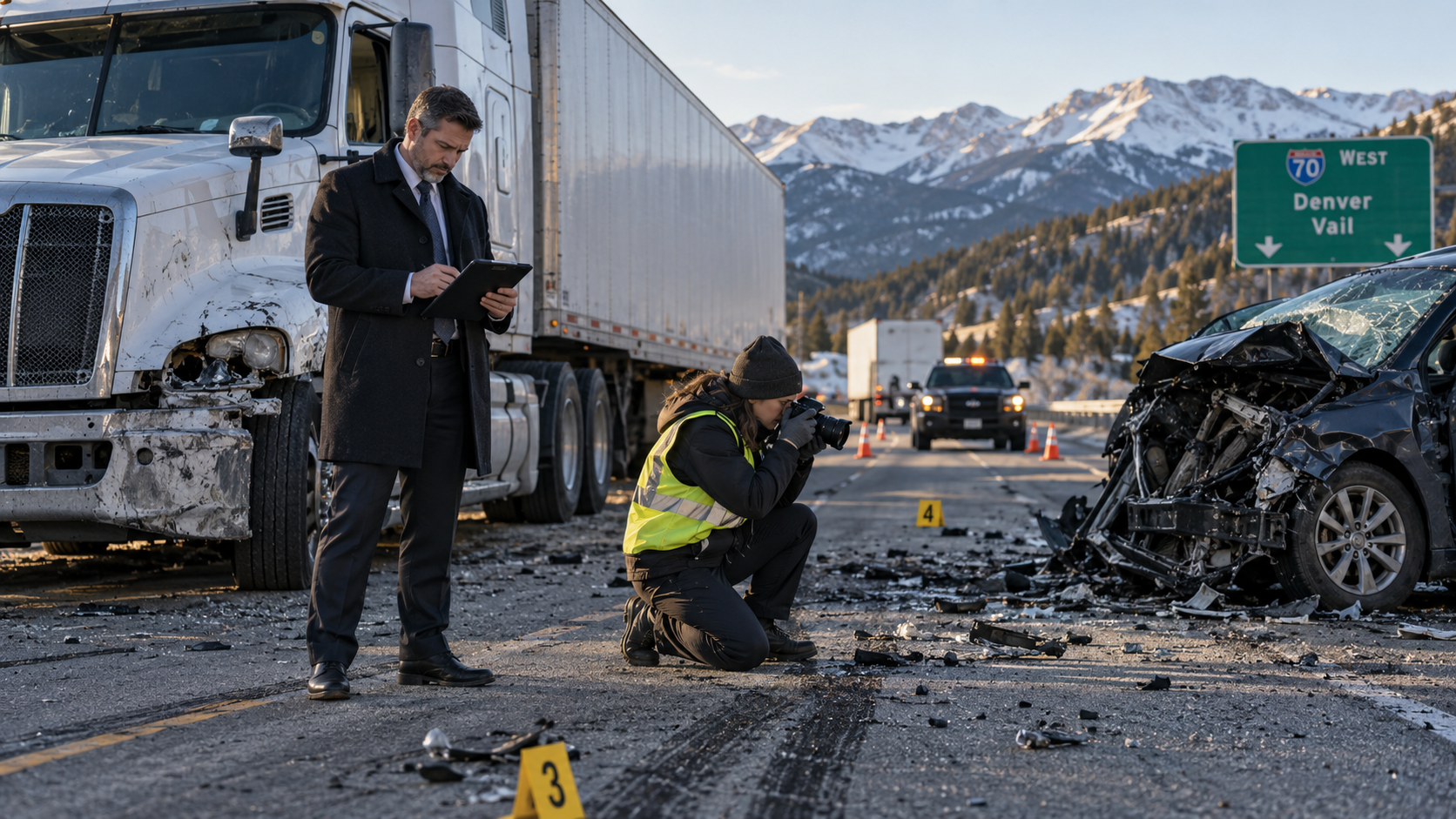
The moment a commercial truck is involved, the case changes shape. Interstate carriers answer to the Federal Motor Carrier Safety Regulations, a federal rulebook covering driver hours, maintenance, drug testing, and hiring, and violations often sit at the center of a claim. Responsibility rarely stops with the driver, either. Depending on what went wrong, the motor carrier, a maintenance contractor, a parts manufacturer, or a cargo loader can each share the blame. Their insurers know this, and defense teams often start work within days.
The evidence that starts disappearing, and the rules behind it
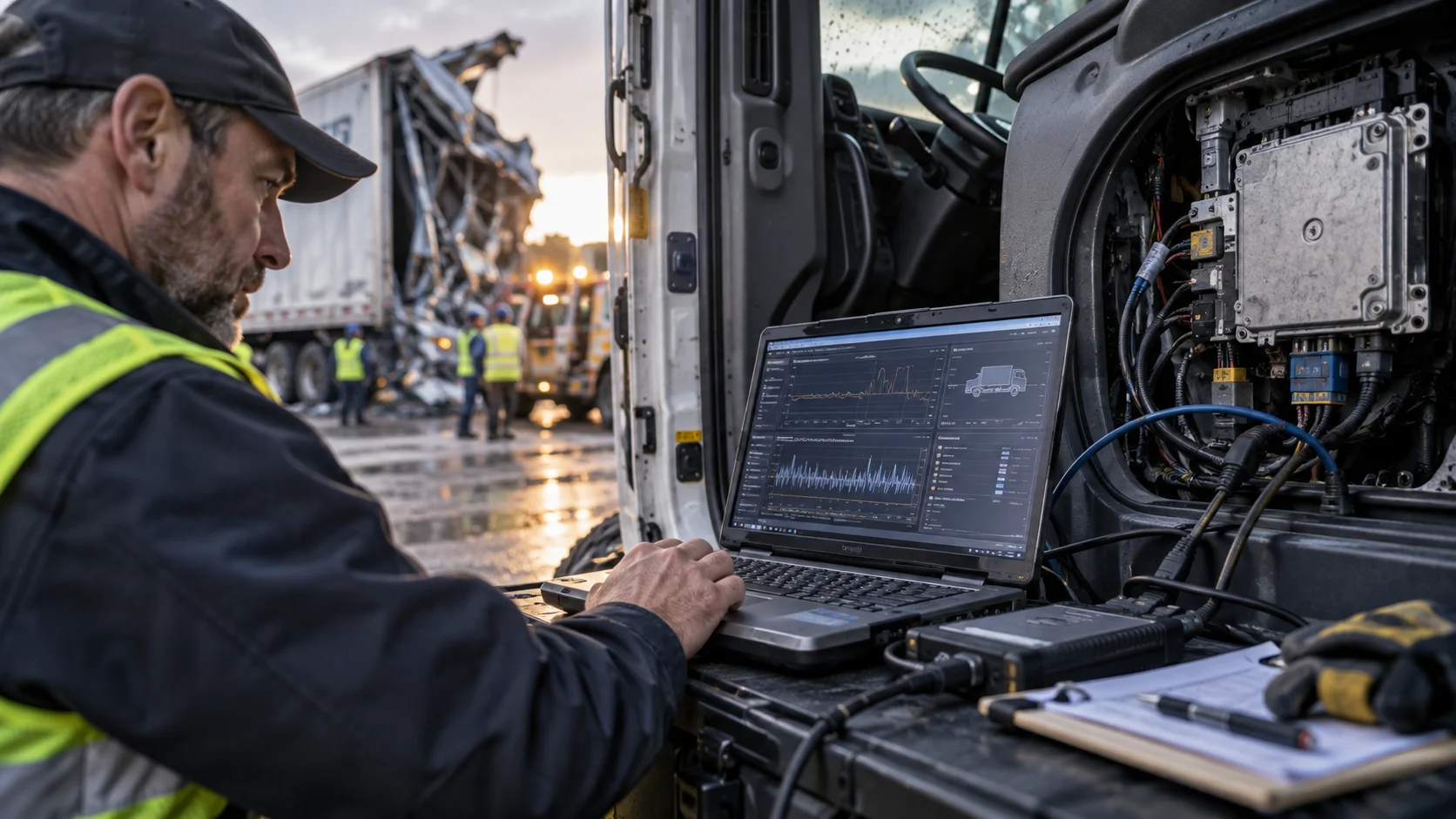
Not all truck crash evidence lasts, and the timelines differ by type. Two of the most valuable records are also the most fragile. The engine control module, or black box, captures speed, braking, and throttle in the seconds before impact, and looped dashcam systems record over themselves as they run. Neither is covered by a federal preservation rule, so how long that data survives depends on the equipment and the carrier's practices. It can be gone in days, especially once a truck is repaired or returned to service. Getting to that black box data before it is overwritten often decides whether the case is provable.
Other records last longer because federal law says so. A carrier must keep each driver's hours-of-service logs and supporting documents for at least six months under 49 CFR 395.8(k)(1). Those electronic logging device records show whether a tired driver was pushed past the legal limit. Once that six-month clock runs out, the company can destroy the file unless someone has already demanded it be kept.
How a Colorado truck accident attorney locks the evidence down
That demand is a spoliation letter, and sending it early is one of the most useful things a lawyer does. It tells the carrier, driver, and insurers that a claim is coming and that they must preserve specific evidence, so they can no longer claim they had no reason to save the black box download or the driver's file. The scope has to be right. Ask for too little and important data slips through; ask for everything and a judge may reject the request as overbroad. We have been brought in to fix cases where evidence was lost both ways. When a company destroys records after getting a proper letter, courts can impose sanctions, including an instruction that lets the jury assume the missing evidence would have hurt the company. That risk of sanctions is why we push for truck accident evidence preservation right away.
Building the case and finding everyone at fault
Preserving the records is only the first step. A crash reconstruction expert can turn skid marks, vehicle damage, and electronic data into a clear account of what happened, and that often reveals more than one responsible party. Fault also carries real financial weight in Colorado. Under the state's modified comparative negligence rule, an injured person who is 50% or more at fault recovers nothing, and any award is reduced by the share of blame assigned to them (C.R.S. § 13-21-111). Insurers know this, so they work to pin as much fault on you as they can.
If you or a loved one was injured in a crash with a commercial truck, call us at 866-377-3800 or schedule a free consultation at www.metierlaw.com.
Colorado's deadlines, and why waiting hurts
Colorado gives you three years from a motor vehicle crash to file an injury claim (C.R.S. § 13-80-101(1)(n)). If the crash was fatal, a wrongful death claim generally must be filed within two years of the death (C.R.S. § 13-80-102), a shorter, separate deadline families often miss. Those deadlines sound generous, but the evidence is often gone within weeks, long before they run out. Crash trends appear in CDOT's crash data, and the state's 2026 traffic safety laws show how often the rules change.
Frequently Asked Questions
How soon should I contact a truck accident attorney after a crash?
As soon as you can. The most fragile evidence, like the black box and looped dashcam footage, can be overwritten within days once the truck is back on the road, so an early preservation letter protects more proof.
What evidence does a truck accident lawyer preserve after a crash?
Engine control module data, electronic logging device logs, maintenance and inspection records, driver qualification files, dispatch and GPS records, drug and alcohol testing, and any dashcam or nearby surveillance footage.
How long do trucking companies have to keep their records?
Federal record-keeping minimums are shorter than people expect. Hours-of-service logs and supporting documents must be kept for at least six months under 49 CFR 395.8(k)(1), and after that a company can destroy them unless a letter has locked them in place.
Can I still recover if I was partly at fault for the crash?
In Colorado, yes, as long as you are less than 50% at fault. Your recovery is reduced by your share of the blame, and at 50% you recover nothing, which is why insurers try to shift fault onto you.
Getting the right help after a Colorado truck crash
A serious truck crash leaves you focused on recovery at the moment the evidence is most at risk. That is the gap a good lawyer closes. We work to preserve the proof before it's gone, bring in experts who can read it, and find every company that shares the blame, while handling the carrier's insurers so you don't have to. We have stood with injured Coloradans for decades and know how these companies operate. To see how we handle these claims, our Colorado truck accident lawyers page lays it out.
Call Metier Law Firm at 866-377-3800 or schedule your free consultation today at www.metierlaw.com.
Disclaimer: Past results discussed should not be considered a guarantee of your results as the factors of every case are individually unique. This content is for informational purposes only and does not constitute legal advice. Consult a qualified attorney from Metier Law Firm regarding your individual situation for legal advice.
Tell Us About Your Case – Free Case Review with a Colorado Truck Accident Lawyer
Tell Us About Your Case – Free Case Review with a Personal Injury Lawyer
(866) 377-3800Our Locations
.webp)
Do I have a Case?
How Much Should I Be Offered?
Do I Need an Attorney?
If these questions have crossed your mind, let us help. You may need a little direction or may not need an attorney at all, but you deserve to be confident knowing your options. We can provide you with information about our Attorneys of the West® accident investigations and legal services. Your confidential consultation with us is totally free.
Keep up with us!
