.svg)


TL;DR - Key Takeaways
- FMCSA is preparing two hours-of-service pilot programs. Neither one changes the rules truck drivers follow today, and only drivers chosen for the studies would get the exemptions.
- The Split Duty Period pilot would let a driver pause the 14-hour driving window once, for 30 minutes to three hours. Time spent waiting at a shipper or receiver can count toward the pause, even though the driver is on duty.
- With a full three-hour pause, a driver in the study could still be driving 17 hours after starting work.
- The Flexible Sleeper Berth pilot would allow 6/4 and 5/5 rest splits. Today’s rules require one rest period of at least seven hours in the sleeper berth.
- FMCSA first proposed both pilots in September 2025 and plans a full launch in 2027. Comments on its October 2026 notices close December 7, 2026.
- After a crash, a logbook violation doesn’t prove fatigue caused it, and a clean logbook doesn’t prove the driver was alert.
- ELD data shows when a driver was off duty, not whether the driver slept. That’s why we compare it with dispatch messages, GPS data, receipts, and other records.
How long should a truck driver work before resting? And is one long block of sleep safer than two shorter ones? The Federal Motor Carrier Safety Administration (FMCSA) is preparing two pilot programs to study both questions.
One pilot would let drivers pause their 14-hour driving window for up to three hours. The other would let them split their required 10 hours of rest into shorter blocks than the rules allow today. FMCSA first proposed the Split Duty Period pilotand the Flexible Sleeper Berth pilot in September 2025. In October 2026, it published follow-up notices on the data it will collect for the 14-hour pause study and the sleeper berth study.
Neither program changes the rules truck drivers follow today. The exemptions would apply only to drivers chosen for the studies.
Hours-of-service records are where we start when we investigate driver fatigue after a serious truck crash. If these pilots lead to new rules, they’ll change what a legal driving schedule looks like.
What Are the Current Federal Hours-of-Service Rules?
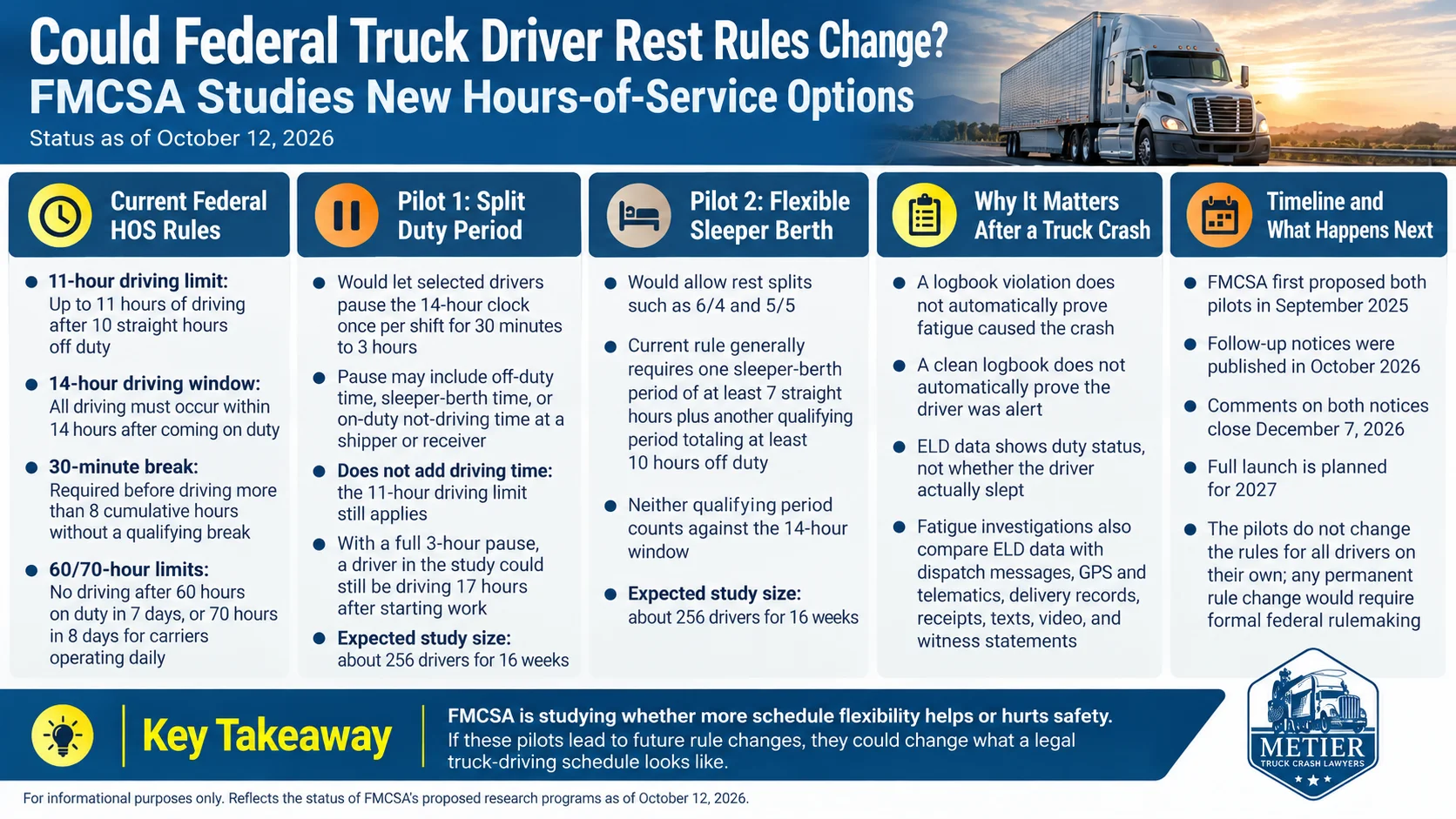
Federal hours-of-service (HOS) rules limit how long interstate truck drivers can drive and stay on duty. For drivers who haul cargo, 49 C.F.R. § 395.3 sets these limits:
- 11-hour driving limit: A driver can drive up to 11 hours after 10 straight hours off duty.
- 14-hour driving window: Once a driver comes on duty after 10 hours off, all driving has to happen within the next 14 hours.
- 30-minute break: A driver can’t drive more than 8 total hours without a break of at least 30 minutes in a row.
- 60/70-hour limits: A driver can’t drive after 60 hours on duty in 7 straight days. If the carrier runs trucks every day of the week, the limit is 70 hours in 8 days.
The limits are meant to keep tired drivers off the road. 49 C.F.R. § 395.1 lists exceptions, including extra driving time when a driver runs into unexpected bad weather or road conditions and relief for some short-haul drivers. Drivers helping with declared emergencies can also get temporary relief, which we explain in our post on FMCSA’s 30-day emergency HOS exemption.
How Would the Split Duty Period Pilot Pause the 14-Hour Clock?
Under current rules, the 14-hour clock keeps running once it starts. Meal stops, fuel stops, and hours spent waiting at a loading dock all count against it. One exception is a qualifying sleeper berth split, which doesn’t count against the 14 hours.
The Split Duty Period pilot would let drivers in the study stop that clock once per shift, for 30 minutes to three hours. The pause can be off-duty time or sleeper berth time. It can also be on-duty time spent not driving, as long as the driver is at the place where cargo is picked up or delivered.
FMCSA proposed a similar pilot in 2020 but never started it. That earlier version wouldn’t have let any on-duty time count toward the pause. This time, the agency points to detention: long waits at a shipper or receiver to load or unload. A driver who pulls over for bad weather could also use the pause, but only by logging that time as off duty or in the sleeper berth.
The pause doesn’t add driving time. The 11-hour driving limit still applies, and so does the 10-hour rest period at the end of the shift. FMCSA expects about 256 drivers to take part, each for 16 weeks.
Why Might Pausing the Driving Window Affect Safety?
FMCSA has argued that a pause would let drivers rest or avoid traffic without losing hours on the 14-hour clock. A driver facing a snowstorm could wait it out instead of driving through it to finish before the window closes.
The tradeoff is a longer workday, since a full three-hour pause means a driver in the study could still be driving 17 hours after starting work. Advocates for Highway and Auto Safety raised that concern when it opposed the proposal during the November 2025 comment period. The group argued that FMCSA should deal with detention problems instead.
FMCSA dropped a similar pause from its 2020 hours-of-service rule after commenters warned that carriers, shippers, or receivers would push drivers to use the break for business reasons instead of rest. This version lets on-duty time at a loading dock count toward the pause, and on-duty time isn’t rest. Those are the results we’ll watch most closely when FMCSA reports its findings.

What Is the Flexible Sleeper Berth Pilot Program?
A sleeper berth is the sleeping compartment in a long-haul truck. Drivers who use one can split their required 10 hours off duty into two periods.
Under § 395.1(g), one period must be at least 7 straight hours in the sleeper berth. The other must be at least 2 straight hours off duty, in the sleeper berth, or both. Together they have to add up to at least 10 hours, and neither one counts against the 14-hour window. That allows splits like 7/3 and 8/2.
The Flexible Sleeper Berth pilot would cut the longer sleeper berth period to a minimum of 5 straight hours. Drivers in the study could use a 6/4 split, a 5/5 split, or anything in between. Like the pause study, this one plans to enroll about 256 drivers for 16 weeks.
Would Shorter Sleeper-Berth Periods Make Truck Drivers More Tired?
FMCSA doesn’t have enough data to answer that yet, which is why it’s running the study. In its notice, the agency cites research suggesting split sleep can still be restorative. It also cites newer studies finding that the body’s internal clock affects fatigue more than splitting sleep does.
Alertness depends on when a driver sleeps, how long that sleep lasts without interruption, and how many hours the driver has been awake. A driver who gets two five-hour rest periods may not sleep as well as one who gets a single 10-hour block. Some drivers may do better with rest that fits their natural sleep patterns or their route.
Until FMCSA changes the rule, the 7-hour minimum still applies to every driver outside the study.
How Will FMCSA Measure Driver Fatigue?
Both studies use the same tools: drivers will take reaction-time tests, rate how sleepy they feel, and wear a wrist device that tracks sleep. They’ll also fill out surveys before and after the study. Researchers will collect each driver’s duty-status records, along with driving data from a telematics device in the truck.
Each driver will spend part of the study under current rules and part under the exemption, so researchers can compare the same person under both schedules.
Both studies rely on volunteers, and FMCSA expects them to attract drivers who want the extra flexibility. Carriers with an “Unsatisfactory” safety rating, an FMCSA enforcement action in the past three years, or above-average out-of-service rates can’t take part. The results will show how these schedules work for screened volunteers rather than the trucking industry as a whole.

Why Do Hours-of-Service Rules Matter After a Truck Accident?
In its pilot notice, FMCSA says fatigue may be involved in over 30 percent of fatal crashes involving commercial vehicles. When we investigate a serious crash, we look past the moments before impact. We need to know how long the driver had been working and when the driver last had a real chance to sleep.
Questions we ask include:
- How many hours had the driver been on duty?
- How much time had the driver spent driving?
- When did the driver last take a qualifying rest period?
- Was the driver using an authorized exception or exemption?
- Did dispatch instructions or delivery deadlines shape the driver’s schedule?
- Do the driver’s logged rest periods match other evidence?
- Did the driver show signs of fatigue before the crash?
An hours-of-service violation doesn’t automatically mean fatigue caused the crash. A driver can also follow every rule and still be too tired to drive safely. That’s why we check the logbook against the driver’s actual condition. We cover how fault works in these cases in our post on who is liable if the driver falls asleep at the wheel.
What Evidence Can Show Whether a Truck Driver Was Fatigued?
We start with the electronic logging device (ELD). Federal rules define an ELD as a device that automatically records a driver’s driving time. FMCSA has turned down a request to let drivers go back to paper logs, which we covered in our post on the agency’s ELD decision.
An ELD shows when a driver was off duty, but it doesn’t show whether the driver slept. So we compare the logs with other records, including:
- Dispatch communications
- GPS and telematics records
- Bills of lading and delivery records
- Fuel and toll receipts
- Driver text messages
- Trip schedules
- Carrier safety policies
- Supporting records of duty status
- Video footage
- Witness statements
We also look at whether the trucking company pushed or allowed schedules that made fatigue more likely.
Carriers only have to keep duty-status records and supporting documents for six months under 49 C.F.R. § 395.8(k)(1), and other evidence can disappear even faster, as we explain in how trucking companies make evidence vanish after crashes.

Could FMCSA’s Research Eventually Change Trucking Regulations?
It could, but a pilot can’t change the rules on its own. FMCSA finished pre-tests with a small group of drivers in 2026 and has said it’s preparing for the full launch of both pilots in 2027.
Publishing a notice doesn’t mean FMCSA has decided to adopt these schedules. To change the rules for every driver, the agency would have to follow the rulemaking process in the Administrative Procedure Act. That means publishing a proposed rule in the Federal Register, taking public comment, and then issuing a final rule. FMCSA used that process for its 2020 hours-of-service changes, which it first proposed in 2019.
Comments on both October 2026 notices close December 7, 2026. The pause study is Docket FMCSA-2026-2081, and the sleeper berth study is Docket FMCSA-2026-2080. These pilots are among several federal trucking changes in progress, and we track the others in pending trucking regulations to watch in 2026.
Why These Studies Matter for Everyone Sharing the Highway
Detention, traffic, and weather all use up hours in a truck driver’s 14-hour window. More control over their schedules could help some drivers rest at better times. The same flexibility could also mean longer workdays and broken-up sleep for people driving some of the heaviest vehicles on the road.
FMCSA is collecting data because it doesn’t yet know which effect is stronger. For everyone who shares the highway with these trucks, the results will help decide how long a truck driver can legally work before resting.
Metier Law Firm Investigates Driver Fatigue and Trucking Safety Violations
At Metier Law Firm, our truck accident lawyers investigate serious truck crashes, including driver fatigue, hours-of-service compliance, ELD records, dispatch practices, and carrier safety policies.
Knowing the rules is only part of the job. We also look at how the driver actually operated before the crash and whether the trucking company or anyone else contributed to it.
If you or a family member has been seriously injured in a commercial truck accident, contact Metier Law Firm to learn more about your legal options.
This article is for informational purposes only and reflects the status of FMCSA’s proposed research programs as of October 12, 2026. It is not legal advice.
Government sources: 49 C.F.R. § 395.3: Maximum driving time for property-carrying vehicles | 49 C.F.R. § 395.1: Scope of rules in this part | FMCSA Hours of Service | Federal Register: Pilot Program to Allow Commercial Drivers to Pause Their 14-Hour Driving Window (Oct. 6, 2026) | Federal Register: Pilot Program to Allow Commercial Drivers to Split Sleeper Berth Time (Oct. 7, 2026)
Tell Us About Your Case – Free Case Review with a Personal Injury Lawyer
(866) 377-3800Our Locations
.webp)
Do I have a Case?
How Much Should I Be Offered?
Do I Need an Attorney?
If these questions have crossed your mind, let us help. You may need a little direction or may not need an attorney at all, but you deserve to be confident knowing your options. We can provide you with information about our Attorneys of the West® accident investigations and legal services. Your confidential consultation with us is totally free.
Keep up with us!
