.svg)


TL;DR - Key Takeaways
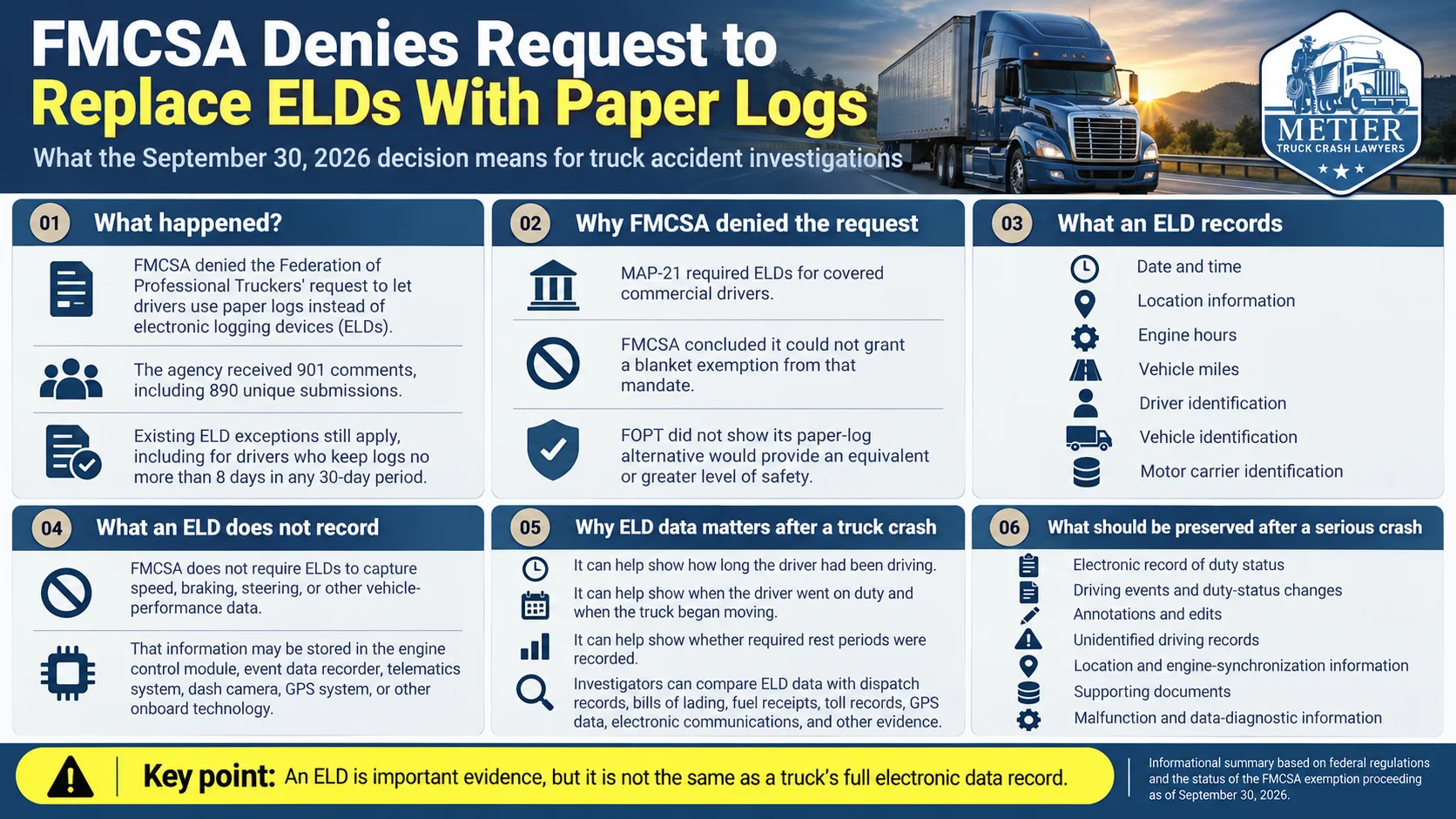
- FMCSA denied the Federation of Professional Truckers' (FOPT) request to let drivers log their hours on paper instead of using electronic logging devices (ELDs). The denial was published in the Federal Register on September 30, 2026.
- The exemption would have covered FOPT members plus any other professional driver who opted in. FMCSA received 901 public comments, 890 of them unique, before ruling on it.
- Two reasons drove the decision. Congress required ELDs through the MAP-21 highway law, and the agency concluded it can't grant a blanket exemption from that mandate. FOPT also failed to show its paper-log plan would be as safe as the current rule.
- Nothing changed for drivers already covered by the ELD rule. Existing exceptions still apply, including one for drivers who keep logs no more than 8 days in any 30-day period.
- An ELD connects to the truck's engine and automatically records the date, time, location, engine hours, miles, and driver, vehicle, and carrier identification. After a crash, that record helps show when the truck was moving and how the driver's time was logged.
- Speed, braking, and steering data don't come from the ELD, because FMCSA doesn't require ELDs to record them. When a truck captures that data, it's stored in systems like the engine control module, event data recorder, dash camera, or telematics platform.
- Drivers and authorized carrier staff can make certain edits to ELD records, and each change must be annotated. After a serious crash, we preserve the full electronic record, including edits, unidentified driving records, and supporting documents, rather than relying on a printed log.
The Federal Motor Carrier Safety Administration (FMCSA) has rejected a request that would have allowed potentially broad categories of commercial truck drivers to use paper logs instead of electronic logging devices to track their hours behind the wheel.
On September 30, 2026, FMCSA denied an exemption requested by the Federation of Professional Truckers (FOPT). The organization sought to give professional drivers the option of manually recording their records of duty status rather than using an electronic logging device, commonly called an ELD.
FMCSA's September 30, 2026 decision concluded that the proposed exemption did not demonstrate that it would provide a level of safety equivalent to or greater than the existing ELD requirement. The agency also explained that Congress directed the Department of Transportation to require ELDs for commercial vehicles operated by drivers who are required to maintain records of duty status.
For motorists who share the highway with commercial trucks, the decision highlights an important safety issue: knowing how long a commercial driver has been driving and working before a crash.
What Is an Electronic Logging Device?
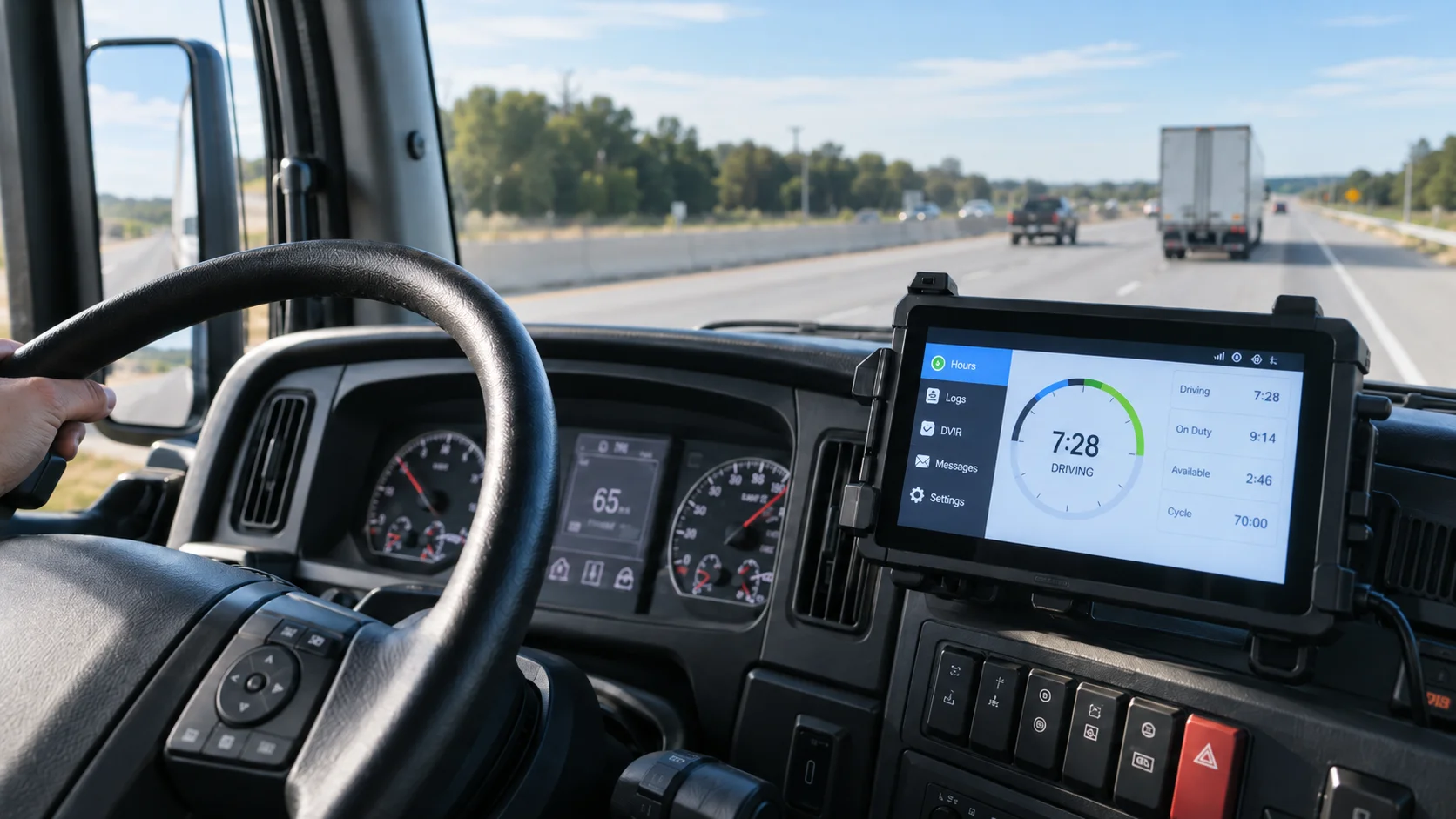
An electronic logging device is technology used to record a commercial driver's driving time and other information needed to document compliance with federal hours-of-service regulations.
Unlike a traditional paper logbook that relies heavily on information manually entered by the driver, an ELD synchronizes with the commercial vehicle's engine and automatically records driving time.
According to FMCSA's Electronic Logging Devices guidance, the ELD rule was designed to make records of duty status easier and more accurate to track, manage, and share.
Most commercial drivers who are required to maintain records of duty status must use an ELD, although federal regulations contain several exceptions. For example, drivers who are required to maintain records of duty status no more than eight days during a 30-day period are among those who may use paper records instead of an ELD. FMCSA explains the existing ELD exemptions here.
What Did the Trucking Group Ask FMCSA to Change?
FOPT asked FMCSA for an exemption that would allow professional drivers to choose to record their hours manually rather than through an ELD.
FMCSA originally published the exemption request for public comment in February 2026. The requested exemption would have applied to FOPT members as well as other professional drivers who chose to participate.
FMCSA ultimately received 901 comments representing 890 unique submissions before deciding to deny the request.
The debate reflected very different views about ELDs and driver safety.
Supporters of the exemption argued, among other things, that electronic logs can create pressure on drivers working against an electronic clock. Some commenters argued that additional flexibility could allow drivers to make safer decisions about when to stop and rest. Commenters also raised concerns about ELD costs, technical issues, and inadequate truck parking.
Opponents argued that electronic logs improve accountability and make it more difficult to conceal violations of federal hours-of-service requirements. Safety organizations and other commenters urged FMCSA to retain the electronic logging requirement.
Why Did FMCSA Deny the ELD Exemption?
FMCSA identified two fundamental problems with the request.
First, the agency pointed to the congressional mandate contained in the Moving Ahead for Progress in the 21st Century Act, commonly known as MAP-21. Congress directed the Secretary of Transportation to adopt regulations requiring ELDs in covered commercial motor vehicles operated by drivers required to maintain records of duty status.
FMCSA concluded that it could not grant the type of blanket exemption contemplated by the request.
Second, FMCSA determined that FOPT had not demonstrated that the proposed alternative would achieve an equivalent or greater level of safety.
FOPT proposed measures that included educating members about completing paper logs accurately, random internal audits by participating carriers, and excluding drivers who violated hours-of-service limits.
But the requested exemption was not limited to FOPT members. FMCSA found that the application did not adequately explain how those safeguards would apply to the broader, undefined population of drivers who might participate.
FMCSA therefore denied the request. The agency's complete reasoning can be found in its Federal Register notice denying the ELD exemption.
Why Do Electronic Logs Matter for Truck Safety?
Federal hours-of-service regulations are intended to limit how long commercial drivers can drive and work before taking required rest.
An ELD does not determine whether a truck driver is actually tired. It does, however, create an electronic record that can help establish when the truck was being driven and how the driver's duty status was recorded.
According to FMCSA's ELD Functions guidance, an ELD automatically records information including:
- Date and time;
- Location information;
- Engine hours;
- Vehicle miles;
- Driver identification;
- Vehicle identification; and
- Motor carrier identification.
The device is synchronized with the truck's engine. FMCSA explains that engine synchronization allows the ELD to capture information concerning engine power status, vehicle motion, miles driven, and engine hours.
During on-duty driving, ELD location information is generally recorded at 60-minute intervals. Location information is also recorded at events such as engine power-up and shutdown and changes in duty status.
That can make ELD records an important source of information when reconstructing a commercial driver's activities before a serious crash.
What Can ELD Records Reveal After a Truck Accident?
When fatigue or excessive driving time may have contributed to a crash, investigators may compare ELD records with other available evidence.
Depending on the circumstances, those records can help investigators examine questions such as:
- How long had the driver been driving?
- When did the driver go on duty?
- When did the truck begin moving?
- Where was the truck during portions of the driver's shift?
- Were required rest periods recorded?
- Do the electronic records match other evidence about the driver's activities?
The last question can be particularly important.
A thorough truck accident investigation may involve comparing ELD information with dispatch records, bills of lading, fuel receipts, toll records, GPS and telematics data, electronic communications, delivery records, engine-control-module information, inspection records, and other evidence.
The purpose is not simply to find a violation. It is to reconstruct what actually happened before the collision.
An ELD Is Not the Same as a Truck's "Black Box"
There is also an important limitation to understand.
An ELD is primarily designed to document information related to a driver's hours of service. It should not automatically be treated as a complete record of everything the truck was doing before a crash.
FMCSA specifically states in its ELD Functions FAQs that ELDs are not required to collect vehicle speed, braking, steering, or other vehicle-performance information.
Those types of data may be available from other electronic systems on a commercial truck.
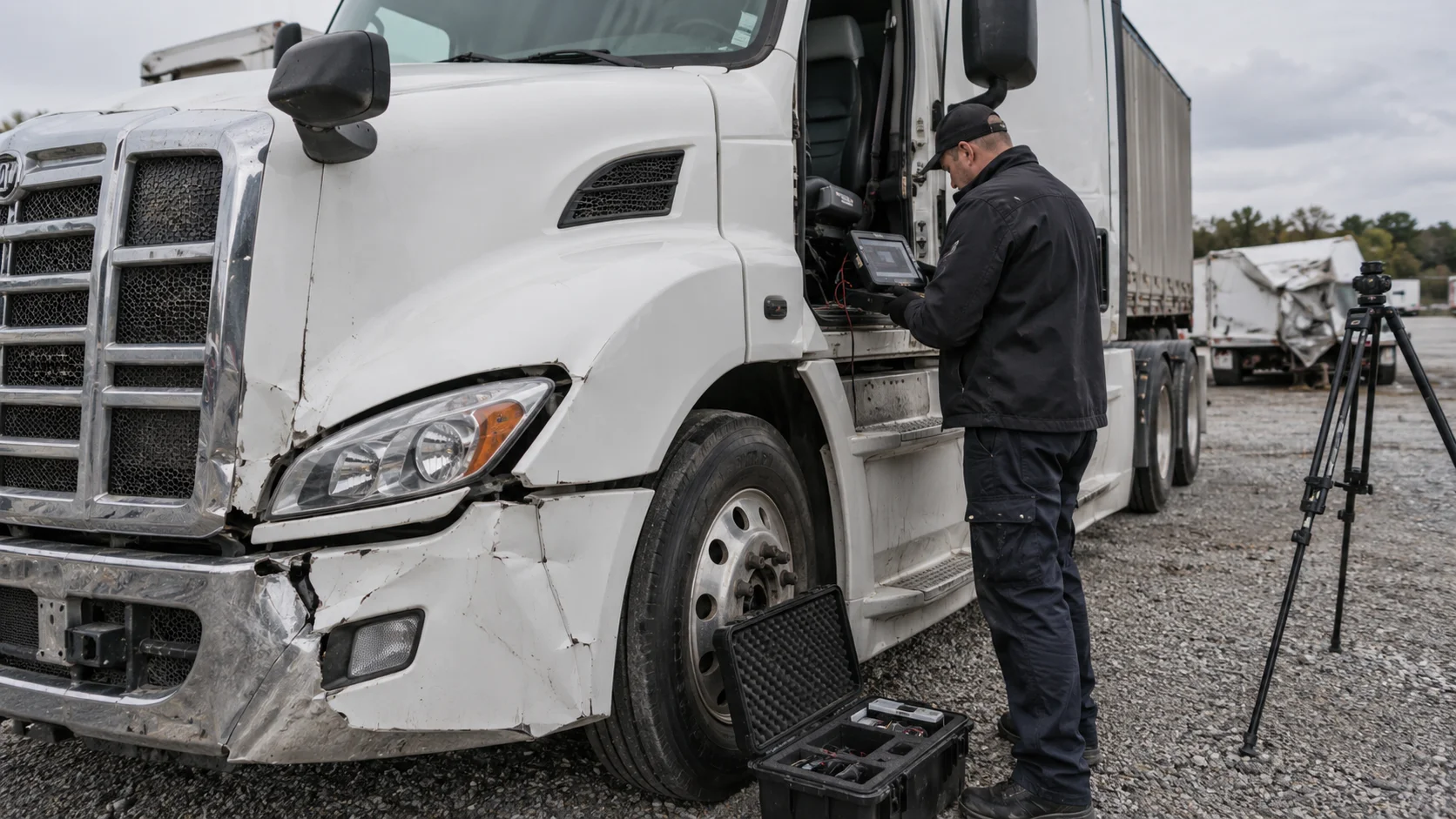
For example, depending on the truck and its equipment, investigators may need to examine information from the engine control module, event data recorder, telematics system, collision-avoidance system, dash camera, fleet-management platform, GPS system, or other onboard technology.
That distinction is important because preserving only the driver's electronic log may leave significant electronic evidence unexplored.
Can ELD Records Be Changed?
ELD records are not necessarily a completely untouchable electronic record.
Drivers and authorized carrier personnel can make certain edits under FMCSA's rules, but the ELD system maintains information concerning changes to records. Automatically recorded driving time is also subject to specific restrictions.
That means an experienced truck accident investigation should not stop with a printed driver's log.
The underlying electronic data, annotations, edits, unidentified driving records, supporting documents, and related carrier records may provide a more complete picture of what occurred.
FMCSA maintains an extensive ELD Frequently Asked Questions resource explaining how electronic logs, edits, malfunctions, records, and other aspects of the ELD system operate.
What ELD Data Should Be Preserved After a Truck Accident?
When a serious truck crash occurs, preserving the relevant electronic evidence can be an important part of determining what happened.
Depending on the circumstances, potentially relevant ELD evidence may include the driver's underlying electronic record of duty status, driving events, duty-status changes, annotations, edits, unidentified driving records, location information, engine synchronization information, and supporting documents.
Investigators may also need to determine whether the ELD experienced a malfunction or data-diagnostic event.
FMCSA's guidance concerning ELD malfunctions and data diagnostic events explains that an ELD can experience problems involving power, engine synchronization, data recording, data transfer, and other functions.
Preserving the electronic data can therefore be more informative than simply obtaining a printed copy of the driver's log.
Why Driver Fatigue Matters in Truck Accident Investigations
A fully loaded tractor-trailer can cause catastrophic injuries when something goes wrong.
When investigating a serious truck crash, determining what happened in the seconds before impact is important. But investigators may also need to understand what happened hours, or even days, before the collision.
A driver's schedule can matter.
So can the motor carrier's scheduling practices, dispatch communications, delivery expectations, route planning, available parking, and decisions made when a driver was approaching federal driving limits.
An ELD can be one part of that investigation.
It does not establish by itself that a driver was fatigued, negligent, or responsible for a collision. Instead, ELD data should be considered alongside the physical evidence, witness testimony, other electronic data, company records, and the circumstances of the crash.
Electronic Evidence Can Disappear After a Truck Crash
Commercial trucks can generate large amounts of electronic information, but not every system stores its information indefinitely.
That is one reason a prompt investigation can be important after a catastrophic truck accident.
Attorneys investigating a commercial vehicle collision may need to identify the truck, driver, motor carrier, trailer, freight involved, and other companies connected to the trip and determine what electronic and documentary evidence should be preserved.
That can include far more than an ELD.
Metier Law Firm Investigates the Evidence Behind Serious Truck Crashes
At Metier Law Firm, our truck accident lawyers investigate beyond the police report.
In a serious commercial truck accident case, our investigation may include the driver's electronic logs, hours-of-service records, dispatch information, truck data, maintenance records, carrier safety information, shipping documents, communications, and other evidence relevant to determining why the crash occurred and which companies may be responsible.
Our trial lawyers understand that the evidence explaining a catastrophic truck crash may exist in multiple systems and in the records of multiple companies.
If you or a family member has been seriously injured in a commercial truck accident, contact Metier Law Firm to learn more about your legal options.
This article is for informational purposes only and is based on federal regulations and the status of the FMCSA exemption proceeding as of September 30, 2026. It is not legal advice.
Tell Us About Your Case – Free Case Review with a Personal Injury Lawyer
(866) 377-3800Our Locations
.webp)
Do I have a Case?
How Much Should I Be Offered?
Do I Need an Attorney?
If these questions have crossed your mind, let us help. You may need a little direction or may not need an attorney at all, but you deserve to be confident knowing your options. We can provide you with information about our Attorneys of the West® accident investigations and legal services. Your confidential consultation with us is totally free.
Keep up with us!
