.svg)


TL;DR - Key Points
- The evidence that decides a truck crash case often starts disappearing within days, not years.
- A commercial truck's ECM, the "black box," can overwrite itself in about 30 days or less, and some systems wipe in a matter of days.
- Dashcam and fleet-camera footage records over itself on a loop unless someone moves to preserve it.
- The trucking company's response team is often on the scene within hours, building their version of events.
- Oregon law gives you two years to file, but that deadline is not the clock that should worry you first.
- What you do in the first 48 hours protects both your health and your claim.
- A spoliation letter is the tool that freezes the evidence before it's gone.
Most people hurt by a semi on Oregon’s highways and streets assume they have plenty of time. The law almost seems to agree. Oregon gives you two years to file a personal injury claim, so where's the rush? Here's the hard truth: the proof that wins or loses your case can be gone in days. I'm Emily Benight, a partner and truck crash lawyer at Metier Law Firm, licensed here in Oregon and representing people injured by commercial trucks across the Pacific Northwest. If you're trying to figure out what to do after a Portland truck accident, the answer starts the second those vehicles come to rest, not two years down the road.
Portland moves a staggering amount of freight. I-5 and I-84 cut straight through the city, the Rose Quarter interchange piles commuter and truck traffic on top of each other, and drayage trucks haul loads in and out of the Port of Portland around the clock. In 2024, ODOT recorded 1,696 motor carrier crashes on Oregon roads, with 73 people killed and 488 injured. Tractor-trailers were involved in 982 of them. When one of those trucks hits a passenger car, the people in the smaller vehicle are the ones who pay for it.
Call Metier Law Firm at 866-377-3800 or schedule your free consultation today at www.metierlaw.com
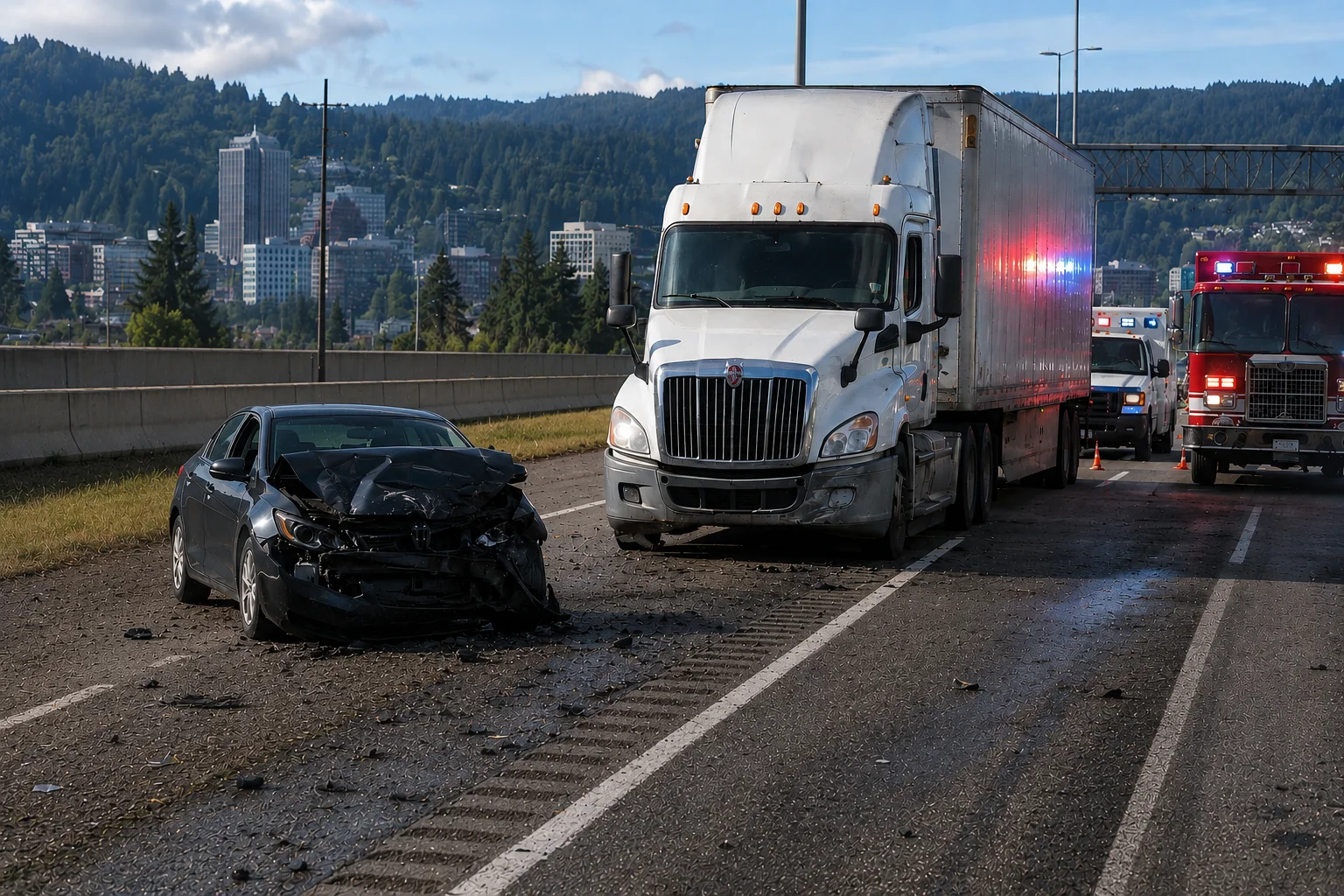
Why the Real Clock Starts at the Moment of Impact
A truck crash case is built on data, and most of that data lives on the truck or with the company that owns it. That's the problem. The people who control it have every reason to let it slip away.
Start with the black box. Modern commercial trucks carry an electronic control module, or ECM, that records speed, throttle, and braking in the seconds before a crash. That data can be overwritten in about 30 days or less, and older systems can lose it in days. If the truck gets repaired or put back into service, the record can disappear with it.
Then there's camera footage. Plenty of trucks run forward-facing or driver-facing cameras from systems like Lytx or Samsara. Those cameras record on a loop and write over old footage unless a specific event saves a clip. Routine driving, including the minutes before your crash, gets recorded over fast.
The truck's hours-of-service records sit in a slightly different spot. Federal rules require carriers to keep electronic logging device records for six months, so that data isn't gone overnight. The catch is that without legal pressure, the company decides what it holds onto and what it hands over, and six months passes quicker than most injury cases resolve.
Off the truck, the scene itself is fading. Skid marks get washed away by Portland rain and ground down by traffic. Final vehicle positions are cleared so the road can reopen. The witnesses who saw what happened start losing the details within days.
One more thing is happening while you're still in the hospital. The trucking company's rapid-response team is often on the scene within hours. Their investigators photograph what helps them, take statements, and start shaping the story before you've had a chance to. Knowing what early evidence still exists, and grabbing it before they bury it, is most of the battle.
Call Metier Law Firm at 866-377-3800 or schedule your free consultation today at www.metierlaw.com
The First Hour: What to Do at the Scene
If you're physically able, a few steps right away protect both your safety and your case.
- Get to a safe spot and call 911. Report every injury, even the ones that feel minor.
- Let the police build a report. That official record carries weight later.
- Photograph everything you can: vehicle positions, damage, skid marks, road conditions, and the truck's company name and DOT number.
- Get the driver's information and the carrier's name, but don't argue about fault and don't apologize.
- Say as little as possible to anyone except the police and medical staff.
The First 24 Hours: Protect Your Health and the Record
See a doctor, even if you think you walked away fine. Adrenaline hides serious injuries, and a brain injury or internal damage can take a day or more to surface. A medical record from day one also ties your injuries to the crash, which matters when the insurer later claims you were already hurt.
Oregon also requires you to file an accident report with the DMV when a crash causes injury, death, or significant property damage. Save everything from these first hours: photos, the crash report number, names, and any paperwork you're handed. If the trucking company or its insurer calls, and they often call fast, don't give a recorded statement before you've talked to a lawyer.
Hours 24 to 48: Get Ahead of Their Team
This is the window where a case is often won or lost, and most people have no idea it's happening. The faster a lawyer gets involved, the faster a spoliation letter goes out. That letter is a formal legal notice telling the trucking company and its insurer they have a duty to preserve everything: the ECM data, the camera footage, the driver logs, the maintenance records. Once they've received it, "accidentally" overwritten data turns into a problem a court can punish them for.
Knowing what to do after a Portland truck accident really comes down to two things: protecting your health, and locking down the proof before the people who control it can make it disappear. The first part is yours to handle. The second is where we come in.
If you or a loved one was injured in a crash with a commercial truck, call us at 866-377-3800 or schedule a free consultation at www.metierlaw.com.
Portland's Freight Routes Make Speed Matter Even More
The crashes we see tend to cluster where freight and everyday traffic collide: the I-5 stretch heading south toward Tualatin, the I-5 and I-84 split near the Rose Quarter, the I-205 bypass, and the industrial routes feeding the Port. We've broken down those specific Portland corridors and crash zones in more detail elsewhere. The common thread is that these are busy, fast, camera-and-sensor-heavy environments. That usually means there's strong evidence right after a crash, and a short window to grab it.

Frequently Asked Questions
How long after a truck accident should I get a lawyer?
As fast as you reasonably can. The evidence that proves a truck case, the black box data and camera footage especially, can be overwritten within weeks, so the sooner a preservation letter goes out, the more of your case survives. There's no upside to waiting.
What evidence disappears after a truck crash?
The fragile pieces are the truck's ECM black box data, looped dashcam footage, skid marks and vehicle positions at the scene, and witness memory. Driver logs and maintenance records last longer, but they can still be purged or "lost" without a legal hold in place.
Do I have to report a truck accident in Oregon?
Yes. Oregon requires you to file a report with the DMV when a crash causes injury, death, or significant property damage. Calling the police at the scene starts the record, but the DMV report is a separate step.
How long do I have to file a truck accident claim in Oregon?
Personal injury claims must be filed within two years of the crash under ORS 12.110. That sounds like plenty of time, and it's the answer that gets people in trouble, because the evidence window closes long before the filing deadline does.
When should I call a Portland truck accident lawyer?
Before you talk to the trucking company's insurer, and ideally within the first day or two. An early call is what lets a Portland truck accident lawyer preserve evidence while it still exists.
Call Metier Law Firm at 866-377-3800 or schedule your free consultation today at www.metierlaw.com
Move Before the Evidence Does
Two years is the deadline to file, but it isn't the deadline that decides your case. The black box, the footage, the skid marks, and the memories are all on a much shorter timer, and the trucking company is already working theirs. We've spent years going up against carriers and their insurers for truck crash victims across Oregon, and the cases that go well almost always share one thing: someone acted early. When a crash proves fatal, our Portland Wrongful Death Lawyers step in just as quickly to preserve that same evidence before it disappears. If you've been hurt, let us start protecting your claim today, while the proof is still there to protect.
Call Metier Law Firm at 866-377-3800 or schedule your free consultation today at www.metierlaw.com. Our truck accident lawyers also represents injured victims in Fort Collins, Colorado Springs, Cheyenne, Gillette, and Casper. If the crash happened closer to home, our Denver truck accident lawyer team can start the same investigation right away, and riders and drivers in Seattle can count on our Seattle truck accident lawyer team to move just as fast.
Disclaimer: Past results discussed should not be considered a guarantee of your results as the factors of every case are individually unique. This content is for informational purposes only and does not constitute legal advice. Consult a qualified attorney from Metier Law Firm regarding your individual situation for legal advice.
Tell Us About Your Case – Free Case Review with a Truck Accident Lawyer
Tell Us About Your Case – Free Case Review with a Personal Injury Lawyer
(866) 377-3800Our Locations
.webp)
Do I have a Case?
How Much Should I Be Offered?
Do I Need an Attorney?
If these questions have crossed your mind, let us help. You may need a little direction or may not need an attorney at all, but you deserve to be confident knowing your options. We can provide you with information about our Attorneys of the West® accident investigations and legal services. Your confidential consultation with us is totally free.
Keep up with us!
