.svg)


TL;DR: Key Takeaways
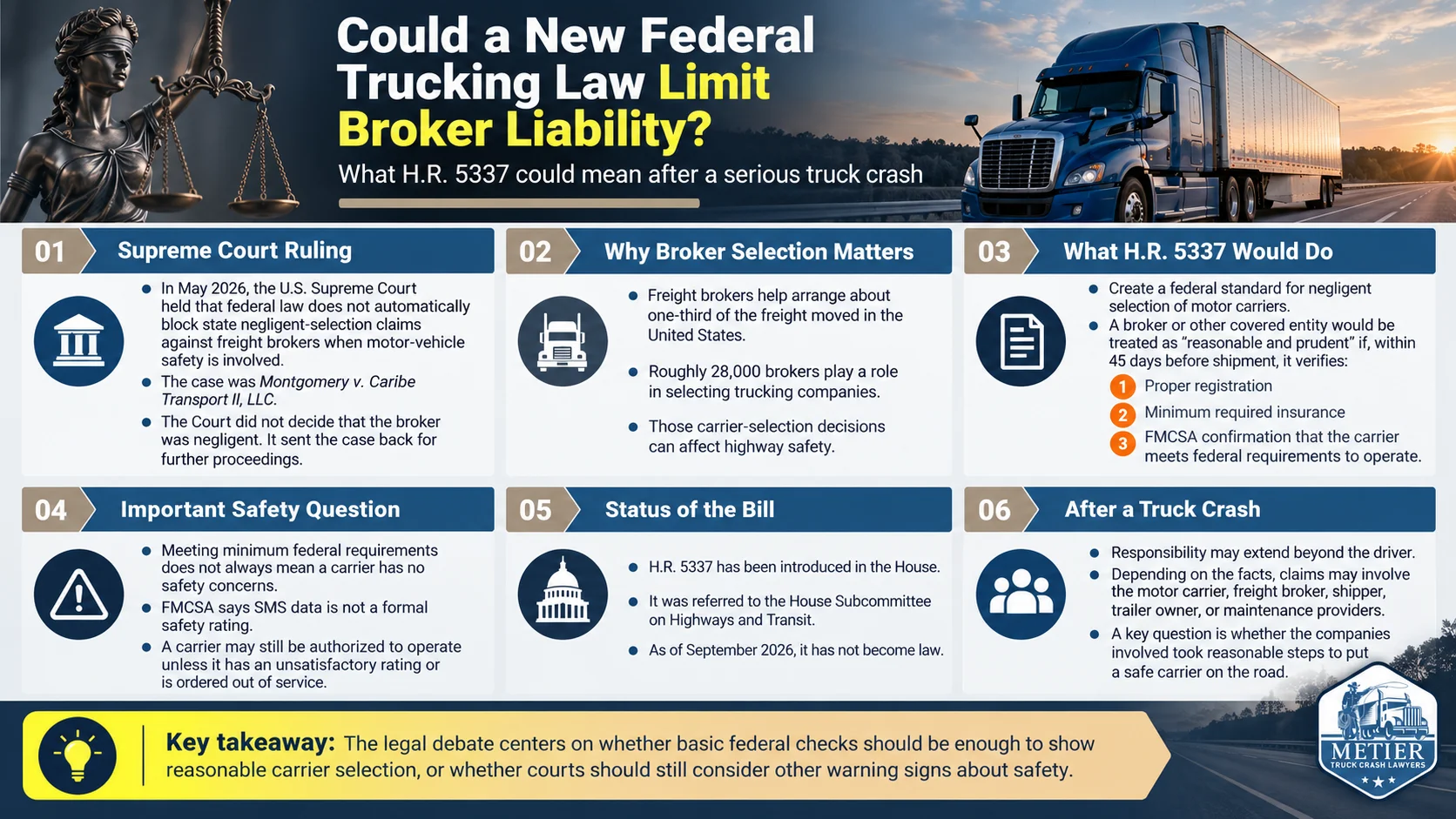
- In May 2026, the U.S. Supreme Court held that federal transportation law does not automatically block state negligent-selection claims against freight brokers when the claim concerns motor-vehicle safety.
- The case, Montgomery v. Caribe Transport II, LLC, involved broker C.H. Robinson and a crash that cost the plaintiff his leg. The Court did not decide that the broker was negligent. It sent the case back for further proceedings.
- About 28,000 freight brokers arrange one-third of the freight moved in the United States, so a broker's carrier-selection decisions carry real weight on the highway.
- H.R. 5337, the Motor Carrier Safety Selection Standard Act, would create a federal test that treats a broker as reasonable and prudent if it verifies registration, minimum insurance and FMCSA confirmation that the carrier meets federal safety requirements.
- The bill has been referred to the House Subcommittee on Highways and Transit. It has not become law.
- FMCSA warns that its Safety Measurement System data is not a safety rating. A carrier stays authorized to operate unless it receives an unsatisfactory rating or is ordered out of service.
- The open question is whether meeting minimum federal requirements should be enough to establish reasonable carrier selection, or whether courts should still weigh other safety information a broker had at the time.
A major debate is developing in Washington over who should bear responsibility when a freight broker selects an unsafe trucking company and that carrier causes a serious crash.
The issue took on new importance after the U.S. Supreme Court's May 2026 decision in Montgomery v. Caribe Transport II, LLC, a case involving freight brokerage giant C.H. Robinson. The Supreme Court unanimously held that federal transportation law does not automatically prevent states from allowing negligent-selection claims against freight brokers when those claims concern motor-vehicle safety.
Now, C.H. Robinson and other members of the freight industry are asking Congress and federal regulators for a national standard governing how brokers and shippers select trucking companies. C.H. Robinson CEO Dave Bozeman recently took that argument to Capitol Hill, warning lawmakers that differing state liability standards could increase litigation, insurance costs and ultimately the cost of moving freight.
At the center of the debate is H.R. 5337, the Motor Carrier Safety Selection Standard Act.
For people who share the road with commercial trucks, however, the important question is not simply whether brokers need a clear rule.
It is what that rule requires brokers to do to protect the public from unsafe trucking companies.

What Does a Freight Broker Do?
Freight brokers play an enormous role in the trucking industry.
A company that needs freight transported does not always hire a trucking company directly. Instead, it may hire a freight broker to locate and arrange transportation with a motor carrier.
The Supreme Court described brokers as intermediaries connecting sellers with the motor carriers that actually move their goods. According to information cited by the Court, roughly 28,000 brokers arrange transportation for approximately one-third of freight shipped in the United States by more than 780,000 carriers.
That means a broker's carrier-selection decisions can have real consequences on America's highways.
The legal question is what responsibility a broker has when selecting the trucking company that will ultimately put an 80,000-pound tractor-trailer on the road.
The Supreme Court's C.H. Robinson Decision
The case that brought this issue to the Supreme Court arose from a devastating truck crash.
Shawn Montgomery was stopped in his tractor-trailer when another truck struck him. Montgomery suffered severe and permanent injuries, including the amputation of his leg.
C.H. Robinson had brokered the shipment being transported by the other truck.
Montgomery alleged that C.H. Robinson negligently selected the motor carrier, Caribe Transport II. His lawsuit alleged that the carrier had a "conditional" FMCSA safety rating and deficiencies involving driver qualification, hours of service and other safety issues.
C.H. Robinson argued that the Federal Aviation Administration Authorization Act, or FAAAA, preempted the negligent-selection claim.
The Supreme Court disagreed.
On May 14, 2026, the Court unanimously held that the FAAAA's motor-vehicle-safety exception permits this type of state negligent-selection claim against a freight broker. The Court explained that requiring a broker to exercise ordinary care when selecting a carrier concerns the trucks used to transport the freight and therefore falls within the law's safety exception.
Importantly, the Supreme Court did not decide that C.H. Robinson was negligent. It decided that federal law did not automatically eliminate Montgomery's state-law negligent-selection claim. The case was sent back for further proceedings.
That distinction matters.
The ruling allows courts to examine the evidence and determine whether a broker failed to exercise the level of care required under applicable state law.
What Would the Motor Carrier Safety Selection Standard Act Do?
H.R. 5337 would create a federal standard for negligent selection of motor carriers.
Under the bill, a covered entity, including a freight broker, would be considered "reasonable and prudent" in selecting a motor carrier if, within the specified period before shipment, it verifies three things:
- The motor carrier is properly registered;
- The carrier has at least the minimum insurance required by federal and state law; and
- FMCSA confirms that the carrier meets the federal requirements necessary to operate.
The bill would also require the U.S. Department of Transportation to revise the methodology used for motor-carrier safety-fitness determinations and directs the agency to consider all available data when determining carrier fitness.
The legislation applies broadly. Its definition of a "covered entity" includes shippers, consignees, brokers, freight forwarders and certain other transportation intermediaries.
As of September 2026, H.R. 5337 has been introduced in the House and referred to the Subcommittee on Highways and Transit; it has not become law.
Why the Proposed Standard Matters After a Truck Crash
The difference between the Supreme Court's decision and the proposed legislation could become significant in truck-crash litigation.
Under Montgomery, a state negligent-selection claim against a broker is not automatically barred by federal law. Depending on the applicable state's negligence law and the evidence, a court may therefore consider whether a broker exercised reasonable care when choosing a motor carrier.
H.R. 5337 would establish a defined federal pathway for determining that a covered entity acted reasonably and prudently in selecting the carrier.
That raises an important safety issue:
What happens when a trucking company technically satisfies the federal operating requirements but other available information raises concerns about its safety performance?
"Authorized to Operate" Does Not Necessarily Mean "No Safety Concerns"
This distinction is particularly important because of the way FMCSA's current safety system works.
FMCSA's Safety Measurement System, or SMS, uses inspection, violation and crash information to identify motor carriers for potential intervention.
But FMCSA specifically warns users that SMS information is not itself a federal safety rating and should not be used by itself to draw conclusions about a carrier's overall safety condition. Unless a carrier has received an unsatisfactory safety rating or has otherwise been ordered out of service, it generally remains authorized to operate.
FMCSA separately explains that its current formal safety-rating system can produce "satisfactory," "conditional" and "unsatisfactory" ratings following an on-site investigation.
Those distinctions matter because a motor carrier may have safety information in federal databases without having been formally declared unfit to operate.
The proposed legislation therefore presents an important policy question: Should satisfying federal operating requirements be enough to conclusively establish reasonable carrier selection, or should courts also be permitted to consider other safety information that was available to a broker when it selected the carrier?
FMCSA Is Already Reconsidering How Carrier Safety Should Be Determined
The federal government has also been examining the broader safety-fitness system.
FMCSA has pursued rulemaking aimed at changing how the agency determines whether a motor carrier is fit to operate. The agency has considered using additional safety-performance and compliance information in making those determinations.
H.R. 5337 would require the Secretary of Transportation, within one year after enactment, to issue regulations revising the methodology for motor-carrier safety-fitness determinations. The legislation specifically says the Secretary must consider the use of all available data when determining carrier fitness.
That portion of the proposal could lead to a more comprehensive federal safety determination.
The critical issue will be what information ultimately goes into that determination and how effectively it identifies unsafe carriers before a catastrophic crash occurs.
The Trucking Industry's Argument
C.H. Robinson and freight-industry representatives argue that brokers need a predictable national standard rather than potentially different standards imposed through negligence law in different states.
Following Montgomery, industry representatives have also warned that expanded litigation exposure could increase broker insurance and compliance costs. C.H. Robinson has argued that those costs could ultimately increase transportation and consumer costs.
The industry is also responding operationally. Transport Topics has reported that brokers, insurers and shippers are reassessing carrier-vetting procedures, documentation and monitoring following the Supreme Court decision.
Those are legitimate considerations in the debate over a national standard.
But efficiency and predictability are not the only considerations.
Any national carrier-selection standard also has to protect the people driving alongside commercial trucks.
Carrier Selection Can Be a Truck-Safety Decision
When an unsafe trucking company causes a catastrophic collision, determining responsibility can require looking beyond the driver who was behind the wheel.
A serious truck-crash investigation may examine the motor carrier's hiring and training practices, hours-of-service compliance, maintenance program, inspection history, prior violations and safety-management practices.
In appropriate cases, it may also be necessary to investigate who selected the motor carrier and what that company knew, or reasonably should have known, when it made that decision.
The Supreme Court's decision in Montgomery confirms that federal transportation law does not categorically prevent states from imposing reasonable-care obligations on freight brokers when motor-vehicle safety is involved.
Congress is now considering whether to replace some of that uncertainty with a national carrier-selection standard.
The details of that standard matter.
A federal rule could potentially create greater consistency while improving safety if it relies on meaningful, current and comprehensive carrier-safety information.
But a standard that treats basic operating authority and minimum insurance as sufficient without adequately accounting for available warning signs could have very different consequences.
For truck-crash victims and everyone sharing America's highways with commercial vehicles, the ultimate question should remain focused on safety:
Did the companies responsible for putting that truck on the road take reasonable steps to make sure the carrier could operate safely?
Questions People Ask About Broker Liability and Truck Crashes
Can a freight broker be sued after a truck crash?
Federal law no longer blocks the claim automatically. In Montgomery v. Caribe Transport II, LLC, the Supreme Court held that the FAAAA's motor-vehicle-safety exception permits a state negligent-selection claim against a freight broker. Whether a particular broker is liable still depends on the negligence law of the state where the claim is brought and on the evidence about what the broker knew and did when it chose the carrier.
What does negligent selection of a motor carrier mean?
It is a claim that the company arranging the shipment failed to use reasonable care in choosing the trucking company that hauled it. The question is what safety information was available when the selection was made and what a reasonable company would have done with it. That inquiry often turns on the carrier's inspection and violation history, its federal safety rating, and its record on driver qualification and hours-of-service compliance.
Does federal operating authority mean a trucking company is safe?
No. FMCSA states that Safety Measurement System data is not a federal safety rating and should not be used by itself to draw conclusions about a carrier's overall safety condition. Unless FMCSA has issued an unsatisfactory safety rating or ordered the carrier to stop operating, the carrier remains authorized to operate. A motor carrier can have a documented record of violations in federal databases and still be legally permitted to haul freight.
Would H.R. 5337 prevent injured people from bringing claims against brokers?
H.R. 5337 has not become law. As introduced, it would treat a covered entity as having selected a motor carrier in a reasonable and prudent manner if, within 45 days before the shipment, it verified three things: that the carrier is registered, that it carries the minimum insurance required by federal and state law, and that FMCSA confirms the carrier meets the safety standards required to operate. How much that would limit a claim would depend on how courts applied the standard to other safety information a broker had at the time of selection.
Besides the driver, who can be held responsible for a commercial truck crash?
Depending on the facts, responsibility may extend to the motor carrier, the freight broker, the shipper, the trailer owner and the companies that maintained the equipment. The decisions that matter often happened well before the collision. A carrier may have hired a driver who was not qualified to be behind the wheel, or deferred maintenance it knew was due. A broker may have placed the load with a carrier it never meaningfully reviewed. Our truck accident lawyers look at every company in that chain and at the records showing what each one knew.
Injured in a Commercial Truck Crash?
Truck crashes can involve far more companies than the trucking company whose name appears on the tractor or trailer. Depending on the facts, the investigation may involve the driver, motor carrier, freight broker, shipper, trailer owner, maintenance providers and other companies involved in the transportation chain.
At Metier Law Firm, our truck accident lawyers investigate the companies and decisions behind serious commercial trucking crashes. That includes examining federal safety records, carrier history, corporate relationships and the evidence showing how and why a motor carrier was selected.
If you or a family member has been seriously injured in a commercial truck crash, understanding every company involved in putting that truck on the road can be an important part of determining what happened and who may be legally responsible.
Call Metier Law Firm at 866-377-3800 or schedule your free consultation today at www.metierlaw.com.
Disclaimer: Past results discussed should not be considered a guarantee of your results as the factors of every case are individually unique. This content is for informational purposes only and does not constitute legal advice. Consult a qualified attorney from Metier Law Firm regarding your individual situation for legal advice.
Tell Us About Your Case – Free Case Review with a Personal Injury Lawyer
(866) 377-3800Our Locations
.webp)
Do I have a Case?
How Much Should I Be Offered?
Do I Need an Attorney?
If these questions have crossed your mind, let us help. You may need a little direction or may not need an attorney at all, but you deserve to be confident knowing your options. We can provide you with information about our Attorneys of the West® accident investigations and legal services. Your confidential consultation with us is totally free.
Keep up with us!
