.svg)


TL;DR - Key Takeaways
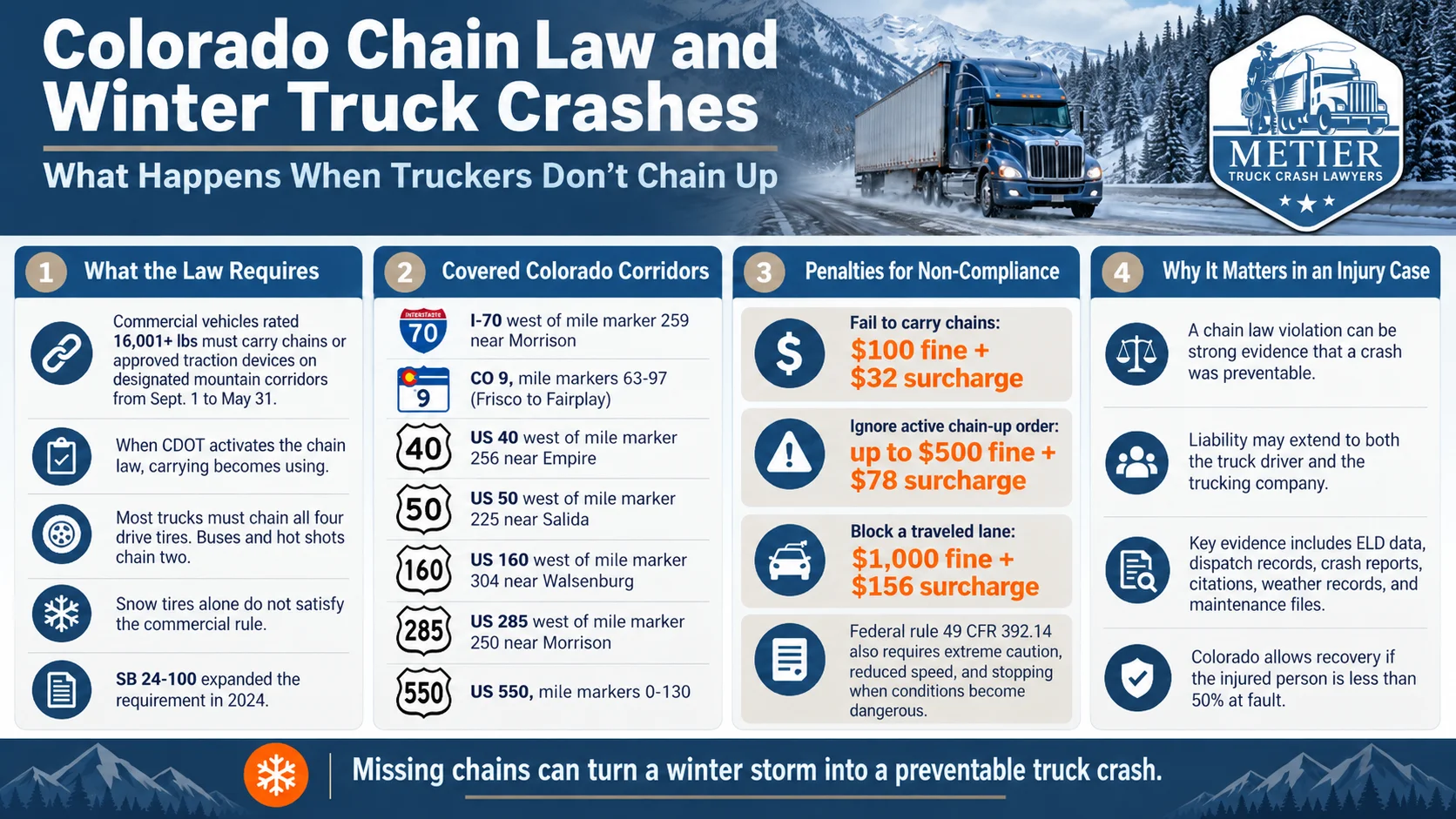
- The Colorado chain law requires commercial vehicles rated at 16,001 pounds or more to carry chains or approved traction devices on seven mountain corridors from September 1 through May 31.
- Senate Bill 24-100, signed in 2024, expanded the carry requirement well beyond I-70 to routes like US 550, US 160, and Colorado Highway 9.
- A trucker who fails to carry chains on a listed corridor faces a $100 fine plus a $32 surcharge. Ignoring an active chain-up order runs up to $500 plus a $78 surcharge, and blocking the road costs $1,000 plus a $156 surcharge.
- Federal rules under 49 CFR 392.14 tell drivers to slow down and stop when conditions turn dangerous, so a truck that crashes on bare tires points to a driver who kept going when caution said to park.
- When a winter truck crash traces back to a missing set of chains, the trucking company and the driver can both be held responsible for the harm they cause.
- We move fast to pull the electronic logs, dispatch records, and State Patrol citations that show whether the truck was chained when it should have been.
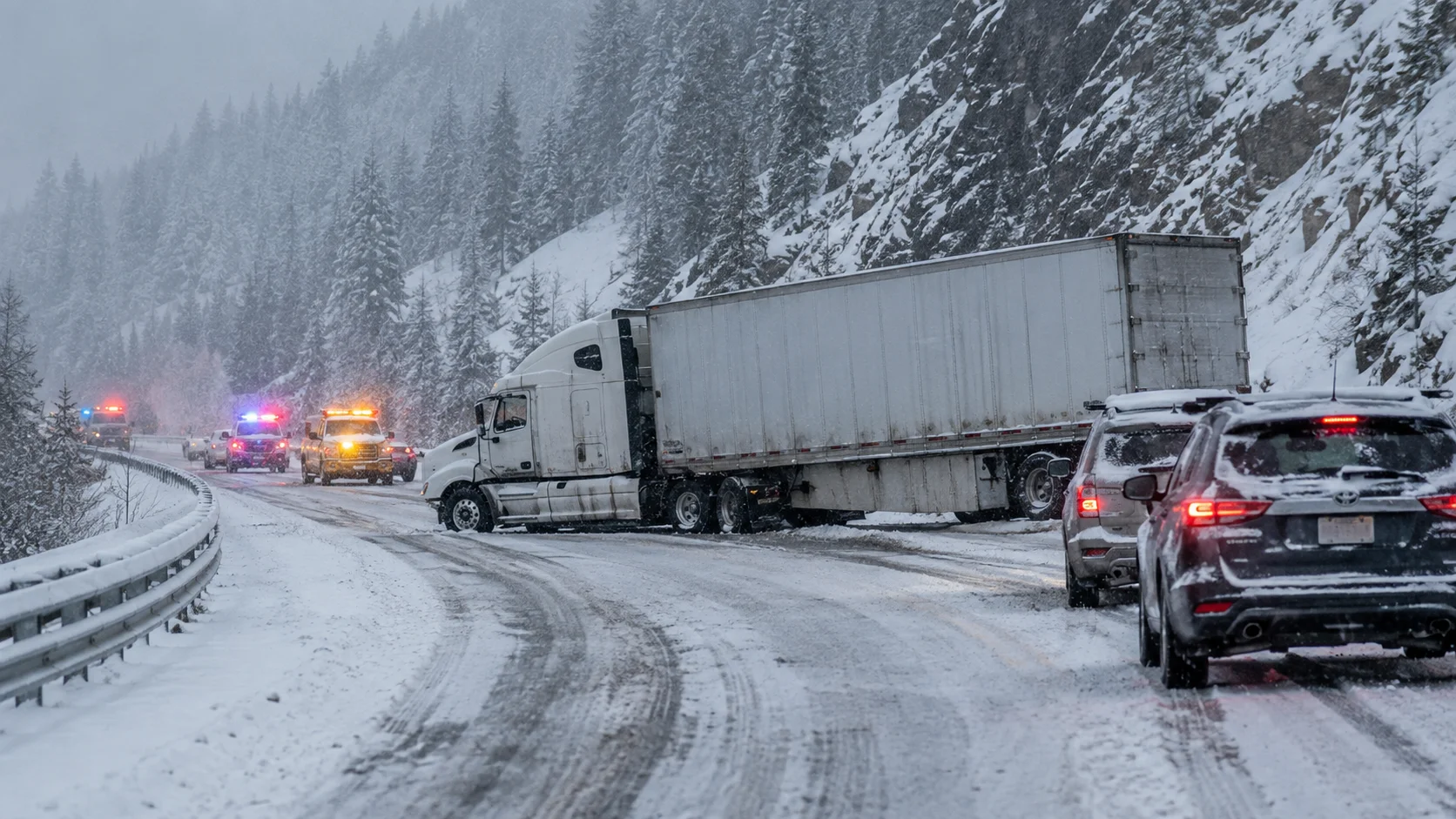
I hold a Class A commercial driver's license, so I understand the rules that govern these trucks and what a driver faces on a snow-packed grade. I'm Mike Chaloupka, Managing Partner at Metier Law Firm, and our team has spent decades representing people hurt by trucks that were not fit to be on a mountain highway. Every winter we see the same pattern on Colorado's high country roads. A commercial truck loses traction on packed snow, jackknifes or slides across the median, and the people in the passenger vehicles are the ones who get hurt. The Colorado chain law exists to prevent exactly that, and when a trucker ignores it, the crash that follows was preventable.
What the Colorado Chain Law Actually Requires
Colorado runs two winter rules that people mix up. The passenger traction law covers everyday drivers and asks for snow tires, all-weather tires, or chains. The commercial rule is stricter, and it applies to any commercial motor vehicle with a gross vehicle weight rating of 16,001 pounds or more.
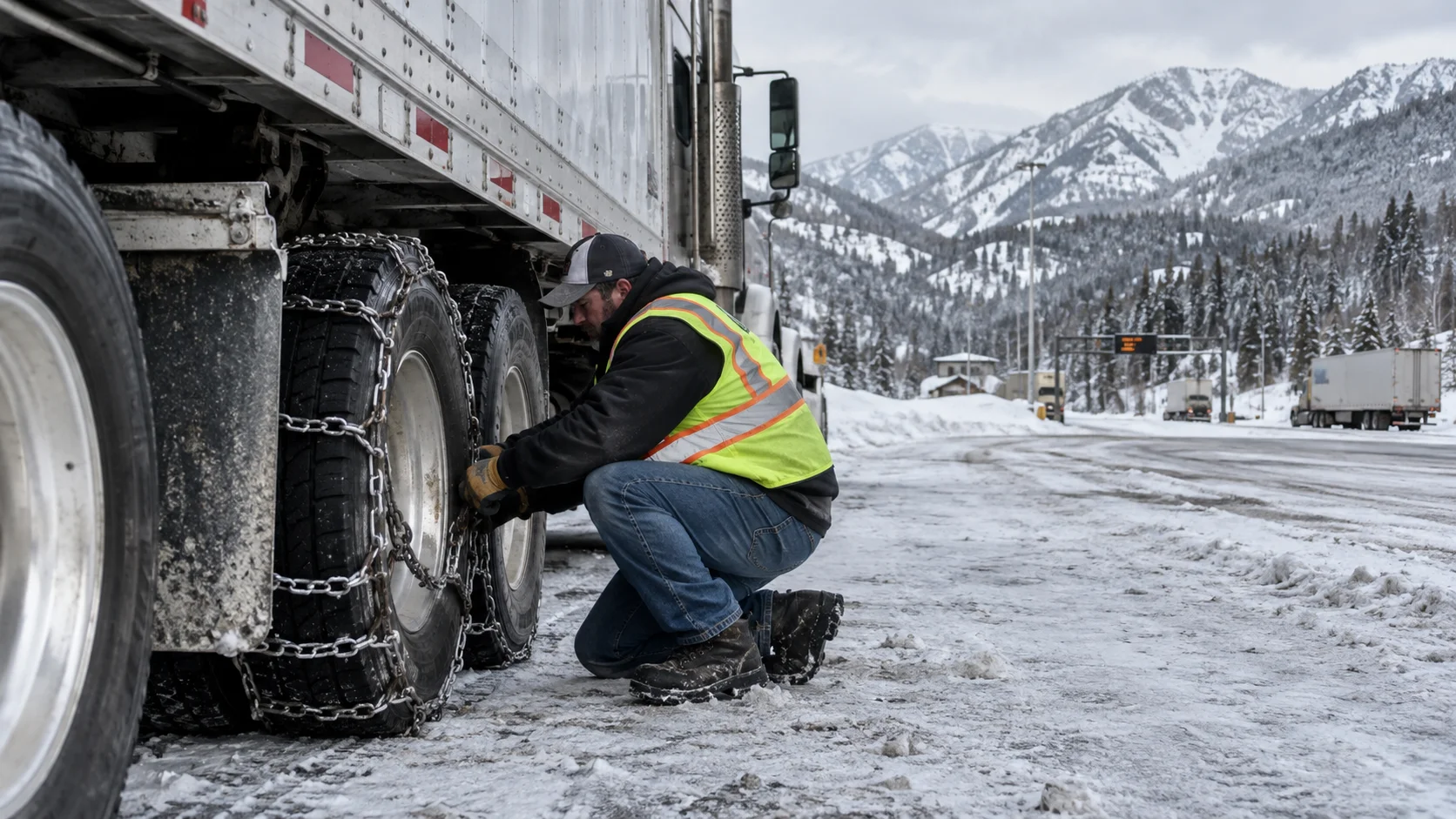
From September 1 through May 31, those trucks have to carry chains or approved alternate traction devices on the corridors the state has designated. Carrying is the baseline. When the Colorado Department of Transportation activates the chain law during a storm, the requirement changes from carrying to using. Most trucks, including straight trucks, single and tandem drive axle combinations, and auto transporters, have to chain all four drive tires. Buses and hot shots chain two. Snow tires do not count for a commercial vehicle. Only chains or a CDOT-approved traction device will do.
The season opens on September 1 because high-country storms arrive long before winter reaches Denver or Fort Collins, and a September squall on Vail Pass hits as hard as a January one. Senate Bill 24-100, signed in 2024, expanded the corridors where these rules apply and increased the state's enforcement.
The Corridors Where Chains Are Mandatory
The carry requirement now covers more than 1,400 centerline miles of highway and 130 chain stations, with 22 of them on the I-70 mountain corridor alone. The stretches where commercial drivers must carry chains from September through May include:
- I-70 west of mile marker 259 near Morrison
- Colorado Highway 9 from mile marker 63 to 97, between Frisco and Fairplay
- US Route 40 west of mile marker 256 near Empire
- US Route 50 west of mile marker 225 near Salida
- US Route 160 west of mile marker 304 near Walsenburg
- US Route 285 west of mile marker 250 near Morrison
- US Route 550 from mile marker 0 to 130
We see these same routes repeatedly in our cases, and several rank among Colorado's most dangerous roads. The I-70 climb west of Denver carries the heaviest freight traffic and the steepest sustained grades, which is why we see so many runaway and out-of-control truck crashes on that stretch.
What It Costs a Trucker to Ignore the Rule
The penalties climb with the severity of the violation. Failing to carry chains on one of the listed corridors draws a $100 fine plus a $32 surcharge. Ignore an active chain-up order and the fine runs up to $500 plus a $78 surcharge. A truck that gets stuck and blocks a traveled lane costs its driver $1,000 plus a $156 surcharge.
Those fines are small next to the damage a loaded tractor-trailer does when it slides. Federal law backs up the state rule. Under 49 CFR 392.14, a commercial driver has to use extreme caution in snow and ice, reduce speed, and stop driving altogether when conditions become dangerous enough. A driver who passes a chain station in a whiteout has already broken two sets of rules before the crash happens.
Why a Missing Set of Chains Becomes Your Injury Case
A chain law violation is rarely the only failure in these crashes. Usually a tight delivery deadline sits behind it, along with a driver who kept moving when the safe choice was to shut down.
Colorado follows modified comparative fault, so an injured person can recover as long as they are less than 50 percent responsible for the crash. A trucker who violated the chain law carries a heavy share of the blame, and so does a company that pushed a driver into a mountain storm on a tight deadline. We have seen carriers try to pin the outcome on the weather, as if snow on a September pass were a surprise. The rule removes that excuse: the storm was foreseeable.
If you or a loved one was injured in a crash with a commercial truck, call us at 866-377-3800 or schedule a free consultation at www.metierlaw.com.
How We Prove a Truck Wasn't Chained When It Should Have Been
We start with the timeline. Electronic logging devices record where a truck was and how fast it was moving, and that data lines up against the National Weather Service record and CDOT's chain law activations for that stretch of road. If the chain law was in effect for that stretch, and the truck was running at highway speed on bare drive tires, the logs show it.
We pull the dispatch records, which show what the company knew and told the driver to do. We request the Colorado State Patrol crash report and any chain law citation, and we check the maintenance file to see whether the truck even carried usable chains. Trucking companies know this evidence is damaging, so we send a spoliation letter early to stop them from losing or writing over it. The State Patrol's enforcement crackdowns on commercial violations show how often these trucks are out of compliance, and a winter crash on a chain law corridor deserves the same scrutiny. When brakes are part of the story, we bring in the same analysis we use in Colorado brake failure cases.
Our Denver truck accident lawyers handle these winter cases across the I-70 corridor and the mountain passes that feed it.
Frequently Asked Questions
Does the Colorado chain law apply to my pickup or SUV?
No. The commercial chain law applies to vehicles rated at 16,001 pounds or more. Passenger vehicles fall under the separate traction law, which calls for snow tires, all-weather tires, or chains during a declared traction alert.
A truck without chains hit me on I-70. Does that automatically mean the driver is at fault?
It does not decide the case on its own, but it is strong evidence. A chain law violation shows the driver broke a safety rule written for the exact conditions of the crash, and that matters under Colorado's comparative fault system.
How long do I have to file a claim after a winter truck crash in Colorado?
Colorado gives you three years from the date of a motor vehicle crash to file a personal injury claim under C.R.S. 13-80-101. Waiting hurts the case, because the electronic and weather data we rely on can be overwritten within weeks.
What if I was partly responsible for the crash?
You can still recover in Colorado as long as you were less than 50 percent at fault. Your recovery is reduced by your share of the blame, but a trucker's chain law violation often shifts most of the responsibility onto the trucking company.
Talk to a Firm That Knows What Chaining Up Really Means
Most winter crashes on Colorado's mountain corridors trace back to a driver or a company that treated the Colorado chain law as optional, and the people in the other vehicles are the ones left injured. We understand these roads and the rules that govern the trucks on them, and we know how to hold a carrier accountable when it sends an unprepared truck into a storm. Call Metier Law Firm at 866-377-3800 or schedule your free consultation today at www.metierlaw.com.
Disclaimer: Past results discussed should not be considered a guarantee of your results as the factors of every case are individually unique. This content is for informational purposes only and does not constitute legal advice. Consult a qualified attorney from Metier Law Firm regarding your individual situation for legal advice.
Tell Us About Your Case – Free Case Review with a Personal Injury Lawyer
(866) 377-3800Our Locations
.webp)
Do I have a Case?
How Much Should I Be Offered?
Do I Need an Attorney?
If these questions have crossed your mind, let us help. You may need a little direction or may not need an attorney at all, but you deserve to be confident knowing your options. We can provide you with information about our Attorneys of the West® accident investigations and legal services. Your confidential consultation with us is totally free.
Keep up with us!
