.svg)


Key Takeaways
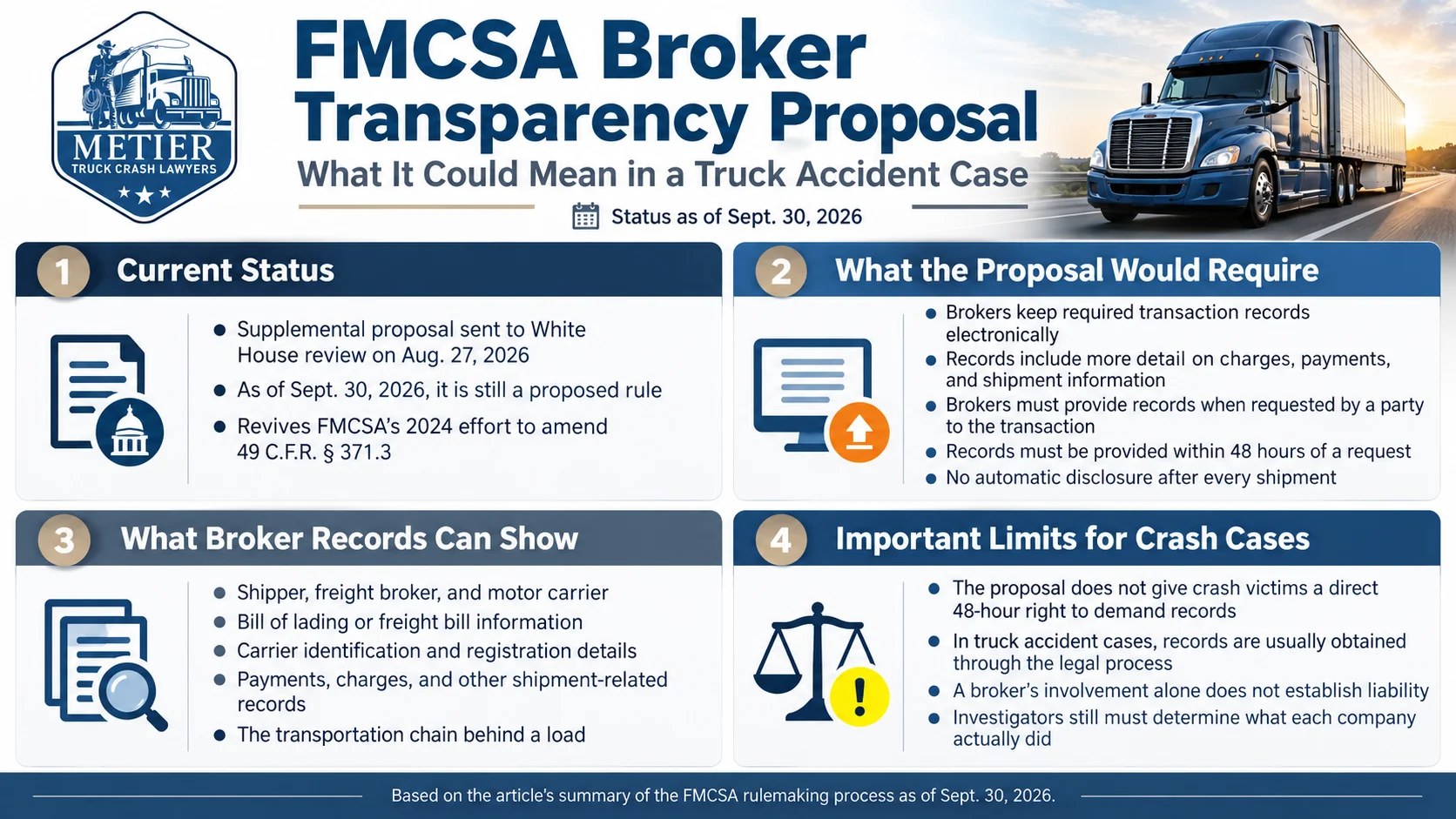
- FMCSA sent a supplemental broker transparency proposal to the White House Office of Information and Regulatory Affairs on August 27, 2026. As of September 30, 2026, it's still a proposed rule, and its requirements could change before a final version is issued.
- The supplemental revives a rulemaking that started with a November 2024 FMCSA proposal to amend 49 C.F.R. § 371.3, the federal regulation that sets the records property brokers must keep.
- Under the 2024 proposal, brokers would keep transaction records electronically, include more detail on charges and payments, and have an affirmative duty to provide the records within 48 hours of a request.
- The 2024 version didn't require brokers to send records automatically after every shipment. Only a request from a party to the brokered transaction starts the 48-hour clock.
- OOIDA and the Small Business in Transportation Coalition pushed for stronger rules. Parts of the brokerage and trucking industries objected over compliance costs, confidential rates, and interference with private contracts.
- The proposal gives people injured in truck crashes no right to demand a broker's records. In a truck accident case, those records are obtained and preserved through the legal process.
- Broker records can identify the shipper, the broker, and the motor carrier behind a load, along with the bill of lading and payment details. A broker's involvement doesn't by itself establish responsibility for a crash, so we look at what each company actually did.
The Federal Motor Carrier Safety Administration (FMCSA) is moving forward in 2026 with an effort to increase transparency between freight brokers, motor carriers, and shippers.
In August 2026, FMCSA submitted a supplemental proposal on Transparency in Property Broker Transactions for review by the White House Office of Information and Regulatory Affairs. The action revives a rulemaking that began with an FMCSA proposal published in November 2024. As of September 30, 2026, the changes have not become a final rule.
The rulemaking is significant because freight brokers play an increasingly important role in arranging commercial transportation. The records generated by those relationships can show who arranged a shipment, which carrier was selected, what the parties were paid, and how the transportation arrangement was structured.
What Is a Freight Broker?
A freight broker generally acts as an intermediary between a shipper that needs freight transported and a motor carrier that will actually haul the load.
The broker may identify available carriers, negotiate rates, communicate requirements for a shipment, and arrange for a motor carrier to transport the freight.
That distinction can become important after a serious truck accident. The company whose name appears on shipping paperwork may not be the company that owned the tractor, employed the driver, or physically transported the load.
Understanding the relationships among the shipper, freight broker, motor carrier, driver, and other transportation companies can therefore be an important part of investigating a commercial truck crash.
What Did FMCSA's 2024 Broker Transparency Proposal Include?
FMCSA's original proposal would amend 49 C.F.R. § 371.3, the federal regulation governing records that property brokers must maintain.
FMCSA proposed four significant changes:
- Electronic records. Brokers would be required to maintain the required transaction records electronically.
- More detailed transaction information. Broker records would provide greater visibility into the charges and payments associated with a shipment.
- An affirmative obligation to provide records. Instead of merely stating that parties to the transaction have a right to review the records, the proposed regulation would expressly require the broker to provide them when requested.
- A 48-hour deadline. A broker would have to electronically provide the required records within 48 hours after receiving a request from a party to the brokered transaction.
One important distinction is that FMCSA's 2024 proposal did not require brokers to automatically send these records after every shipment. The 48-hour requirement would be triggered by a request from a party to the transaction.
Why Is FMCSA Considering the Change?
Federal broker-transparency requirements are not new.
FMCSA explained that existing regulations already give parties to a brokered transaction access to certain broker records. But motor carriers told the agency that obtaining those records can be difficult in practice.
According to FMCSA, some broker contracts contain provisions requiring carriers to waive their ability to review transaction records. The agency also heard complaints that brokers sometimes made records available only for physical inspection at their offices or delayed responding to requests.
FMCSA described the underlying problem as an information imbalance among brokers, carriers, and shippers. Greater access to transaction information, the agency reasoned, could help the parties make better business decisions and resolve payment and service disputes more efficiently.

Why Are Some Trucking Companies Supporting Greater Transparency?
Owner-operators and small motor carriers have been among the strongest advocates for broker transparency.
The Owner-Operator Independent Drivers Association (OOIDA) petitioned FMCSA for stronger requirements, including electronic disclosure of transaction records. The Small Business in Transportation Coalition also sought restrictions on contractual provisions that require carriers to waive their rights to inspect broker records.
The issue can be especially important when a shipper pays one amount to move a load but the carrier actually hauling the freight receives substantially less.
Access to transaction records can give carriers more information about the economics of a shipment and may help them evaluate their relationships with brokers.
Why Have Brokers Opposed Parts of the Proposal?
The proposal has also faced opposition from segments of the brokerage and trucking industries.
Among the concerns are the potential administrative and technology costs associated with producing records, the confidentiality of negotiated rates, and the effect disclosure could have on private contractual relationships.
FMCSA considered alternatives including automatic disclosure of records, a prohibition on contractual waivers, and a deadline longer than 48 hours. The agency's original proposal did not adopt automatic disclosure and did not expressly prohibit waiver provisions.
Those competing concerns are part of the reason the 2026 development is important: FMCSA has now returned to the issue with a supplemental proposal under federal review rather than simply finalizing the original 2024 language.
What Could Broker Records Tell Us After a Truck Accident?
Although FMCSA's broker-transparency proceeding is primarily aimed at the commercial relationship among brokers, carriers, and shippers, broker records can also be relevant to understanding the transportation chain surrounding a serious truck crash.
Depending on the circumstances, records associated with a brokered shipment may help identify:
- the shipper;
- the freight broker;
- the motor carrier selected to transport the load;
- the carrier's identifying and registration information;
- the bill of lading or freight bill;
- payments and charges associated with the shipment; and
- other entities involved in arranging or performing the transportation.
FMCSA's proposal specifically contemplates broker records containing information such as the consignor's name and address, the originating motor carrier's name, address and registration number, the bill of lading or freight bill number, compensation connected with the shipment, payment information, and certain penalties.
That information can help establish the chain of relationships behind the truck and its load.
Broker Transparency Does Not Automatically Give Crash Victims Access to the Records
There is an important limitation.
The proposed FMCSA rule would require disclosure upon request by a party to the brokered transaction. It does not create a general right for every member of the public - or every person injured in a truck accident - to demand a broker's records within 48 hours.
In truck accident litigation, relevant broker and shipping records may instead need to be obtained and preserved through the legal process.
That makes early investigation important. A commercial truck crash may involve substantially more evidence than the driver's logbook and the trucking company's records.

Why the Broker's Role Can Matter in a Truck Accident Case
Modern freight transportation can involve multiple companies.
A shipper may hire a broker. The broker may arrange transportation with a motor carrier. That carrier may use a particular driver and tractor-trailer to move the freight. In more complicated arrangements, additional intermediaries or carriers may also be involved.
When a catastrophic crash occurs, investigators need to determine what each company actually did - not simply what it called itself.
Questions may include:
- Who selected the motor carrier?
- What information was available about that carrier?
- What contractual requirements applied to the shipment?
- Who communicated with the carrier and driver?
- Were multiple brokers, carriers, or other transportation companies involved?
- What records document those relationships?
The answers depend on the facts of the individual case and the applicable law. A broker's involvement in arranging a shipment does not by itself establish responsibility for a crash.
What Happens Next?
As of September 30, 2026, FMCSA's broker-transparency changes remain in the rulemaking process.
FMCSA sent its supplemental proposal to the White House for regulatory review on August 27, 2026. The matter is still identified as being at the proposed-rule stage, meaning the precise requirements could change before any final regulation is issued.
For trucking companies, brokers, shippers, and attorneys handling commercial vehicle cases, it is a rulemaking worth watching.
Metier Law Firm Investigates the Companies Behind a Truck Crash
A serious commercial truck accident investigation should look beyond the truck itself.
At Metier Law Firm, our truck accident lawyers investigate the companies and relationships involved in putting a commercial vehicle and its load on the highway. That can include the motor carrier, driver, shipper, freight broker, maintenance providers, contractors, and other companies whose conduct may be relevant to the crash.
Our trial lawyers handle complex truck accident cases and understand that critical evidence can exist throughout the transportation chain.
If you or a family member has been seriously injured in a commercial truck accident, contact Metier Law Firm to learn more about your legal options.
This article is for informational purposes only and is based on the status of the FMCSA rulemaking as of September 30, 2026. Federal regulations and pending rulemakings may change.
Tell Us About Your Case – Free Case Review with a Personal Injury Lawyer
(866) 377-3800Our Locations
.webp)
Do I have a Case?
How Much Should I Be Offered?
Do I Need an Attorney?
If these questions have crossed your mind, let us help. You may need a little direction or may not need an attorney at all, but you deserve to be confident knowing your options. We can provide you with information about our Attorneys of the West® accident investigations and legal services. Your confidential consultation with us is totally free.
Keep up with us!
