.svg)


Key Takeaways
- Colorado State Patrol data shows the truck driver is at fault in about a third of fatal commercial-vehicle crashes, and the people killed are usually in the other vehicle.
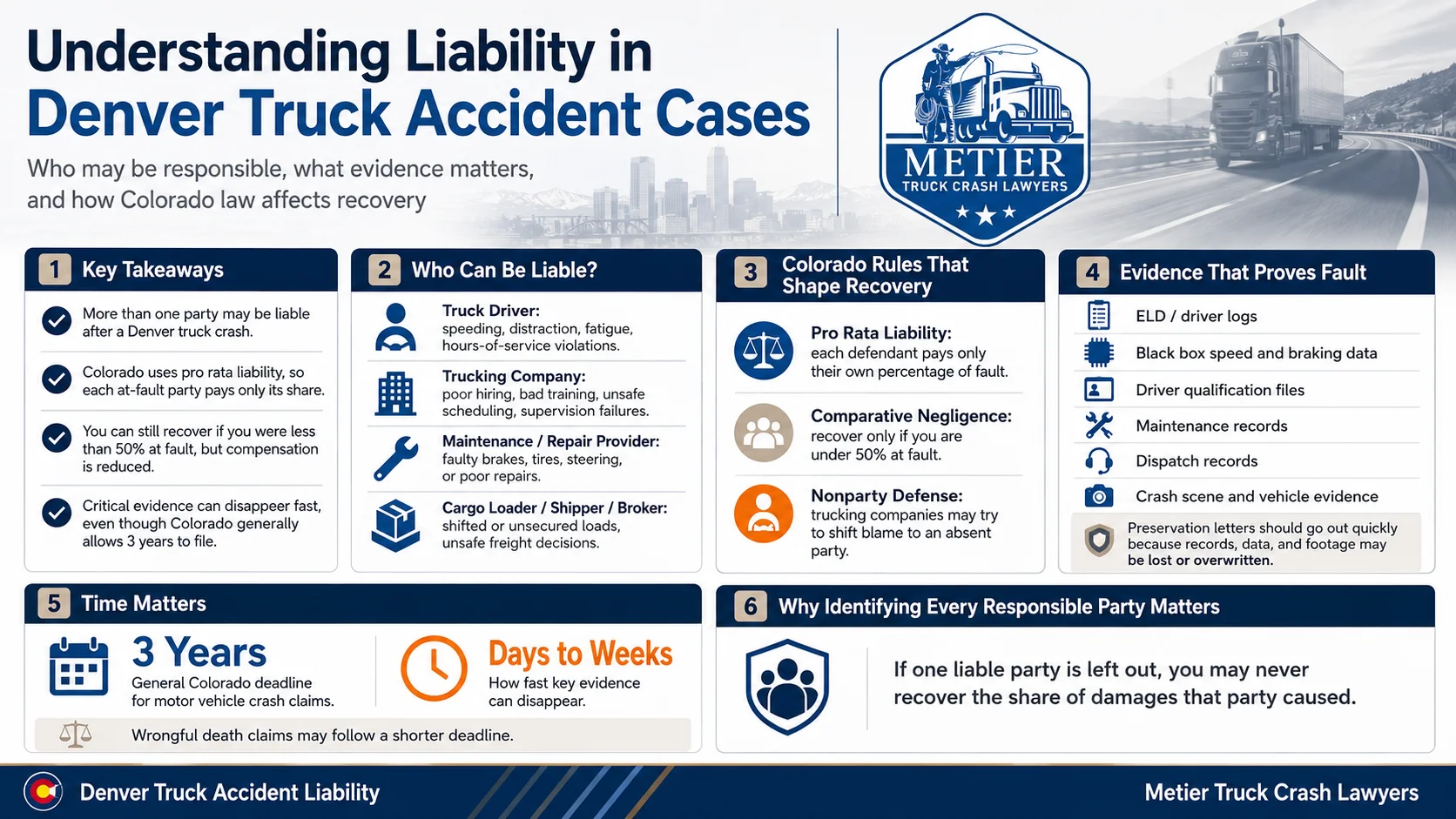
- More than one party can be liable for a Denver truck accident, including the driver, the trucking company, a maintenance shop, or whoever loaded the freight.
- Colorado uses pro rata liability, which means each at-fault party pays only its own share, so identifying every responsible party changes what you can actually recover.
- Under Colorado's comparative negligence rule, you can still recover if you were less than 50 percent at fault, though your compensation drops by your percentage of blame.
- Trucking companies can shift blame onto an absent "nonparty," which is one reason we move fast to name and pursue everyone who contributed to the crash.
- Driver logs, black box data, and maintenance records prove who did what, and that evidence starts disappearing within days.
- Colorado gives you three years to file a truck crash claim, but waiting can cost you the proof your case depends on.
After a crash with a commercial truck in Denver, one of the first questions we hear is a plain one: who pays for this? It almost never has a one-name answer. A tractor-trailer wreck usually pulls in several companies, several insurance policies, and several sets of defense lawyers, and figuring out Denver truck accident liability means untangling all of them.
I'm Emily N. Benight, truck accident lawyer and partner at Metier Law Firm, and I've spent my career representing people hurt in truck crashes and families living with the aftermath of catastrophic injuries. Our Founding Partner, Tom Metier, is one of only a small number of attorneys in Colorado who hold board certification in truck accident law from the National Board of Trial Advocacy. That background shapes how we approach every case: we know what records a carrier is supposed to keep, where those records live, and how companies try to make them disappear.
Denver's freight corridors put trucks and cars in the same tight spaces
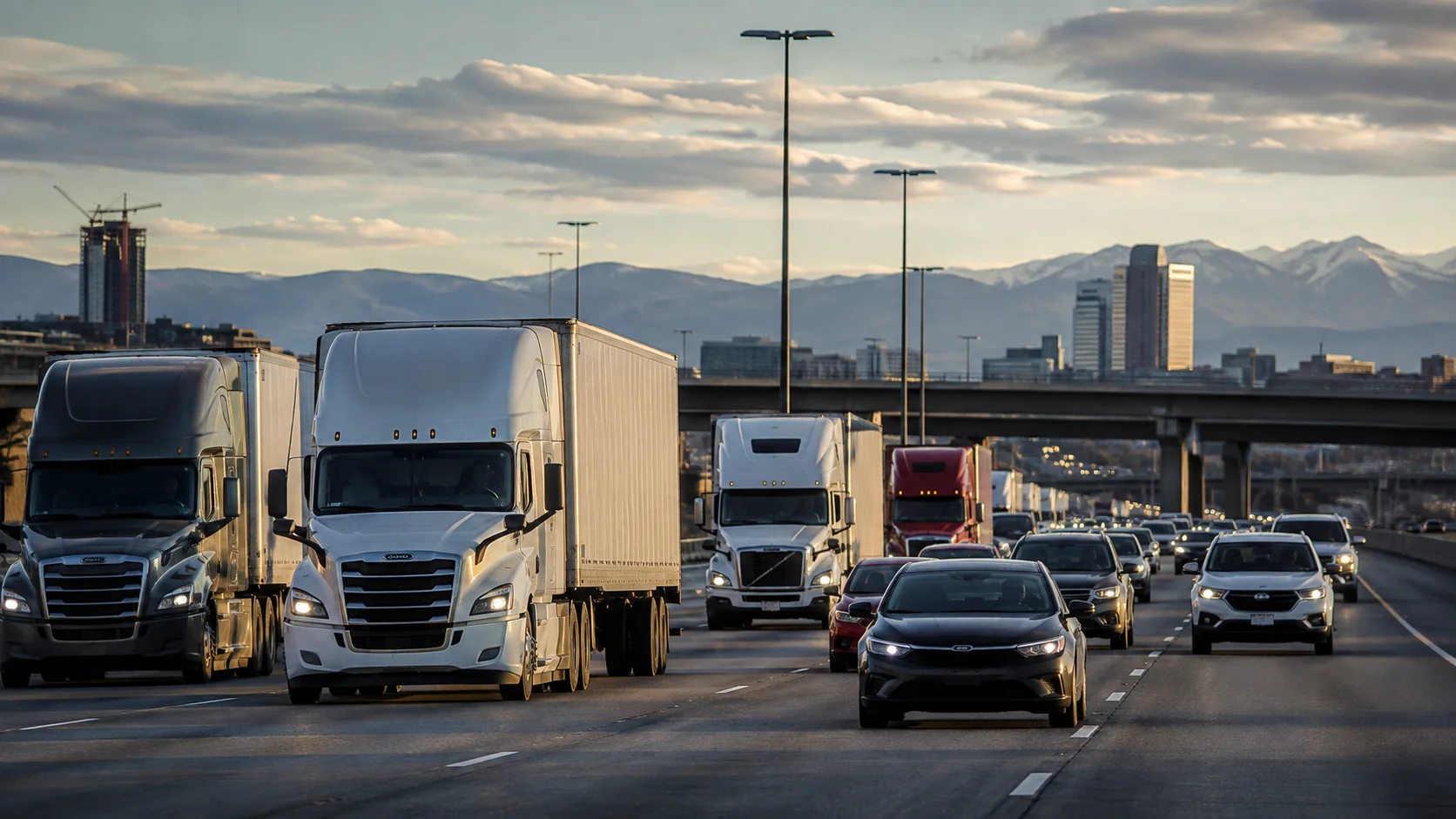
Colorado is a freight hub, and Denver sits at the center of it. I-70 runs east and west through the metro, I-25 carries traffic north and south, and I-225, I-270, and many of the main artery streets in Denver also funnel commercial trucks through vital neighborhoods and suburbs full of passenger cars. All of this contributes to a mix where people get hurt by these massive vehicles.
The numbers back it up. Colorado State Patrol counted 52 fatal crashes involving commercial motor vehicles in 2023, and the total ticked back up in 2024 after two straight years of decline. That same data shows the truck driver is at fault in about a third of the fatal crashes involving a commercial vehicle. When an 80,000-pound truck causes a wreck, the people who die are usually in the other vehicle, not the truck. NHTSA found that 70 percent of people killed in large-truck crashes in 2022 were occupants of other vehicles. That's the whole reason pinning down responsibility matters. Troopers name I-70 as the road with the most commercial-vehicle crashes in the state, and the mountain corridor draws the heaviest enforcement. You can explore statewide crash figures through the Colorado Department of Transportation crash data dashboard.
Who can be held liable for a Denver truck accident?
Liability in a Denver truck accident can rest with one party or several. The chain of decisions that leads to a crash usually runs back further than the driver behind the wheel.
The driver
If a trucker was speeding, following too closely, driving distracted, or pushing past the federal hours-of-service limits, the driver's negligence is often the starting point. We cover how impairment and inattention factor in over on our post about distracted truck driving in Denver.
The trucking company
A carrier can be on the hook two different ways. It's responsible for what its driver does on the job, and it's separately responsible for its own choices. Hiring a driver with a bad record, skipping training, ignoring warning signs, or setting schedules that force drivers to stay on the road too long are all failures that belong to the company, not the driver. We've written before about how unqualified drivers end up behind the wheel when carriers cut corners on hiring.
Maintenance and repair providers
Trucks need working brakes, tires, and steering, and federal rules require carriers to inspect and repair their fleets. When a separate maintenance company does that work and does it badly, and a mechanical failure causes the crash, that company can share the blame.
Cargo loaders, shippers, and brokers
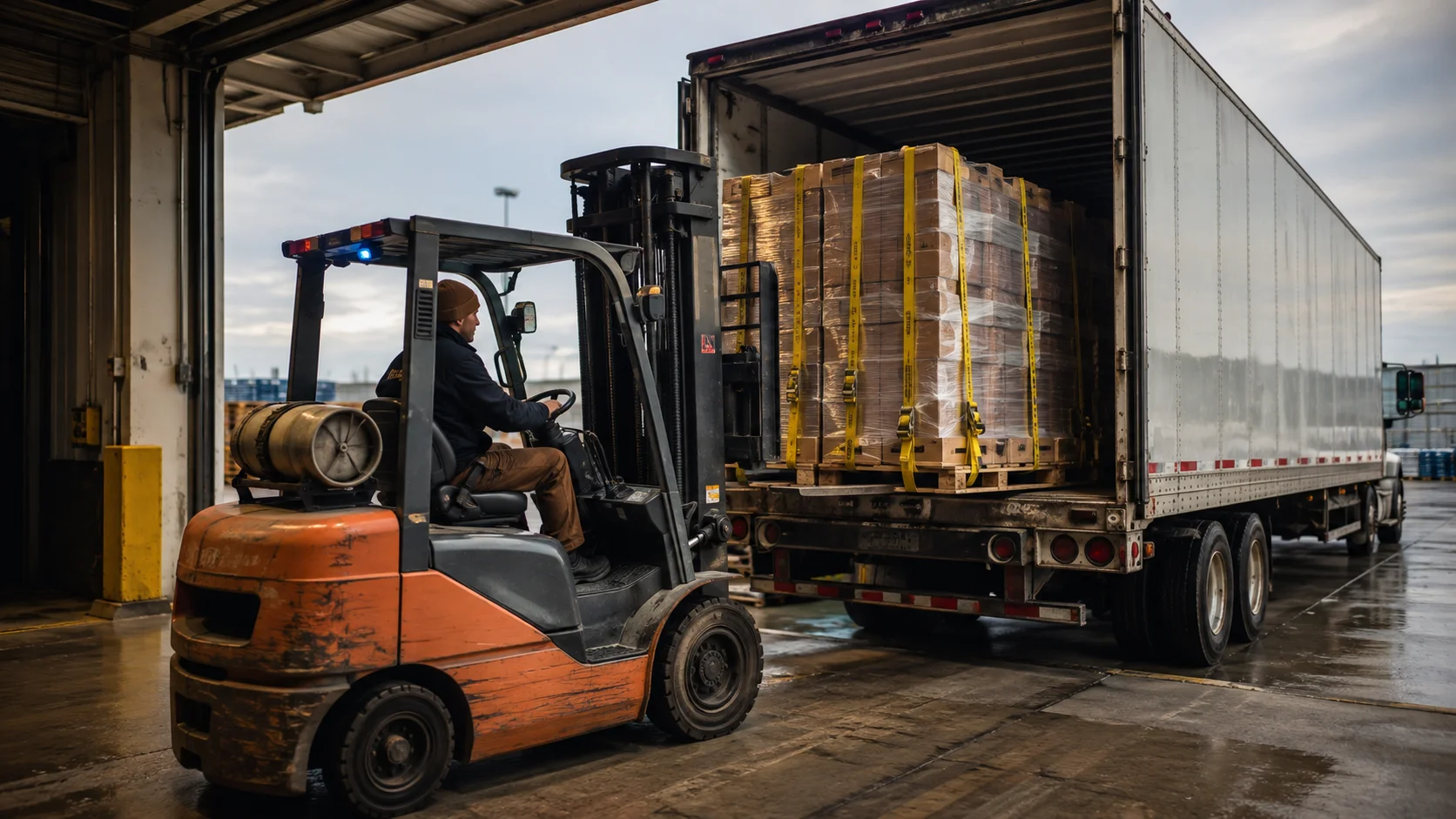
A load that shifts can cause a rollover or a jackknife. The company that loaded the freight has a duty to secure it under the federal cargo securement rules. Depending on the arrangement, a shipper or freight broker may also share responsibility for putting an unsafe operation on the road.
How Colorado decides who pays
This is where a Denver truck accident case gets more complicated than a fender bender, and it's the part most people don't see coming.
Colorado uses pro rata liability under C.R.S. 13-21-111.5. In plain terms, each at-fault party pays only its own percentage of the damages, not the whole amount. If a jury finds the driver 60 percent responsible and the maintenance shop 40 percent, you collect from each of them separately for their share. That's why naming every responsible party matters so much. Miss one, and you may never recover the portion of your losses that party caused.
The same statute lets a defendant point at an empty chair. A trucking company can formally designate a "nonparty," someone you didn't sue, and argue that person or company was actually at fault. It has to do this within 90 days of the case starting, unless a court determines otherwise. We've seen carriers use this tactic to spread blame onto a broker, a loading company, or another driver who isn't in the courtroom. When we identify and pursue every liable party early, we take that move away from them.
Your own conduct factors in too. Colorado follows modified comparative negligence under C.R.S. 13-21-111. If you're found 50 percent or more at fault, the law bars your recovery completely. At 49 percent or less, you can still recover, but your award drops by your share of the blame. With more than one defendant, your fault gets measured against their combined fault. Insurers know this rule, and they work hard to inflate the victim's percentage, which is one more reason the evidence has to be locked down and read correctly.
Proving each party's share comes down to evidence
You can't hold a company accountable for a share of fault you can't prove. Truck cases turn on records that most drivers never think about: electronic logging device data, the black box that captures speed and braking, driver qualification files, maintenance logs, and dispatch records.
The problem is timing. Black box data gets overwritten. Camera footage gets deleted. Trucks get repaired and put back into service. That's why we send a spoliation letter as soon as we take a case, putting every company on notice that they have a legal duty to preserve the proof. Wait too long, and the record that shows exactly who failed is simply gone.
If you or a loved one was injured in a crash with a commercial truck, call us at 866-377-3800 or schedule a free consultation at www.metierlaw.com.
Colorado gives you three years, but the clock on evidence runs faster
Under C.R.S. 13-80-101, you generally have three years from the date of a motor vehicle crash to file a truck accident claim in Colorado. A Denver wrongful death crash follows a separate, shorter deadline, so families should never assume they have the same window.
Three years sounds like plenty of time. It isn't, at least not for the evidence. The trucking company's rapid response team is often working the crash within hours, and the data that proves your case can be gone in a matter of weeks or months. The filing deadline protects your right to be compensated for your injuries, but it does nothing to protect the proof, and that's what we move to secure first.
Frequently Asked Questions
Who can be held liable in a Denver truck accident?
More than one party often shares responsibility. Depending on the facts, liability can fall on the truck driver, the trucking company, a maintenance provider, the company that loaded the cargo, or a shipper or broker. Sorting it out takes a close look at driver logs, company records, and the crash evidence.
What if I was partly at fault for the crash?
Colorado follows modified comparative negligence. You can still recover if you were less than 50 percent at fault, but your compensation is reduced by your percentage of blame. If you're found 50 percent or more at fault, you cannot recover.
Does it matter how many companies I sue?
Yes. Colorado uses pro rata liability, so each at-fault party pays only its own share. If a responsible party is left out, you may never recover the portion of your losses that party caused. That's why identifying everyone involved is so important.
How long do I have to file a truck accident claim in Colorado?
You generally have three years from the date of the crash under C.R.S. 13-80-101. Fatal cases follow a different, shorter deadline. Because critical evidence disappears quickly, it's smart to talk with a lawyer long before the deadline approaches.
Why do I need a lawyer instead of dealing with the insurance company myself?
Trucking companies carry large insurance policies and defense teams built to limit what they pay. A top-rated Denver truck accident lawyer can preserve evidence, identify every liable party, and push back when insurers try to shift blame onto you.
Let's talk about who really pays for your crash
A Denver truck accident is rarely one driver's mistake. It's usually a string of choices made by companies that count on victims not knowing where to look. We know where to look, and we've spent decades reading the records trucking companies would rather you never see. We build every case as if it's going to trial, because that's what moves insurers to pay you the injury compensation you deserve. If you want a team that will find every responsible party and hold each one accountable, we're ready to help. You can learn more about our work on our Denver truck accident lawyers page.
Call Metier Law Firm at 866-377-3800 or schedule your free consultation today at www.metierlaw.com.
Disclaimer: Past results discussed should not be considered a guarantee of your results as the factors of every case are individually unique. This content is for informational purposes only and does not constitute legal advice. Consult a qualified attorney from Metier Law Firm regarding your individual situation for legal advice.
Tell Us About Your Case – Free Case Review with a Personal Injury Lawyer
(866) 377-3800Our Locations
.webp)
Do I have a Case?
How Much Should I Be Offered?
Do I Need an Attorney?
If these questions have crossed your mind, let us help. You may need a little direction or may not need an attorney at all, but you deserve to be confident knowing your options. We can provide you with information about our Attorneys of the West® accident investigations and legal services. Your confidential consultation with us is totally free.
Keep up with us!
