.svg)



TL;DR: Key Takeaways
- Distraction means anything that pulls a truck driver's eyes, hands, or mind off the road, from texting to in-cab screens.
- Federal rules ban commercial drivers from texting (49 CFR 392.80) and holding a phone to call (49 CFR 392.82), and hold the trucking company responsible too.
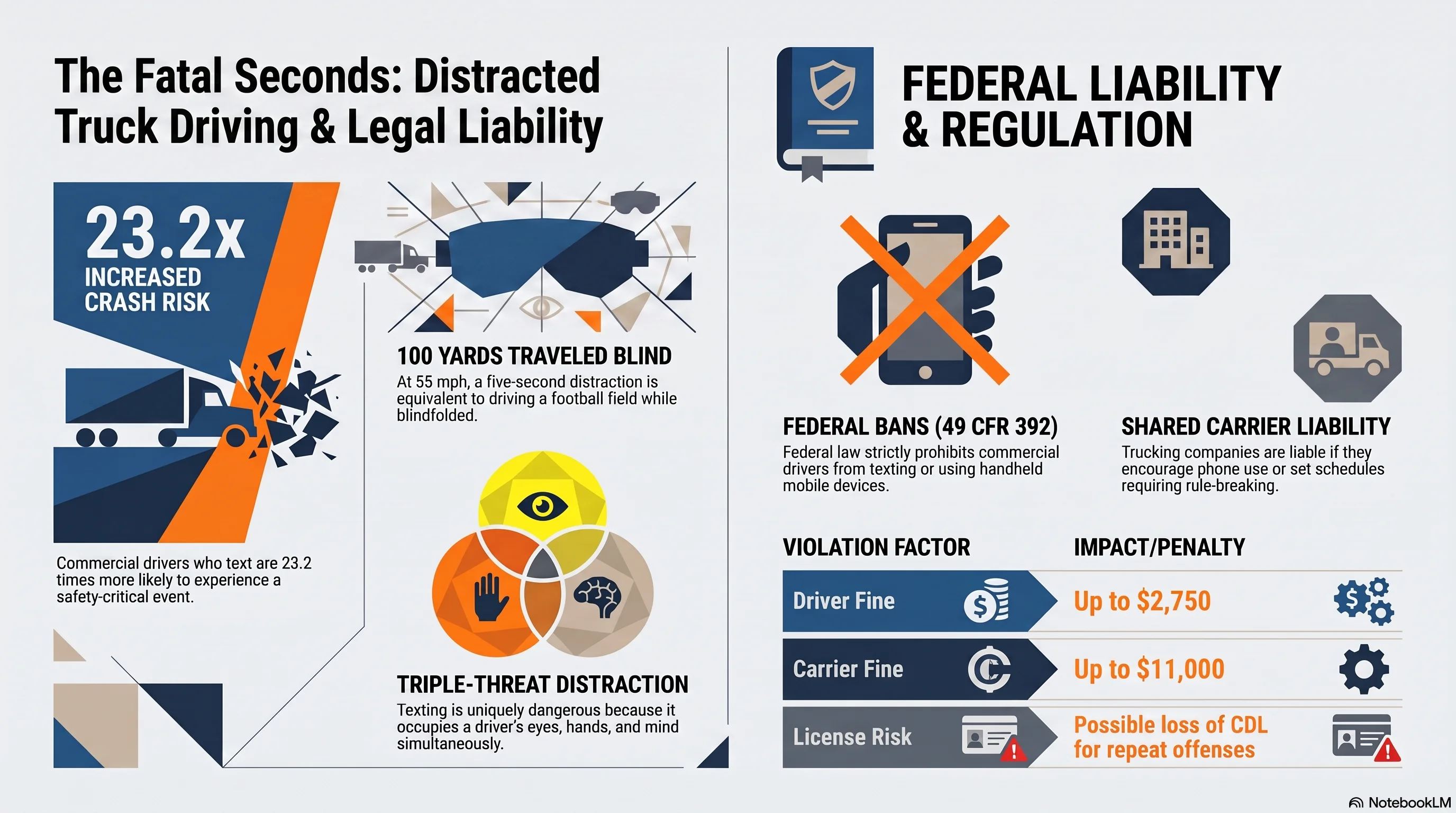
- FMCSA research found commercial drivers who text are 23.2 times more likely to be in a crash or near-crash.
- A loaded semi needs far more room to stop than a car, so a few seconds of distraction on I-25 or I-70 can turn deadly.
- Fatigue is a related danger: not distraction in the strict sense, but a tired driver misses the same hazards.
- Both the driver and the carrier can be liable, which affects the compensation available to you.
I'm Emily Benight, a partner and truck crash lawyer at Metier Law Firm. Much of my work centers on truck collisions and the brain injuries they leave behind, and I've seen how a single glance at a phone changes a family's life. In 2024, distracted driving killed 3,208 people on American roads, according to NHTSA. When the distracted driver is steering an 80,000-pound truck on a Denver freeway, the stakes climb fast.
Denver sits where I-25 and I-70 cross, two corridors that carry much of Colorado's commercial freight, and the Mousetrap interchange there is one of the busiest areas for trucking traffic in the state. When a driver looks down at a text in that traffic, there is rarely room to recover.
Call Metier Law Firm at 866-377-3800 or schedule your free consultation today at www.metierlaw.com
Common Distractions for Truck Drivers
NHTSA breaks distraction into three types: visual (eyes off the road), manual (hands off the wheel), and cognitive (mind off driving). Texting hits all three at once, which is why it draws the most attention. It is not the only problem we see.
Cell phone use is the big one. Reading a message or scrolling an app steals a driver's focus at the worst moment. In-cab technology adds another layer: dispatch tablets, navigation units, and load-tracking screens, with some companies expecting drivers to answer messages while the truck is moving.
Everyday habits cause crashes too. Eating, reaching for a drink, or checking paperwork all count. We have seen cases where something as simple as grabbing a clipboard off the passenger seat led to a serious wreck.

Fatigue: A Related Danger
Fatigue is not distraction in the strict sense. A tired driver can have both hands on the wheel and eyes forward, but the effect is similar: missed hazards, slow reactions, and lane drift. Federal hours-of-service rules cap how long a commercial driver can stay behind the wheel, partly because fatigue is a leading factor in large-truck crashes. When a carrier pushes a driver past those limits to hit a deadline, the company shares the blame.
Why Distraction Is Especially Dangerous in Trucks
A passenger car can stop in a few car lengths. A fully loaded semi cannot. At highway speed it needs a much longer distance to halt, often a couple of football fields at highway speeds. That gap is everything.
Here is the math that stays with me. Sending or reading a text takes a driver's eyes off the road for about five seconds. At 55 mph, that is roughly a football field traveled blind, according to NHTSA. In a car you might get lucky. In a truck on I-225 or the I-70 freight route, five blind seconds can mean a pileup. The same size and weight that make trucks useful make a distracted truck driver far more dangerous than a distracted commuter, and Denver's terrain raises it further: trucks coming down from the foothills on I-70 are already managing grade and brake heat near busy interchanges.
Federal Rules on Distracted Truck Driving
Commercial drivers face stricter rules than the rest of us. Under 49 CFR 392.80, no driver may text while operating a commercial vehicle, and under 49 CFR 392.82, no driver may hold a phone to make a call. Both rules also reach the company: a carrier cannot allow or require it.
The penalties are real: fines up to $2,750 for a driver and $11,000 for a carrier, according to the FMCSA mobile phone rule, and repeat offenses can cost the commercial license. FMCSA based these rules on research showing the danger, including the finding that texting raises a commercial driver's odds of a safety-critical event 23.2 times.
For the full picture of how these violations prove negligence, see our guide to FMCSA Part 392. The short version: when a driver breaks a federal safety rule, that violation becomes strong evidence in your claim.
If you or a loved one was injured in a crash with a commercial truck, call us at 866-377-3800 or schedule a free consultation at www.metierlaw.com.
Liability in Distracted Driving Truck Accidents
This is where a truck case differs from a typical car wreck. More than one party can be on the hook, which is central to truck accident liability.
The driver is the obvious one. If the records show texting or dialing, that points to direct negligence. The trucking company often shares responsibility too. If it pressured the driver to answer dispatch on the road, set schedules that encouraged rule-breaking, or ignored a pattern of violations, it can be liable. That matters because carriers hold far larger insurance policies than individual drivers.
Proving distraction takes fast work. Phone records show when a call or text happened, dispatch logs reveal company messages, and electronic logging device data and any in-cab or dash camera footage can place the distraction at the moment of impact. We pull this evidence quickly, before it gets overwritten, and we know the defenses carriers raise, including blaming you for the crash.
If a distracted trucker hurt you anywhere in the metro, our Denver truck accident lawyers are ready to help.
Frequently Asked Questions
What counts as a distracted driving truck accident?
Any crash where the truck driver's eyes, hands, or mind were off the task of driving. That covers texting, phone calls, eating, reaching for objects, and using in-cab technology.
Is a trucking company liable if its driver was distracted?
It can be. If the company encouraged or required phone use, set unrealistic schedules, or overlooked repeat violations, it may share liability with the driver.
How do you prove a truck driver was distracted?
We use phone records, dispatch logs, electronic logging device data, and camera footage. These can pin the distraction to the second, which is hard for an insurer to dispute.
How long do I have to file a claim in Colorado?
Colorado sets a limited filing window that varies by claim type. Do not wait: evidence fades and deadlines pass. Contact us early to preserve the record and protect your right to file.
Contact a Truck Accident Attorney at Metier Law Firm
A distracted driving truck accident can leave you with injuries that take months or years to heal, and a brain injury can reshape daily life. You should not have to fight the trucking company's insurer alone while you recover. We know how these cases work, how to prove distraction, and the Denver roads where these crashes keep happening.
Our truck accident lawyers bring that same knowledge to families throughout the region. Fort Collins truck accident lawyers on our team handle these claims with the same attention to detail, and Colorado Springs truck accident lawyers apply that same approach further south. We represent families well beyond Colorado too, with Portland truck accident lawyers and Seattle truck accident lawyers ready to fight for victims in the Pacific Northwest. When a distracted driving crash proves fatal, a Denver wrongful death lawyer stands with the family through everything that follows, a Fort Collins wrongful death lawyer offers that same support closer to the foothills, and a Colorado Springs wrongful death lawyer carries it forward for families further south.
Call Metier Law Firm at 866-377-3800 or schedule your free consultation today at www.metierlaw.com.
Disclaimer: Past results discussed should not be considered a guarantee of your results as the factors of every case are individually unique. This content is for informational purposes only and does not constitute legal advice. Consult a qualified attorney from Metier Law Firm regarding your individual situation for legal advice.
Tell Us About Your Case – Free Case Review with a Truck Accident Lawyer
Tell Us About Your Case – Free Case Review with a Personal Injury Lawyer
(866) 377-3800Our Locations
.webp)
Do I have a Case?
How Much Should I Be Offered?
Do I Need an Attorney?
If these questions have crossed your mind, let us help. You may need a little direction or may not need an attorney at all, but you deserve to be confident knowing your options. We can provide you with information about our Attorneys of the West® accident investigations and legal services. Your confidential consultation with us is totally free.
Keep up with us!
