.svg)


TL;DR - Key Takeaways
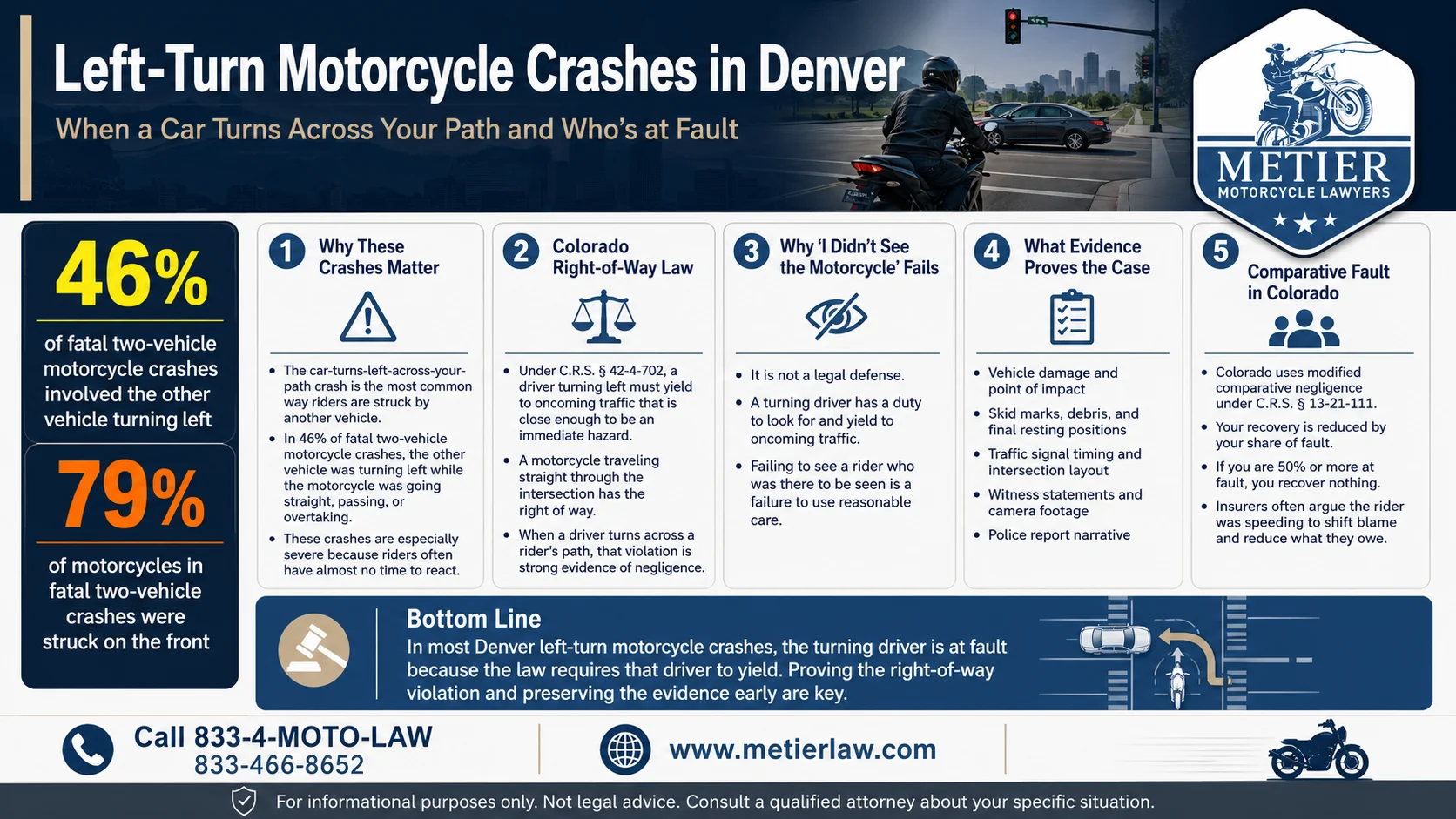
- The car-turns-left-across-your-path crash is the single most common way riders are struck by another vehicle. NHTSA data shows that in 46 percent of fatal two-vehicle motorcycle crashes, the other vehicle was turning left while the motorcycle went straight.
- Colorado law puts the duty to yield on the turning driver. Under C.R.S. § 42-4-702, a driver turning left must yield to oncoming traffic that's close enough to be a hazard, and a rider going straight through an intersection has the right of way.
- "I didn't see the motorcycle" isn't a legal defense. Failing to see a rider who was there to be seen is itself a failure to exercise reasonable care.
- The turning driver's right-of-way violation is strong evidence of negligence, but it doesn't end the fault analysis. Insurers still try to shift a percentage onto the rider, which is where Colorado's comparative fault rule applies.
- We ride these Denver roads, and we know how to prove what the driver did wrong when the only two people who saw the crash clearly are the rider and the driver who caused it.
You're proceeding through an intersection on a green light, doing everything correctly, and a car in the oncoming left-turn lane cuts across your path. You have almost no time to react. A motorcycle offers none of the structural protection of an enclosed vehicle, so there is little standing between you and a serious injury. And the driver is already saying the words you'll hear again from their insurance company: "I never saw the motorcycle." I'm Patrick DiBenedetto, a partner here at Metier Law Firm and a rider myself, and this is the crash we see more than any other at our Denver office.
"The turning driver almost always says they didn't see the rider, as if that resolves the question. It does not. Colorado law required that driver to yield, and failing to see you is not the same as being excused for hitting you. That distinction is the heart of the case, and it's one we can prove."
That's what this post addresses: who had the right of way, what the turning driver's legal duty actually was, and why the "didn't see you" claim doesn't hold up once you understand the law.

Motorcycle rider's view of a car waiting to turn left across an oncoming lane in Denver
Why the Left-Turn Crash Is So Common and So Dangerous
This isn’t a rare scenario. According to the National Highway Traffic Safety Administration, there were 3,419 fatal two-vehicle crashes involving a motorcycle and another vehicle in 2023. In 46 percent of them, the other vehicle was turning left while the motorcycle was going straight, passing, or overtaking. No other crash configuration comes close.
The mechanism is almost always the same. A driver waiting to turn left looks down the road, judges the gap, and pulls across. The difficulty is that a motorcycle's narrow profile makes it hard for drivers to judge speed and distance, so they misjudge the gap and turn directly into a rider who had every right to be there. It happens at signalized intersections and at driveways and side streets on Denver's busier arterials, anywhere a driver has to cross oncoming traffic to complete a turn. The rider going straight rarely has time to avoid it.
The consequences for the rider are severe because of the angle. NHTSA found that in two-vehicle fatal crashes, 79 percent of motorcycles were struck on the front. A left-turning car crossing your path presents its door and quarter panel directly in your line of travel, with no structure to absorb the impact.
What Colorado Law Says About Right of Way
This is where the "didn't see you" account runs into the statute. Colorado law is direct about who must yield when a car turns left. Under C.R.S. § 42-4-702, a driver intending to turn left within an intersection, or into an alley, private road, or driveway, must yield the right of way to any vehicle approaching from the opposite direction that is close enough to be an immediate hazard.
The duty rests on the turning driver. A motorcycle approaching in the oncoming lane, close enough that turning across its path creates a hazard, has the right of way. The turning driver who proceeds anyway has violated the statute, and a violation is a class A traffic infraction. This is one of the clearer right-of-way rules in the Colorado traffic code, and it maps almost precisely onto the oncoming left-turn crash.
Colorado courts have applied this rule to these facts for decades. In one case reflected in the statute's annotations, the evidence showed a driver made a left turn directly across the path of an oncoming vehicle that had the right of way, and the question of that driver's negligence was properly submitted to the jury. The statute is the foundation of a failure-to-yield motorcycle claim in Denver, and it is why the turning driver bears the initial burden on fault.
Why "I Didn't See the Motorcycle" Is Not a Defense
Drivers say it frequently, and they believe it clears them. In fact, it tends to confirm their negligence.
Negligence in Colorado turns on whether a driver exercised reasonable care. A driver turning left has a duty to look for oncoming traffic and to yield to it. A motorcycle in the oncoming lane, in daylight, in plain view, is traffic that a careful driver is expected to see. So when a driver says they didn't see the rider, they are not describing an excuse. They are describing the breach. Failing to see something you had a duty to look for is a failure to exercise reasonable care, not a defense to it.
The "didn't see you" statement is, in substance, an admission that the driver was not watching for what the law required. NHTSA's own guidance for drivers states the duty plainly: a motorcycle's size and narrow profile make its speed and distance difficult to judge, so drivers are instructed to take extra care when deciding whether to turn. A driver who turns across a rider's path and then says they didn't see the motorcycle has omitted the precise duty that both the law and reasonable care require.
That is also why this claim surfaces so quickly from the other side's insurance company. It sounds as though it shifts blame to the rider for being hard to see. It doesn't. If you want to understand the other tactics adjusters rely on after these crashes, we addressed them in our guide on what not to say to insurance after a Denver motorcycle accident.

Proving the Right-of-Way Violation
A right-of-way violation is strong, but it is not automatic. Someone has to establish what happened, and in a left-turn crash the two people who saw it most clearly are the rider and the driver who caused it. That is why the evidence carries the case.
The physical evidence usually tells the story. The point of impact on both vehicles, the final resting positions, skid marks, and debris all help reconstruct the angle of the turn and where each vehicle was when the driver committed to it. A car turning left across your lane leaves a distinct evidence pattern. Traffic and signal timing at the intersection can confirm you had the light. Independent witnesses matter because they counter the driver's version. And the police report, while not the final word on fault, often documents the failure to yield in its narrative.
We act quickly on this evidence because it deteriorates quickly. Camera footage is overwritten, vehicles are repaired, and memories fade. The sooner it is preserved, the harder it is for the other side to recharacterize what happened.
Where Comparative Fault Comes In
Establishing that the driver violated your right of way is the foundation, but Colorado still permits the other side to argue you share some blame. Even in a clear left-turn crash, the insurer will look for a percentage to assign to you, usually by claiming you were speeding and gave the driver less time to clear the intersection.
That argument matters because of how Colorado divides fault. Under the state's modified comparative negligence rule at C.R.S. § 13-21-111, your recovery is reduced by your share of fault, and if your fault is as great as the other party's, meaning 50 percent or more, you recover nothing. So the driver can be plainly at fault for the turn, and the insurer will still work to move your figure from zero to twenty or thirty percent, because every added point reduces what the insurer owes. We explain how that calculation works, and how to counter it, in our full breakdown of Denver comparative fault and Colorado's 50 percent rule. For a left-turn case, the point is straightforward: proving the right-of-way violation is the first step, and holding your fault percentage down is the second.
Frequently Asked Questions
Who is at fault when a car turns left in front of my motorcycle in Denver?
The turning driver usually is. Under C.R.S. Section 42-4-702, a driver turning left must yield to oncoming traffic that's close enough to be a hazard, and a rider going straight through the intersection has the right of way. Turning across your path violates that duty. Fault still has to be proven with evidence, and the driver's insurer may attempt to assign you a share, but the right-of-way violation places the turning driver at fault to begin with.
Is "I didn't see the motorcycle" a valid defense in a Colorado motorcycle accident?
No. A driver turning left has a legal duty to look for and yield to oncoming traffic. A motorcycle in plain view is traffic they were required to see. Failing to see a rider who was there to be seen is itself a failure to exercise reasonable care, which is the definition of negligence, not an excuse for it.
What does Colorado's right-of-way law say about left turns?
C.R.S. Section 42-4-702 provides that a driver intending to turn left within an intersection, or into an alley, private road, or driveway, must yield the right of way to any vehicle approaching from the opposite direction that is close enough to constitute an immediate hazard. A violation is a class A traffic infraction, and it is the core statute in an oncoming left-turn crash.
Can I still recover if the insurance company says I was partly at fault?
Usually yes. Colorado uses modified comparative negligence under C.R.S. Section 13-21-111. Your damages are reduced by your percentage of fault, and you are barred only if your fault is 50 percent or more. Insurers often argue a rider was speeding in order to raise that number, so keeping your fault percentage low is a central part of a left-turn claim.
What evidence proves a left-turn motorcycle crash was the driver's fault?
The point of impact on both vehicles, final resting positions, skid marks, debris, signal timing, independent witness accounts, and the police report narrative all help establish that the driver turned across your right of way. This evidence fades quickly, so preserving it early is important.
How a Denver Attorney Proves a Left-Turn Crash Case
The left-turn crash is the one we see most, and the one insurers work hardest to contest, because it comes down to who had the right of way and whether anyone can prove it. Colorado law favors the rider here. The turning driver had the duty to yield, and "I didn't see you" is an admission rather than an escape.
What matters is having someone who can preserve the evidence and hold the fault allocation where it belongs. At Metier Motorcycle Lawyers, we ride these roads, we understand how these collisions are proven, and we build the evidence the insurer would prefer to leave unexamined.
Disclaimer: Past results discussed should not be considered a guarantee of your results as the factors of every case are individually unique. This content is for informational purposes only and does not constitute legal advice. Consult a qualified attorney from Metier Law Firm regarding your individual situation for legal advice.
Tell Us About Your Case – Free Case Review with a Personal Injury Lawyer
(866) 377-3800Our Locations
.webp)
Do I have a Case?
How Much Should I Be Offered?
Do I Need an Attorney?
If these questions have crossed your mind, let us help. You may need a little direction or may not need an attorney at all, but you deserve to be confident knowing your options. We can provide you with information about our Attorneys of the West® accident investigations and legal services. Your confidential consultation with us is totally free.
Keep up with us!
