.svg)


TL;DR: Key Takeaways
- Washington doesn't total your motorcycle at a fixed percentage. Under the state's total loss formula, it's totaled when repair costs plus salvage value meet or exceed its actual cash value.
- A fair settlement has to include the motorcycle's actual cash value plus the Washington sales tax and title and license fees you'd pay to replace it, even if you keep the salvage.
- You can keep a total loss motorcycle, but the insurer subtracts the salvage value, and it ends up with a salvage or rebuilt title.
- If the at-fault driver had no insurance, you're covered only when you carry uninsured motorist property damage on your motorcycle policy. A car policy's coverage won't reach it.
- You have three years to bring a property damage claim, and your recovery is cut by your share of fault, never barred.
Your motorcycle is sitting in a Seattle-Tacoma tow yard with a bent frame, and the at-fault driver's insurer just floated a number nowhere near what you'd pay to get back on the road. If you built that motorcycle up over years, that first offer can feel like an insult, and Washington gives you more room to push back than the insurer will volunteer.
"Riders call us furious about the injury, then get blindsided by the fight over the motorcycle," says Patrick DiBenedetto, Partner and Motorcycle Lawyer at Metier Law Firm, who rides himself. "Washington gives you real say in what it was worth, whether that's the tax and fees the insurer owes or your right to demand an appraisal. Most riders never get told any of it."
How Washington Decides Your Motorcycle Is a Total Loss
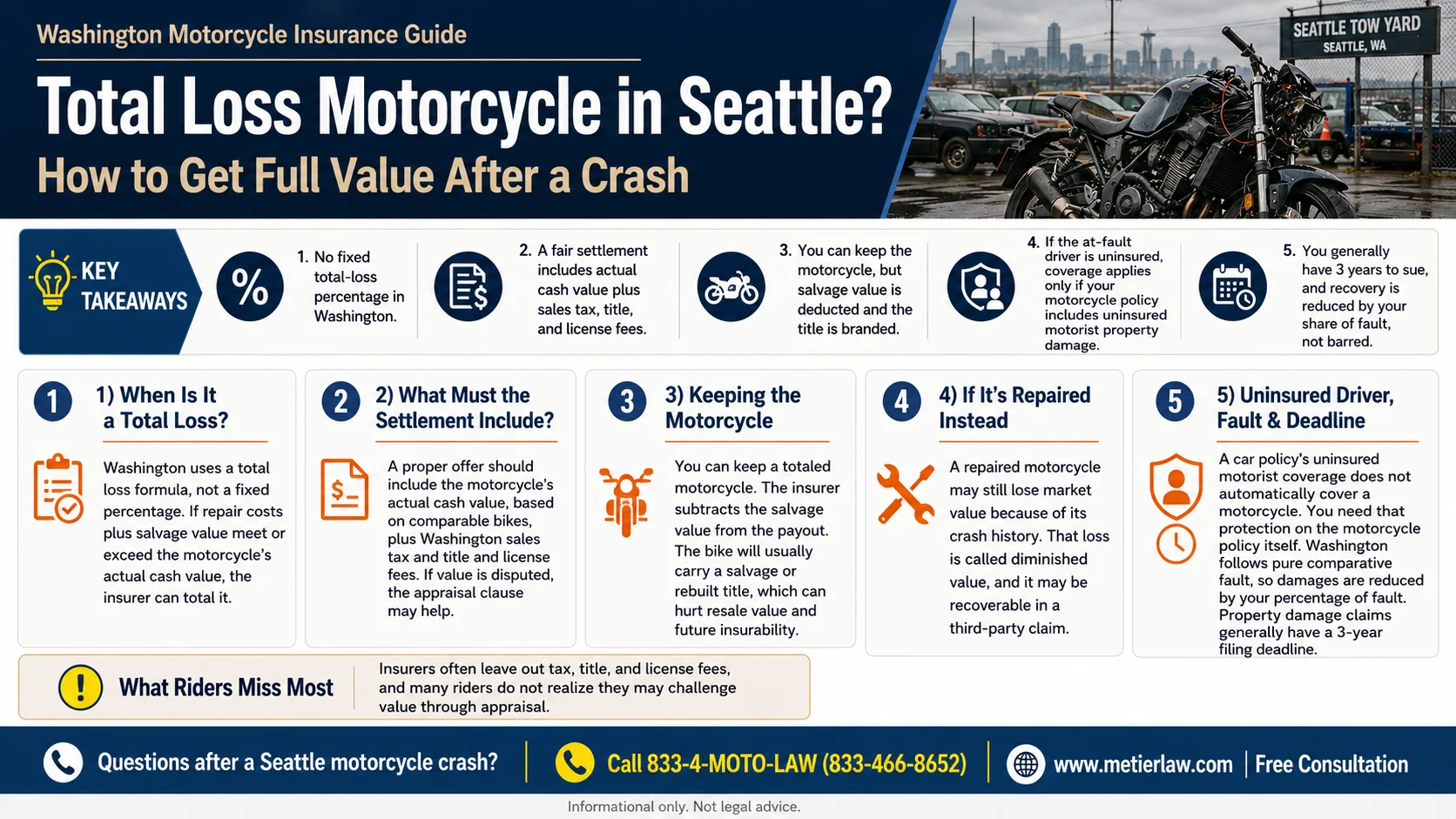
Washington skips the fixed percentage a lot of riders expect. Under WAC 284-30-320, your motorcycle is a total loss when the cost of parts and labor, plus the salvage value, meets or exceeds its actual cash value. Actual cash value is its fair market value right before the crash.
Add the repair cost to the salvage value. If the total reaches what the motorcycle was worth before the crash, the insurer can total it, and no percentage enters into the decision. On a total loss motorcycle claim in Seattle, the insurer controls both the repair estimate and the value it assigns your motorcycle. That is where the disagreement starts. Our breakdown of how insurers value a totaled motorcycle covers the custom-parts problem that trips up riders.
What a Fair Settlement Has to Include
Once your motorcycle is totaled, WAC 284-30-391 governs the settlement. The insurer can offer a comparable replacement, or pay cash based on the actual cash value of a comparable one, less any deductible. Comparable means real, itemized numbers from motorcycles actually for sale.
The settlement also has to include the taxes and fees you'd pay buying that replacement: Washington sales tax plus title and license fees, owed whether or not you keep the salvage. An offer that leaves them out falls short of what you're owed.
If you and the adjuster can't agree on the motorcycle's value, most policies carry an appraisal clause that either side can invoke to settle the actual cash value through independent appraisers.
Keeping Your Motorcycle: The Owner-Retained Salvage Trade-Off
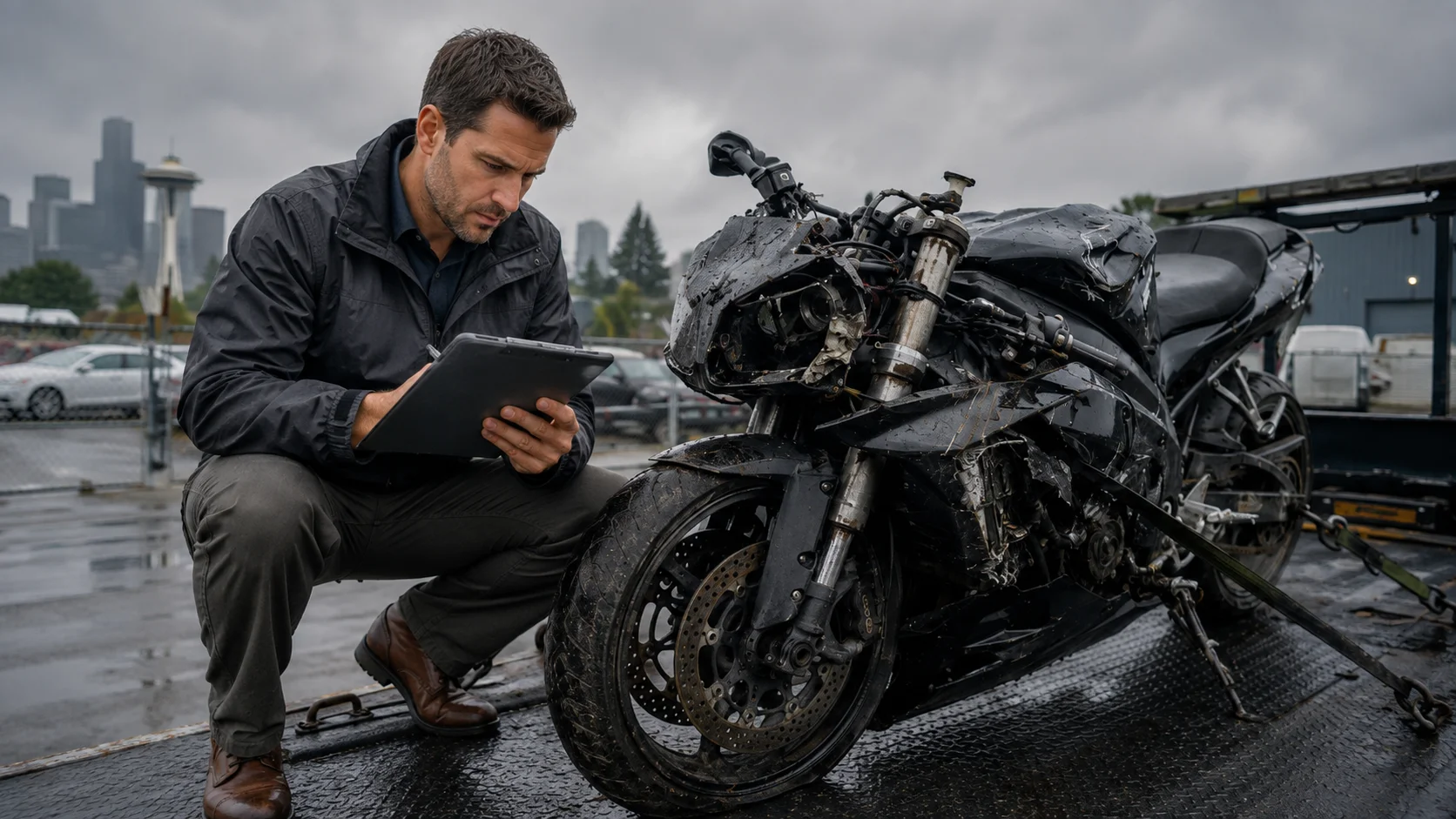
You don't have to sign your total loss motorcycle over. Keep it, and the insurer deducts the salvage value from your payout. On request, it also has to name a salvage buyer who will pay that same amount for at least 30 days.
Keeping it comes with a permanent mark on the title. A motorcycle kept after a total loss is branded with a salvage or rebuilt title, and that brand follows it. It drags down resale value and makes the motorcycle harder to insure or register later. Rebuilding a lightly damaged one yourself can pay off. A badly bent frame rarely does.
If Your Motorcycle Can Be Repaired: Diminished Value
Not every damaged motorcycle is a total loss. When the insurer repairs yours instead of totaling it, you can still lose money. A motorcycle with a crash on its history is worth less than an identical one without, even after a clean repair. Washington calls that gap diminished value. In Grothe v. Kushnivich, the Court of Appeals confirmed an owner can recover post-repair diminished value from the at-fault driver. That is a separate third-party claim, on top of the repair.
When the At-Fault Driver Has No Insurance
This is where Seattle and Tacoma riders get caught. If the driver who totaled your motorcycle carried no insurance, your own coverage becomes the realistic source of payment, because an uninsured driver rarely has assets worth pursuing. That coverage helps only if you carry uninsured motorist property damage on your motorcycle policy.
Washington's UM/UIM statute, RCW 48.22.030, carves motorcycles out of the coverage automatically built into an auto policy. It also lets insurers have you reject motorcycle UM/UIM in writing. So your car's uninsured motorist coverage won't pay for a loss you take while riding. You need it on the motorcycle policy itself, which is why it pays to know what coverage Washington requires before a crash. When it applies, expect a deductible: up to $100 on a standard underinsured property damage claim, and up to $300 for a hit-and-run or phantom vehicle. Riders hit by an uninsured or underinsured driver around Seattle know how fast that gap opens.

Fault and the Clock on Your Claim
Two more rules shape what you can recover on a total loss motorcycle claim. Under RCW 4.22.005, Washington follows pure comparative negligence. When the insurer pins part of the crash on you, your recovery drops by your percentage, but it is never wiped out. A rider found 20 percent at fault still recovers 80 percent of the motorcycle's value. Insurers know riders draw unfair blame, and they lean on it to shave what they owe.
A hard deadline applies too. Damage to your motorcycle counts as a property damage claim, and RCW 4.16.080 gives you three years from the crash to file suit. Settlement talks don't pause that clock. Miss it, and the claim is gone.
Frequently Asked Questions
Is my motorcycle a total loss in Washington if repairs cost more than it's worth?
Close. When repair costs plus salvage value meet or exceed the motorcycle's actual cash value, the insurer can declare a total loss. There's no fixed percentage cutoff in Washington's rules.
Does the insurance company have to pay sales tax on my totaled motorcycle in Seattle?
Yes. Under WAC 284-30-391, the settlement must include the sales tax plus title and license fees for a comparable replacement motorcycle. You're owed them whether or not you keep the salvage.
Can I keep my totaled motorcycle in Washington?
You can. After a total loss, the insurer subtracts the salvage value from your payout and, if you ask, must point you to a buyer who'll pay that amount. Just know the motorcycle will then carry a salvage or rebuilt title, which lowers its value and can complicate insuring or registering it.
What if the driver who totaled my motorcycle had no insurance?
Uninsured motorist property damage coverage can pay, but in Washington only if you carry it on your motorcycle policy. A car policy's uninsured motorist coverage won't reach a loss on a motorcycle, so check your declarations page before you need it.
How long do I have to file a claim for my totaled motorcycle in Washington?
Three years from the date of the crash, because it's a property damage claim under RCW 4.16.080. Talking with the insurer doesn't extend that deadline.
Make the Insurer Prove What Your Motorcycle Was Worth
A total loss offer is only the insurer's opening number. The actual cash value, the tax and fees, the appraisal option, and the coverage that applies when the other driver has nothing can each add to what you're owed. We ride, and we handle these claims across Seattle, Tacoma, and Washington as a Seattle motorcycle accident team. If your motorcycle was totaled and the offer doesn't add up, let us look before you sign.

Disclaimer: Past results discussed should not be considered a guarantee of your results as the factors of every case are individually unique. This content is for informational purposes only and does not constitute legal advice. Consult a qualified attorney from Metier Law Firm regarding your individual situation for legal advice.

Tell Us About Your Case – Free Case Review with a Personal Injury Lawyer
(866) 377-3800Our Locations
.webp)
Do I have a Case?
How Much Should I Be Offered?
Do I Need an Attorney?
If these questions have crossed your mind, let us help. You may need a little direction or may not need an attorney at all, but you deserve to be confident knowing your options. We can provide you with information about our Attorneys of the West® accident investigations and legal services. Your confidential consultation with us is totally free.
Keep up with us!
