.svg)


TL;DR: Key Points
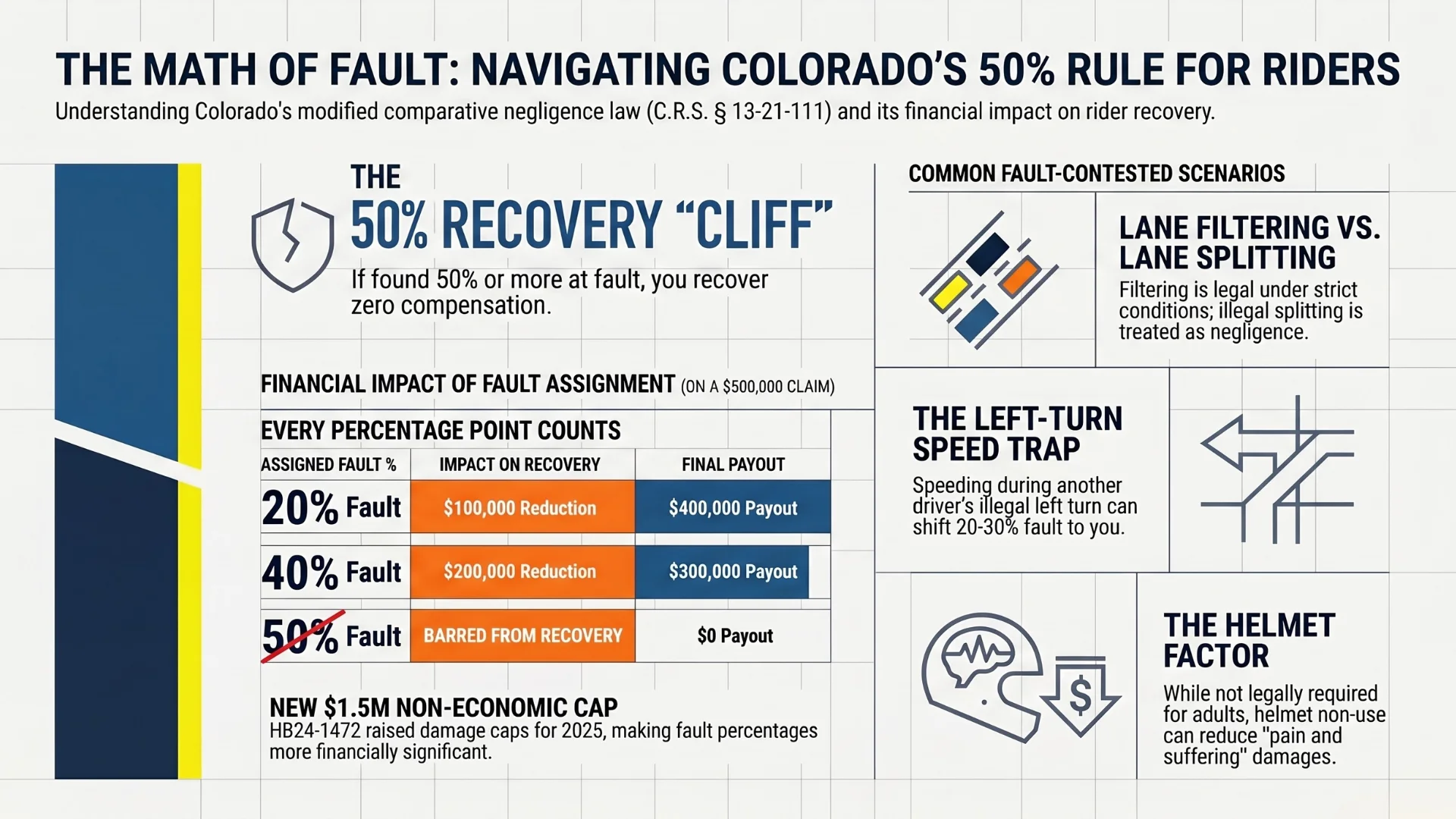
- Colorado follows modified comparative negligence under C.R.S. § 13-21-111 — if you're 50% or more at fault, you can't recover anything.
- Your damages are reduced by your percentage of fault. At 20% fault on a $500K claim, you walk away with $400K. At 40% fault, you collect $300K.
- Insurance adjusters routinely try to push fault percentages higher to reduce what they owe — especially against riders.
- Denver crash scenarios like left-turn accidents, lane-splitting, and helmet non-use all affect how fault gets assigned.
- HB24-1472 raised Colorado's non-economic damages cap to $1.5 million for claims filed on or after January 1, 2025 — which makes fault percentages matter even more.
You didn't expect to be in a crash. Nobody does. But now you're dealing with the aftermath, and the other driver's insurance company is already on the phone suggesting you were "partially at fault." Maybe the adjuster mentions you were speeding a little. Maybe you weren't wearing a helmet. Maybe the crash happened during a left-turn scenario on Colorado Boulevard where these things get murky fast.
Here's what you need to know: partial fault does not automatically kill your Denver motorcycle accident claim. But it can seriously shrink it. And in Colorado, the line between recovering compensation and recovering nothing at all can come down to a single percentage point.
Call Metier Law Firm at 833-4MOTO-LAW (833-466-8652) or schedule your free consultation today at www.metierlaw.com
"Shared fault cases are where injured riders lose the most money," says Patrick DiBenedetto, Partner at Metier Law Firm. "Insurance companies know the law. They know that pushing your fault number up by 10 or 15 percent saves them tens of thousands of dollars. Our job is to fight that number with evidence."
What Colorado's Modified Comparative Negligence Law Actually Says
Colorado's fault framework is spelled out in C.R.S. § 13-21-111. The core rule is this: your negligence doesn't bar recovery unless it's "as great as" the negligence of the person you're suing. In plain English, if you're 49% at fault or less, you can still recover — your damages just get reduced by your fault percentage. But if you hit 50% fault or more, you're completely barred from recovering anything.
That's the 50% Bar. And it's the number insurance adjusters are always trying to reach.
This is what makes every Denver comparative fault motorcycle accident case a numbers fight. The question isn't just whether the other driver was negligent. The question is how the fault gets divided, and who controls the narrative around that division.
How the Math Works in Real Claims
Say you've been hurt in a crash on South Colorado Boulevard. Your documented damages total $500,000 — medical bills, lost wages, pain and suffering, all of it. Here's how your fault percentage directly affects what you recover:
At 20% fault, your $500K claim yields $400,000. At 40% fault, that same claim produces $300,000. The difference between those two outcomes is $100,000. And that's before you factor in the new non-economic damages cap under HB24-1472, which raised the limit to $1.5 million for claims filed on or after January 1, 2025.
More money potentially on the table means the fight over fault percentages has higher stakes than ever.
Call Metier Law Firm at 833-4MOTO-LAW (833-466-8652) or schedule your free consultation today at www.metierlaw.com
Denver Crash Scenarios Where Shared Fault Comes Up
Not every motorcycle crash plays out cleanly. These are the situations we see most often in Denver where fault becomes contested:
Left-Turn Accidents
These are the most common shared fault scenarios in Denver. A driver turning left across your lane is almost always the primary at-fault party. But if you were speeding — even slightly — that gets factored in. Adjusters will argue your speed gave the driver less time to clear the intersection. That's how 0% fault on your end becomes 20% or 30% in their version.
Lane-Splitting and Lane Filtering
These two things are not the same, and the legal distinction matters a lot if you're involved in a crash.
Lane-splitting — riding between lanes of moving traffic — is still illegal in Colorado. If you were splitting lanes when your crash happened, expect that to be treated as evidence of your negligence and factored into your fault percentage.
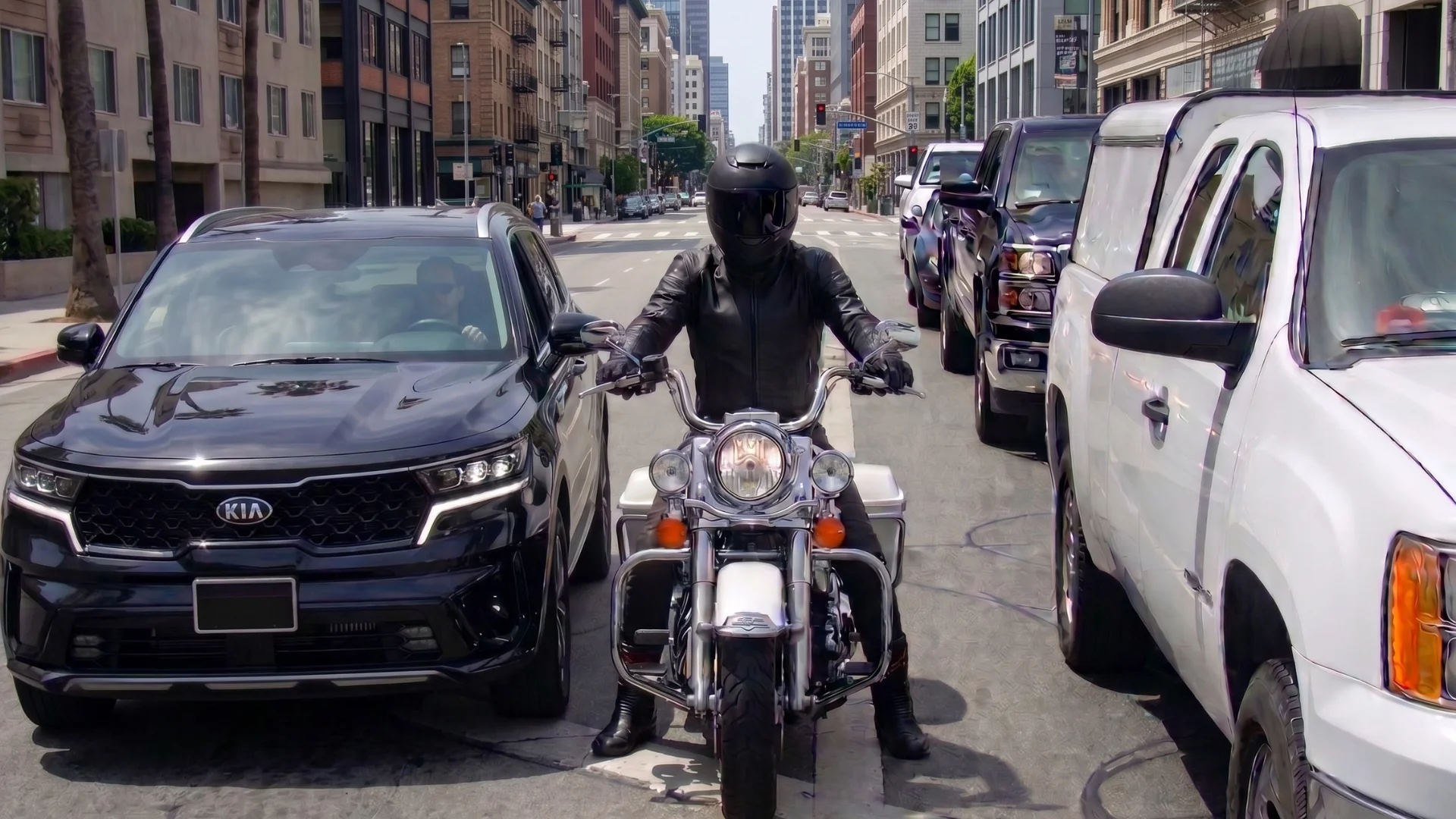
Lane filtering is a different story. Under Senate Bill 24-079 (now C.R.S. § 42-4-1503 as law), which took effect August 7, 2024, lane filtering is legal statewide through September 1, 2027. Riders can pass between stopped vehicles as long as traffic is completely stopped, the lane is wide enough to pass safely, and the motorcycle stays at 15 mph or under. CDOT has published the full conditions on their lane filtering page.
That said, legal doesn't mean fault-free. Because the motorcyclist is the only moving vehicle during a lane filter, insurance adjusters may try to use the maneuver itself as a basis for assigning you partial fault if a collision occurs. How you executed the filter — your speed, lane width, and whether traffic was fully stopped — will all come under scrutiny. Following the conditions set out in SB24-079 to the letter is your best protection against that argument.
Failure-to-Signal Incidents
If another driver changed lanes without signaling and hit you, that's negligence on their part. But if evidence suggests you were in their blind spot or riding in an area of the lane where you were less visible, adjusters may try to assign you partial fault for your positioning. This is where dashcam footage and witness statements become critical.
Helmet Non-Use and Its Impact on Damages
Colorado doesn't have a universal helmet law for adults. But not wearing a helmet absolutely factors into damages in a Denver motorcycle accident claim. If your head injuries are part of your claim and you weren't wearing a helmet, the defense will argue those injuries were worsened by your own choice. Under Colorado's comparative negligence framework, that can reduce your non-economic damages, specifically the pain and suffering component, even if it doesn't bar your claim entirely.
If you've been hurt in a motorcycle crash and need answers, call us at 833-4MOTO-LAW (833-466-8652) or schedule a free consultation at www.metierlaw.com.
How Insurance Adjusters Use the 50% Bar Against Riders
Insurance adjusters aren't neutral fact-finders. Their job is to minimize what their company pays. And Colorado's modified comparative negligence law gives them a very specific tool to do that.
When they contact you early — and they will — they're gathering information to build a fault narrative that pushes your number up. A recorded statement where you say something like "I may not have been paying full attention" can be used to bump your assigned fault from 20% to 35%. That shift alone, on a $500K claim, costs you $75,000.
This is exactly what we mean when we say don't talk to the other driver's insurance company without legal representation. For a deeper look at how fault is determined in Colorado claims generally, you can read our post on at-fault accidents and everything you need to know. For a broader overview of Colorado motorcycle law questions including comparative fault basics, check our Colorado Edition: Top 10 Legal Questions About Motorcycle Accidents.
Call Metier Law Firm at 833-4MOTO-LAW (833-466-8652) or schedule your free consultation today at www.metierlaw.com
What Evidence Controls the Fault Percentage
Fault isn't assigned based on gut feeling. It's built from evidence. Here's what matters most in a Denver comparative fault motorcycle accident case:
The police report is a starting point, not a final answer. Officers reconstruct what happened based on statements and physical evidence, and their conclusions can be challenged. Dashcam footage and traffic camera video, if preserved quickly, can be decisive. Witness statements from other drivers, pedestrians, or cyclists who saw the crash carry real weight.
Accident reconstruction specialists sometimes come in on high-stakes cases to analyze speeds, braking distances, and impact angles. Medical records help document what your actual injuries were, which directly connects to the non-economic damages calculation under HB24-1472. And your own account of what happened, documented early and clearly, is part of how your attorney builds the counter-narrative to the adjuster's version.
The NHTSA's motorcycle safety data and Colorado Department of Transportation crash reporting can also provide statistical context that supports arguments about typical fault distributions in specific crash types.
The HB24-1472 Factor: Why This Matters More Now
Before January 1, 2025, Colorado's non-economic damages cap was significantly lower. HB24-1472 changed that, raising the cap to $1.5 million for most personal injury claims filed on or after that date. For wrongful death claims, the cap is now $2.125 million.
What this means practically: the potential value of a serious motorcycle injury claim in Denver just got substantially larger. And that means the fault percentage fight got more expensive. A 10-percentage-point swing in fault allocation on a high-value claim under the new caps can represent hundreds of thousands of dollars. If your crash happened after January 1, 2025, this is the legal environment your claim lives in.

Frequently Asked Questions
What is Colorado's 50% bar rule for motorcycle accidents?
Under C.R.S. § 13-21-111, if you're found 50% or more at fault for a crash, you're barred from recovering any compensation. If your fault is 49% or less, you can still recover, but your damages are reduced by your fault percentage. This is Colorado's modified comparative negligence rule, and it applies to Denver motorcycle accident claims the same as any other personal injury case in the state.
How does my fault percentage reduce my Denver motorcycle settlement?
Your settlement is reduced dollar-for-dollar by your assigned fault percentage. If a jury or insurer assigns you 25% fault on a $400,000 claim, your recovery drops to $300,000. At 40% fault, the same claim yields $240,000. The 50% threshold is where recovery goes to zero — which is why fault allocation is often the central legal battle in shared fault motorcycle crash cases in Denver.
Does not wearing a helmet affect my motorcycle accident claim in Colorado?
It can affect your damages, specifically the portion tied to head and brain injuries. Colorado doesn't require helmets for adult riders, but the defense will argue that helmet non-use worsened your injuries and contributed to your own harm. This can factor into comparative fault calculations and reduce your non-economic damages. It typically doesn't bar your claim entirely, but it's a legitimate risk that needs to be managed with evidence.
Can I recover compensation if I was lane-splitting when the crash happened?
Lane-splitting is illegal in Colorado, so it's likely to be treated as evidence of your negligence. Whether it bars your claim depends on how much fault it contributes to the overall picture. If the other driver's conduct was the primary cause of the crash, you may still recover — just with a higher fault percentage assigned to you. Every case is different, which is why getting a motorcycle accident attorney in Denver involved early is the right move.
How does HB24-1472 affect my Denver motorcycle accident claim?
If your claim was filed on or after January 1, 2025, the non-economic damages cap under HB24-1472 applies, which raises the cap to $1.5 million for most personal injury cases. That's a major increase from prior limits. For wrongful death claims, the cap is now $2.125 million. The practical effect is that serious claims have higher ceilings than they did before 2025, which makes the fight over fault percentages even more consequential.
Call Metier Law Firm at 833-4MOTO-LAW (833-466-8652) or schedule your free consultation today at www.metierlaw.com
We Know the Difference Between 49% and 50%
At Metier Law Firm, we've seen what happens when riders try to navigate these fault arguments without experienced legal support. Insurance companies are good at what they do. They'll use your own words, your helmet choice, your speed, your lane position. They'll do whatever they can to get that fault number to 50% — because that's where they pay nothing.
Our Denver motorcycle accident lawyers ride. We understand the road dynamics that produce these crashes. And we understand Colorado's modified comparative negligence law from the inside out. We build the evidence, we push back on inflated fault assessments, and we protect your recovery.
The difference between 20% fault and 40% fault on a serious claim can be $100,000 or more. The difference between 49% and 50% is your entire case. Those numbers are worth fighting for.
Call Metier Motorcycle Lawyers at 833-4MOTO-LAW (833-466-8652) or schedule your free consultation today at www.metierlaw.com.
Disclaimer: Past results discussed should not be considered a guarantee of your results as the factors of every case are individually unique. This content is for informational purposes only and does not constitute legal advice. Consult a qualified attorney from Metier Law Firm regarding your individual situation for legal advice.
Tell Us About Your Case – Free Case Review with a Personal Injury Lawyer
(866) 377-3800Our Locations
.webp)
Do I have a Case?
How Much Should I Be Offered?
Do I Need an Attorney?
If these questions have crossed your mind, let us help. You may need a little direction or may not need an attorney at all, but you deserve to be confident knowing your options. We can provide you with information about our Attorneys of the West® accident investigations and legal services. Your confidential consultation with us is totally free.
Keep up with us!
