.svg)


TL;DR – Key Takeaways
- A left-turn crash, where a car turns left across an oncoming rider, is the single most common motorcycle-versus-car collision. NHTSA puts 45% of two-vehicle fatal crashes involving a motorcycle and another vehicle in this category.
- In Colorado, a driver turning left must yield to oncoming traffic under C.R.S. § 42-4-702. Turning into an oncoming rider almost always means the driver failed to yield.
- "I didn't see the motorcycle" is the most common thing drivers say after a Fort Collins motorcycle left-turn accident. It is not a legal defense.
- Fault is proven with evidence: point of impact, your right of way, witnesses, intersection and business cameras, the police report, and the driver's own statement.
- Colorado's comparative fault rule (C.R.S. § 13-21-111) only bars recovery if you're 50% or more at fault. Insurers push your number up to get there.
You're rolling north through a green light on College Avenue, and a car waiting in the oncoming turn lane suddenly swings left across your path. You're on the brakes before you finish the thought. Sometimes there's room. Often there isn't. If you ride in Fort Collins, you already know this one, because it's the crash that puts more riders on the pavement than any other. A Fort Collins motorcycle left-turn accident happens in the space of a heartbeat, and it almost always starts with a driver who crossed a right of way that wasn't theirs to take.
We see these cases constantly. According to the National Highway Traffic Safety Administration (NHTSA), 45% of two-vehicle fatal crashes involving a motorcycle and another vehicle in 2024 happened when the other vehicle was turning left while the rider was going straight, passing, or overtaking. That's not a fluke pattern. That's the defining crash for people on two wheels. "In a left-turn crash, the law is usually on the rider's side from the first second," says Patrick DiBenedetto, Partner at Metier Law Firm and a motorcycle rider himself. "The driver crossed your right of way. Our job is to make the evidence say that as plainly as the statute already does."
Call Metier Law Firm at 833-4MOTO-LAW (833-466-8652) or schedule your free consultation today at www.metierlaw.com
How a Left-Turn Motorcycle Crash Actually Happens
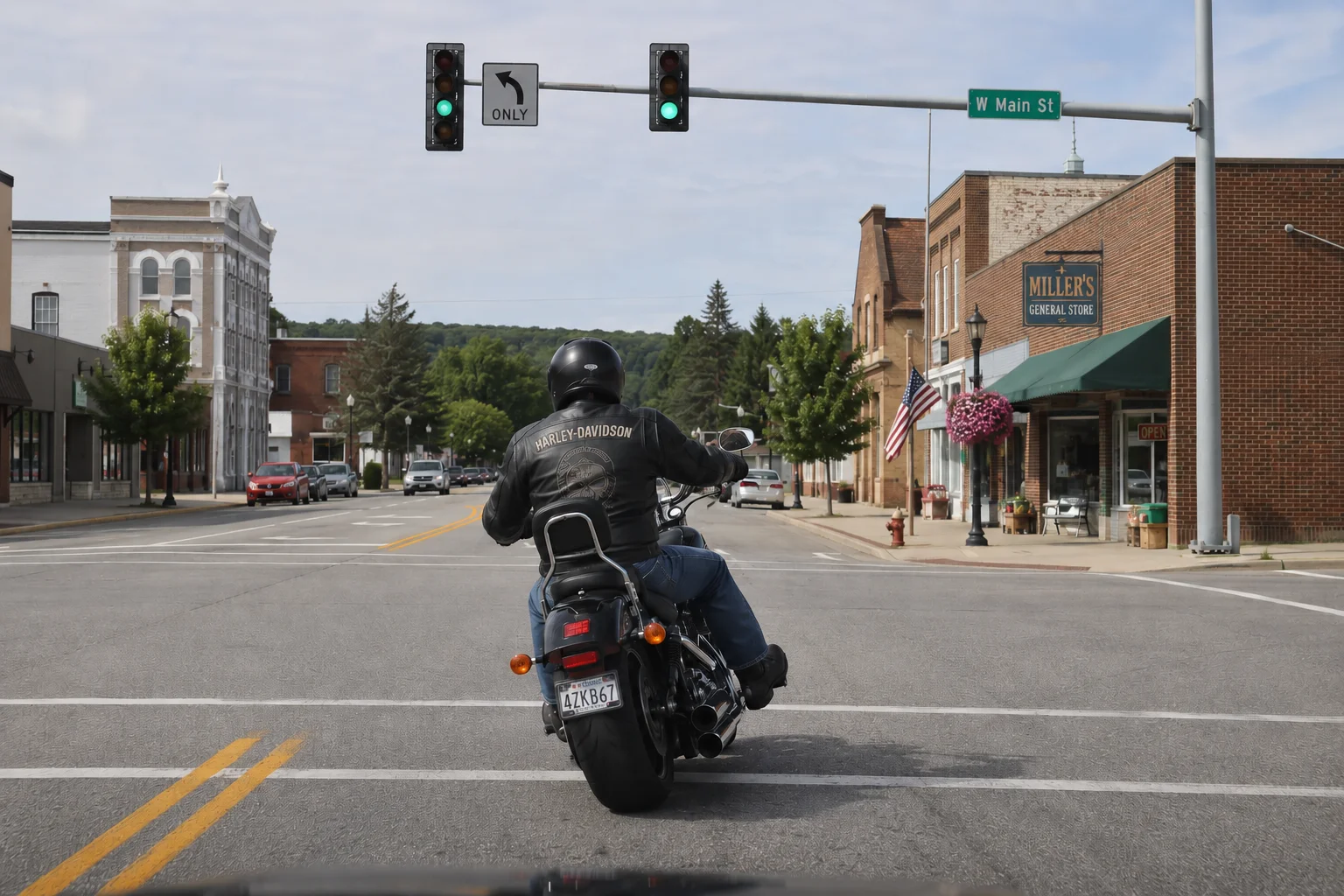
A left-turn collision follows the same geometry almost every time. You're traveling straight through an intersection with the right of way. A driver coming the other direction decides the gap is big enough, turns across your lane, and puts the side of their car where your front wheel is about to be. Because the hit lands on the front of the bike, you get almost no time to brake or swerve, and the crash tends to throw the rider forward. NHTSA data shows about three out of four motorcycles in two-vehicle crashes are struck in the front.
The College Avenue corridor, Harmony Road, and Mulberry Street give this oncoming left-turn motorcycle crash everything it needs: heavy turning traffic, multiple lanes, and drivers focused on the gap instead of the rider filling it.
Why Drivers "Don't See" Riders
The most common thing a driver says afterward is some version of "I just didn't see the motorcycle." It's frustrating, and it's also predictable. A motorcycle is a narrow target. It hides behind a windshield pillar, blends into background traffic, and gives a driver less to work with when judging speed and distance. NHTSA reports that a large share of motorcycle crashes trace back to drivers simply failing to register the rider at all.
Here's the part that matters for your claim. Not seeing you is not a defense. A driver is required to look for and yield to oncoming traffic before turning. Missing you doesn't excuse the turn. It explains the failure.
Call Metier Law Firm at 833-4MOTO-LAW (833-466-8652) or schedule your free consultation today at www.metierlaw.com
Who's at Fault in a Fort Collins Motorcycle Left-Turn Accident
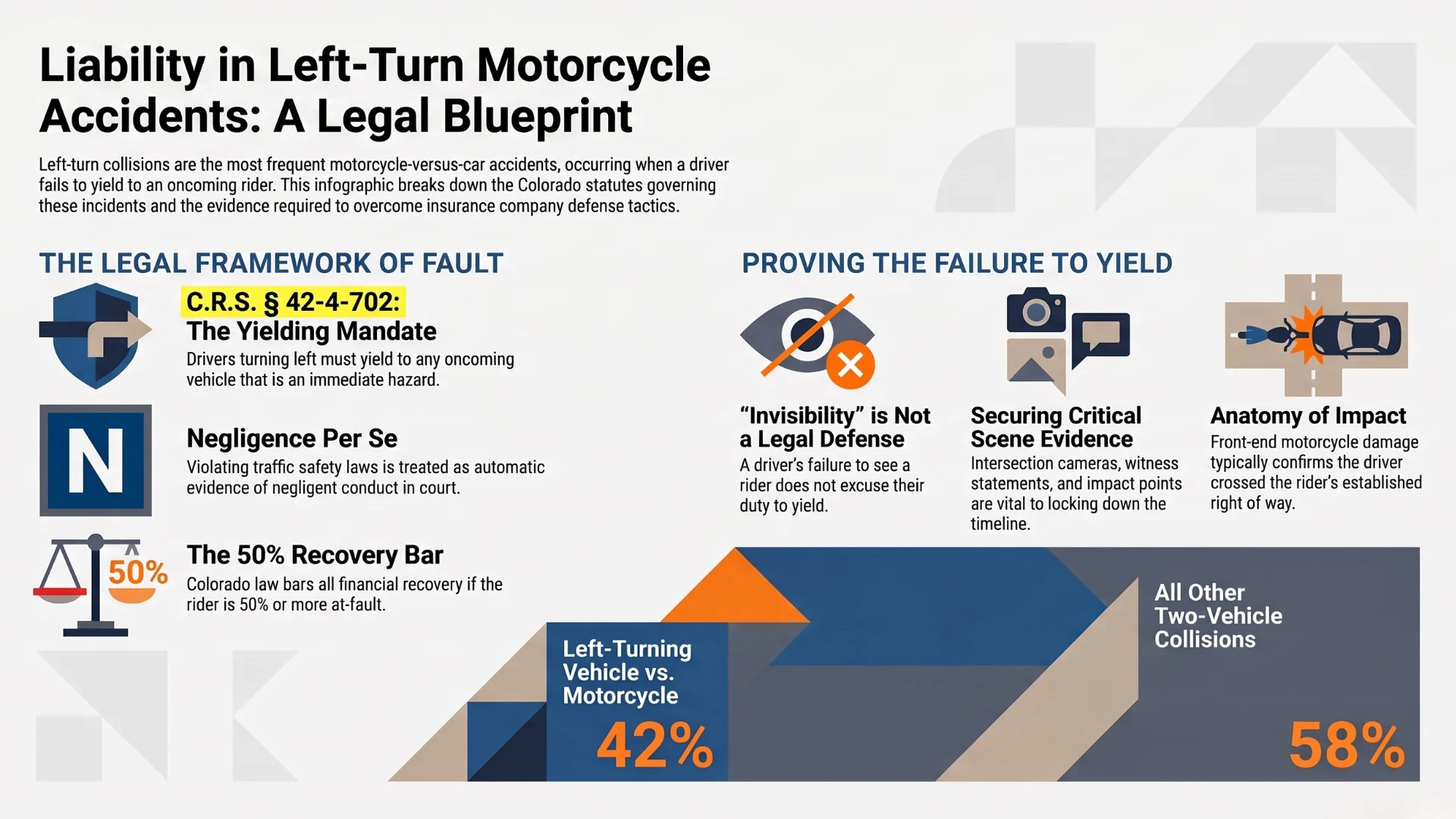
Colorado law is unusually clear here. Under C.R.S. § 42-4-702, a driver turning left must yield the right of way to any vehicle approaching from the opposite direction that's close enough to be an immediate hazard. There are no exceptions written into it. When a driver turns left and hits an oncoming rider, they've almost always broken that statute, and that violation is a class A traffic infraction.
In a civil injury claim, breaking a safety law like this one can count as negligence per se. That means the driver's conduct is treated as negligent because they violated a law built to prevent exactly this kind of crash. That's why motorcycle left turn accident fault usually points hard at the turning driver.
The word "usually" is doing real work in that sentence, though. The at-fault driver's insurance company will look for any reason to move some of the blame onto you.
The Evidence That Proves Failure to Yield
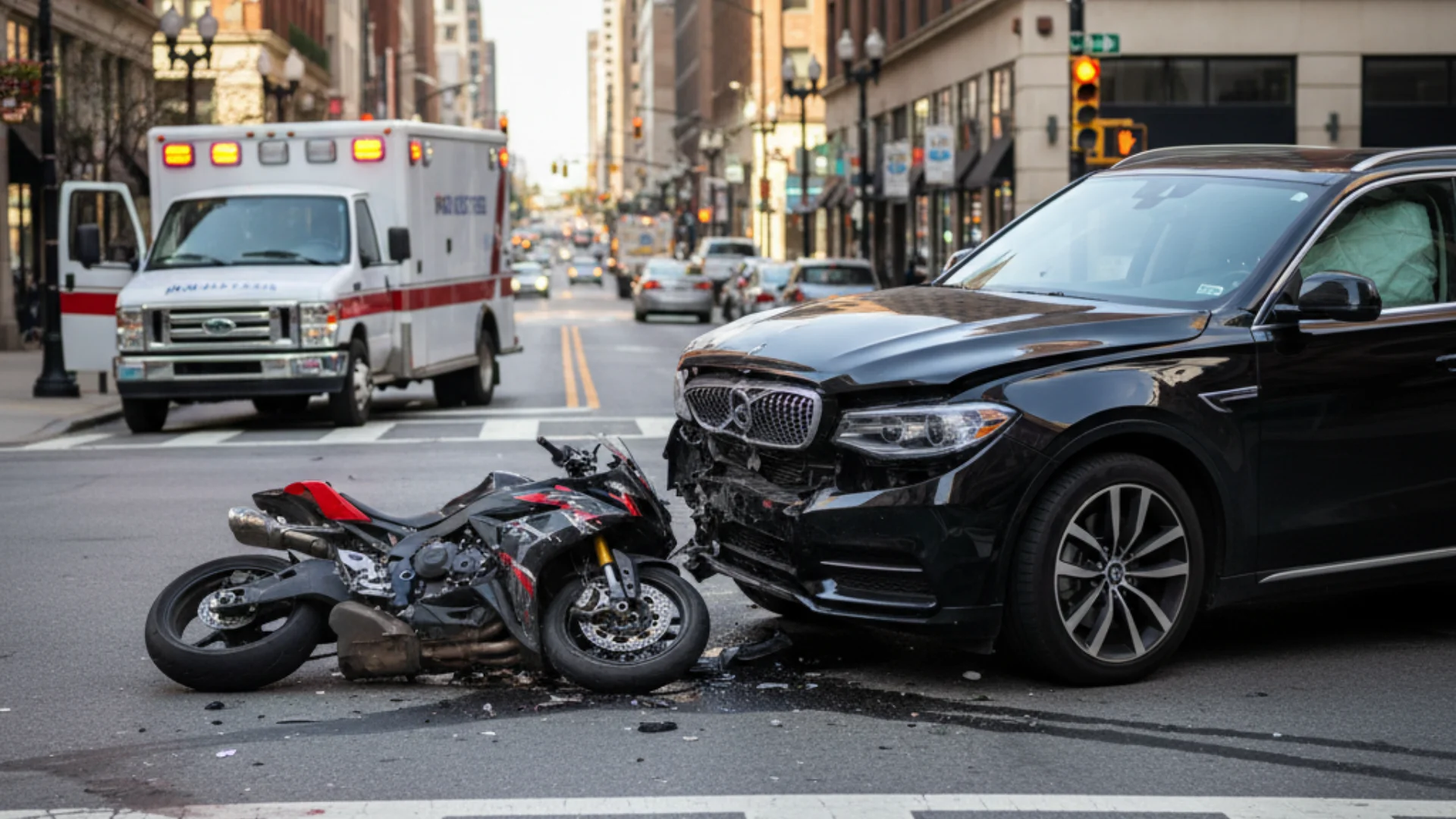
Establishing the turning driver's fault comes down to what you can document. The point of impact tells the story first. Damage to the side of the car and the front of your bike, plus where both ended up resting, lets a reconstruction expert show who was where. Your right of way is built into the traffic pattern itself. Independent witnesses carry real weight, so get names and numbers before anyone leaves the scene.
Many Fort Collins intersections, and the businesses lining College, Harmony, and Mulberry, run cameras, and that footage can be overwritten within days. The police report, the driver's own words at the scene, and data pulled from the vehicles can lock the timeline down. Photograph everything, keep your damaged gear, and don't let the bike get repaired until your case is documented. A failure to yield is easy to argue when the evidence is still fresh and far harder once it's gone.
If you've been hurt in a motorcycle crash and need answers, call us at 833-4MOTO-LAW (833-466-8652) or schedule a free consultation at www.metierlaw.com.
How Colorado's Comparative Fault Rule Affects Your Payout
Even when a car turned left into your motorcycle and the fault looks obvious, the size of your recovery can still come down to a percentage. Colorado uses modified comparative fault under C.R.S. § 13-21-111. You can recover as long as you're less than 50% at fault, and your award is reduced by whatever share gets assigned to you. Cross that 50% line and you recover nothing.
So the insurer's whole game is to push your number up. They'll argue you were speeding, that your lane position was wrong, or that your headlight was off. Every point they add to you is money they keep. If you want the full breakdown of how Colorado comparative fault motorcycle claims get fought, we walk through it in our guide to Colorado's 50% rule. A Fort Collins motorcycle accident lawyer can answer that pressure with the evidence that keeps your fault where it belongs.
Frequently Asked Fort Collins Left Turn Accident Motorcycle Questions
Who is at fault if a car turned left into my motorcycle in Fort Collins?
In most cases, the turning driver. Colorado's left-turn law (C.R.S. § 42-4-702) requires drivers to yield to oncoming traffic before crossing it. A driver who turns left into an oncoming rider has almost certainly failed to yield, which makes them the at-fault party. Your fault only enters the picture if something you did, like speeding, also contributed to the crash.
Is the driver automatically at fault for a left-turn motorcycle accident?
Not automatically, but close. Failure to yield is strong evidence of fault and can support a negligence per se argument. Fault still has to be proven, and the other side will contest it. That's the gap between a left turn collision who is at fault on paper and a claim that actually pays what your injuries are worth.
The insurance company says I was partly to blame. Does that end my claim?
No. Under Colorado's comparative fault rule, you can still recover as long as you're under 50% at fault. Your payment is reduced by your share, so the fight is about keeping that percentage low. Don't treat the adjuster's number as the final word.
How long do I have to file a motorcycle accident claim in Colorado?
Three years from the date of the crash for most motor vehicle injury cases, under C.R.S. § 13-80-101(1)(n). Camera footage and witness memory fade long before that deadline, so the sooner you start, the stronger your claim.
You Had the Right of Way. Your Claim Should Say So.
A car turning left across your lane can take your health, your income, and your confidence on roads you've ridden for years. The law gave you the right of way at that intersection, and a Fort Collins motorcycle left-turn accident claim should reflect that from the first phone call. We ride these roads, we know how Larimer County crashes get investigated, and we know how local insurers argue fault. If a driver turned into your path, you don't have to sort out the evidence alone.
As a motorcycle accident lawyer team that rides these roads ourselves, we bring that same approach to riders throughout Colorado. Our Denver motorcycle accident lawyers handle left-turn claims with that same attention to fault, and our Colorado Springs motorcycle accident lawyers apply it for riders further south.
Call Metier Motorcycle Lawyers at 833-4MOTO-LAW (833-466-8652) or schedule your free consultation today at www.metierlaw.com.
Disclaimer: Past results discussed should not be considered a guarantee of your results as the factors of every case are individually unique. This content is for informational purposes only and does not constitute legal advice. Consult a qualified attorney from Metier Law Firm regarding your individual situation for legal advice.
If You've Been Injured In A Motorcycle Crash, Call Today - (833) 4MOTO-LAW
Tell Us About Your Case – Free Case Review with a Personal Injury Lawyer
(866) 377-3800Our Locations
.webp)
Do I have a Case?
How Much Should I Be Offered?
Do I Need an Attorney?
If these questions have crossed your mind, let us help. You may need a little direction or may not need an attorney at all, but you deserve to be confident knowing your options. We can provide you with information about our Attorneys of the West® accident investigations and legal services. Your confidential consultation with us is totally free.
Keep up with us!
