.svg)


TL;DR - Key Takeaways
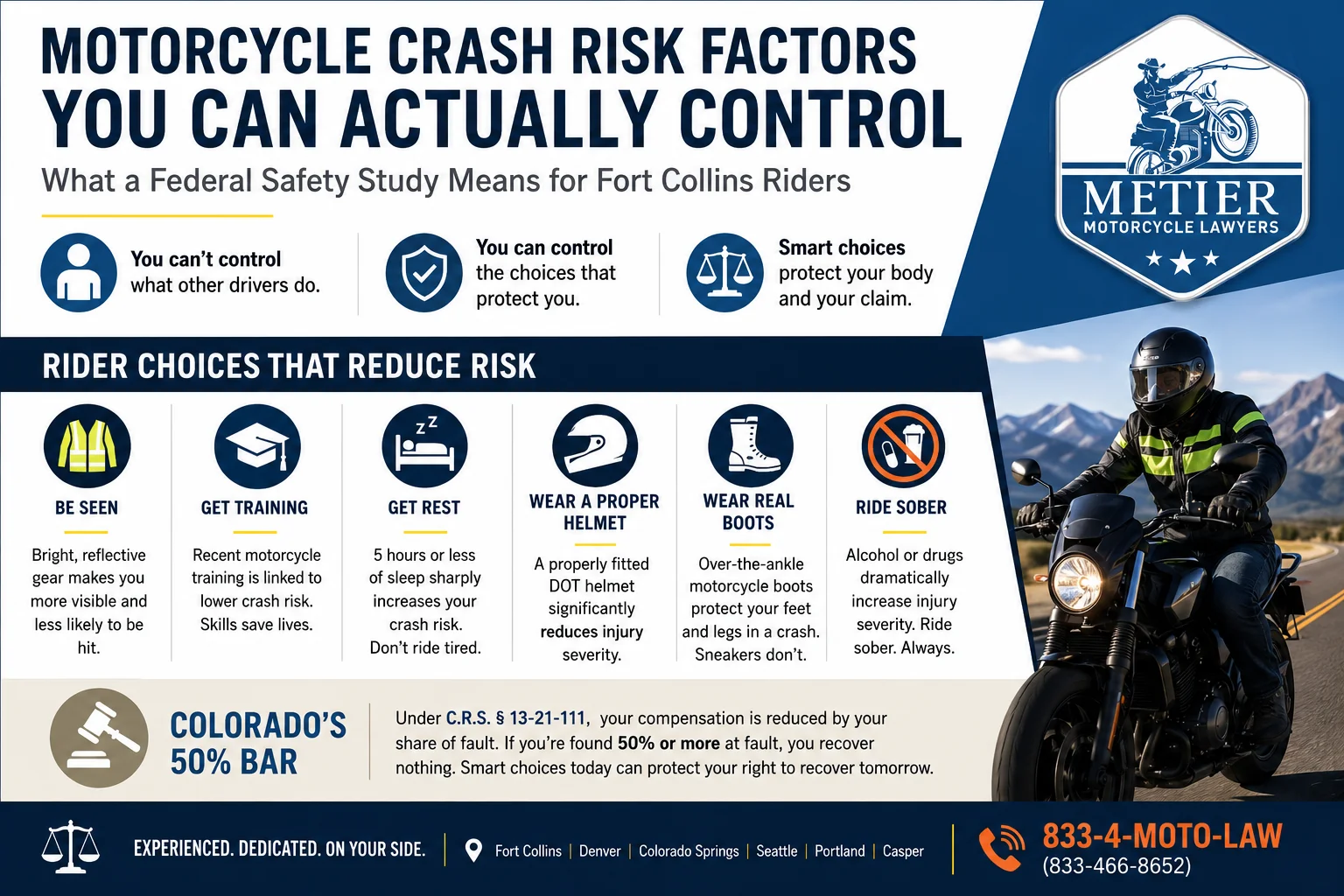
- A federally funded study found that several rider choices are tied to crash risk and injury severity: low conspicuity, little sleep, no recent training, impairment, poor helmet fit, and footwear.
- You can't control the driver who turns across your lane, but bright gear, recent training, rest, sobriety, a properly fitted DOT helmet, and real motorcycle boots are within your control.
- Colorado follows modified comparative fault with a 50% bar under C.R.S. Section 13-21-111, so a rider found 50% or more at fault recovers nothing.
- Colorado doesn't require adult riders to wear helmets, so not wearing one doesn't by itself assign fault, but your gear and training choices still affect both your body and your claim.
Every Larimer County riding season brings the same frustrating truth into our office. Most of the injured riders we represent did nothing wrong in the moment of the crash. A driver misjudged their speed at a College Avenue intersection, or drifted into their lane on Highway 14 toward the Poudre Canyon. You can't control that driver. What the research shows is that a handful of choices you make before you start the engine change your odds of walking away, and change how a later claim holds up. I'm Patrick DiBenedetto, a partner at Metier Law Firm and a rider myself. "Riders ask me how to protect a claim they don't even have yet," I tell clients. "The same gear that protects your body protects your case."
In 2023, 135 motorcyclists were killed on Colorado roads, according to the Colorado Department of Transportation.
Riders make up roughly 3 percent of registered vehicles in the state yet account for close to a fifth of traffic deaths. Those numbers are why the research matters, and why a good Fort Collins motorcycle accident lawyer pays attention to what the data says about preventable risk.
What the Federal Study Actually Measured
After Congress ordered the most comprehensive look at motorcycle crashes in more than 30 years, researchers analyzed the federal Motorcycle Crash Causation Study through the University of North Carolina Highway Safety Research Center. You can read the full report here. The team compared riders in injury crashes against similar riders who weren't, and the factors carrying the most weight weren't luck. They were choices, and they show up in almost every case we handle, right alongside the other factors that can affect your motorcycle accident claim.
Increase Your Chances of Being Seen
The study found that riders in dark, non-reflective upper-body clothing had substantially higher odds of an injury crash than riders who stood out. Retroreflective clothing was tied to lower injury severity when a crash did happen. This matches decades of earlier work showing that riders who are easy to see are less likely to have their right of way violated. A high-visibility jacket can be the difference between a driver seeing you and looking straight through you. For a rider commuting near the CSU campus in low morning light, that margin is real.
Training: Recent Instruction Lowers Crash Odds
Riders who had completed formal training in recent years showed markedly lower odds of crash involvement than those who had not, and the effect held up across the study's models. Motorcycle rider training in Colorado has improved over the years, and a refresher course is worth it even for experienced riders. Skills fade. A course that sharpens your emergency braking and swerving gives you options in the half-second that decides a crash.
Rest: Five Hours or Less Changes Everything
Riders who had five hours of sleep or less before their trip had sharply higher odds of an injury crash. Riding on low sleep dulls the same reflexes you count on to react to a driver's mistake. If you’re exhausted, the safest ride is the one you postpone.
Gear That Reduces Injury When a Crash Happens
A Properly Fitted DOT Helmet
The study found that riders with an acceptable helmet fit had significantly lower injury severity than riders whose helmets did not fit well. A DOT-compliant helmet that actually fits your head does its job. One that is loose or too large gives up much of its protection. Fit is not a detail. It is the whole point of the helmet.
Real Motorcycle Boots, Not Sneakers
The research found that riders in motorcycle-specific footwear had lower injury severity, and noted that legs and feet are among the body regions most often injured in a crash. The study measured proper footwear, not a head-to-head test of boots versus sneakers, but the takeaway’s plain. Over-the-ankle motorcycle boots protect the parts of you that hit the ground and the bike. Sneakers and sandals don’t.
Impairment Raises the Stakes
Riders with a positive blood alcohol concentration had dramatically higher injury severity scores, and the study's authors recommended preventing riding while impaired by alcohol or drugs. CDOT data tells the same story, with a significant share of Colorado motorcycle fatalities involving an impaired rider or driver. Certain prescription medications carry the same risk. Riding sober is the clearest line between a good ride and a bad outcome.
Where Colorado Law Comes In: The 50% Bar
Colorado uses modified comparative fault under C.R.S. Section 13-21-111. Your compensation gets reduced by your share of fault, and if you're found 50 percent or more at fault, you recover nothing. That's the 50 percent bar. A rider who's 49 percent at fault still recovers, reduced by that share. A rider who crosses to 50 percent walks away with nothing. We've broken down exactly how that math plays out in real claims in our guide to how Colorado's 50% rule affects your claim.
Insurers use this statute to build arguments that push your share of fault higher. If you were in dark clothing with no training and a loose helmet, expect the insurance company to argue those choices made your injuries worse and your fault share greater. Your controllable choices become their leverage, which is why an experienced Fort Collins motorcycle accident lawyer prepares for that fight early.
Colorado doesn’t require adult riders to wear a helmet. Under C.R.S. Section 42-4-1502, only riders and passengers under 18 must wear one. Because riding without a helmet’s legal for adults, that choice doesn’t automatically assign you fault for the crash. But an insurer can still argue helmet non-use worsened specific head or facial injuries, shaving your recovery on those damages. The gear choices here protect you twice: your body in the crash, and your claim afterward.

Frequently Asked Questions
Does not wearing a helmet mean I'm at fault for my Colorado motorcycle crash?
No. Colorado doesn’t require adult riders to wear a helmet, so choosing not to wear one doesn’t automatically assign you fault for the crash itself. An insurer can still argue that helmet non-use made specific head or facial injuries worse, which can reduce your recovery on those particular damages. That’s different from being blamed for the crash. A Fort Collins motorcycle accident lawyer can push back on an insurer that tries to stretch this argument.
How does Colorado's comparative fault rule affect my motorcycle accident claim?
Colorado follows modified comparative fault under C.R.S. Section 13-21-111. Your compensation is reduced by your percentage of fault, and if you’re found 50 percent or more at fault, you recover nothing. This is why insurers work to raise your share of fault, and why the choices you can control, like training and conspicuity gear, matter to both your safety and your claim.
Does completing motorcycle rider training in Colorado actually reduce crash risk?
The federal study found that riders who had completed formal training in recent years had markedly lower odds of an injury crash than riders who had not. Training sharpens the emergency skills that decide a crash. A refresher course is worthwhile even for riders with years of experience, because those skills fade without practice.
What gear does the research say reduces motorcycle injury severity?
The study linked a properly fitted DOT-compliant helmet, motorcycle-specific footwear, and retroreflective upper-body clothing to lower injury severity when a crash occurred. Proper motorcycle boots protect the legs and feet, which are among the most commonly injured areas. A helmet that fits correctly protects far better than one that is loose or too large.
Why does high-conspicuity gear matter for Larimer County riders?
The research tied dark, non-reflective clothing to higher injury crash odds and reflective gear to lower injury severity. Around Fort Collins, riders share congested corridors and variable light with commuter traffic. High-conspicuity gear gives drivers a better chance of seeing you before they turn or merge, which is the moment most rider-involved crashes happen.
Ride Protected, and Protect the Claim You Hope You Never Need
You can't control the driver who doesn't see you. You can control whether you're easy to see, whether your skills are sharp, whether you're rested and sober, and whether your helmet and boots are doing their job. The federal research is clear that these choices move the odds, and Colorado's comparative fault law makes them matter to your claim as much as your body. We ride the same Larimer County roads you do, and if a crash happens that wasn't your fault, a Fort Collins motorcycle accident lawyer from our Fort Collins office knows how to counter the insurer's attempts to shift blame onto you.

Disclaimer: Past results discussed should not be considered a guarantee of your results as the factors of every case are individually unique. This content is for informational purposes only and does not constitute legal advice. Consult a qualified attorney from Metier Law Firm regarding your individual situation for legal advice.
Tell Us About Your Case – Free Case Review with a Personal Injury Lawyer
(866) 377-3800Our Locations
.webp)
Do I have a Case?
How Much Should I Be Offered?
Do I Need an Attorney?
If these questions have crossed your mind, let us help. You may need a little direction or may not need an attorney at all, but you deserve to be confident knowing your options. We can provide you with information about our Attorneys of the West® accident investigations and legal services. Your confidential consultation with us is totally free.
Keep up with us!
