.svg)


Key Takeaways
- The adjuster's first call sounds friendly, but it starts a claim investigation, and what you say can move your fault percentage or shrink your motorcycle accident settlement.
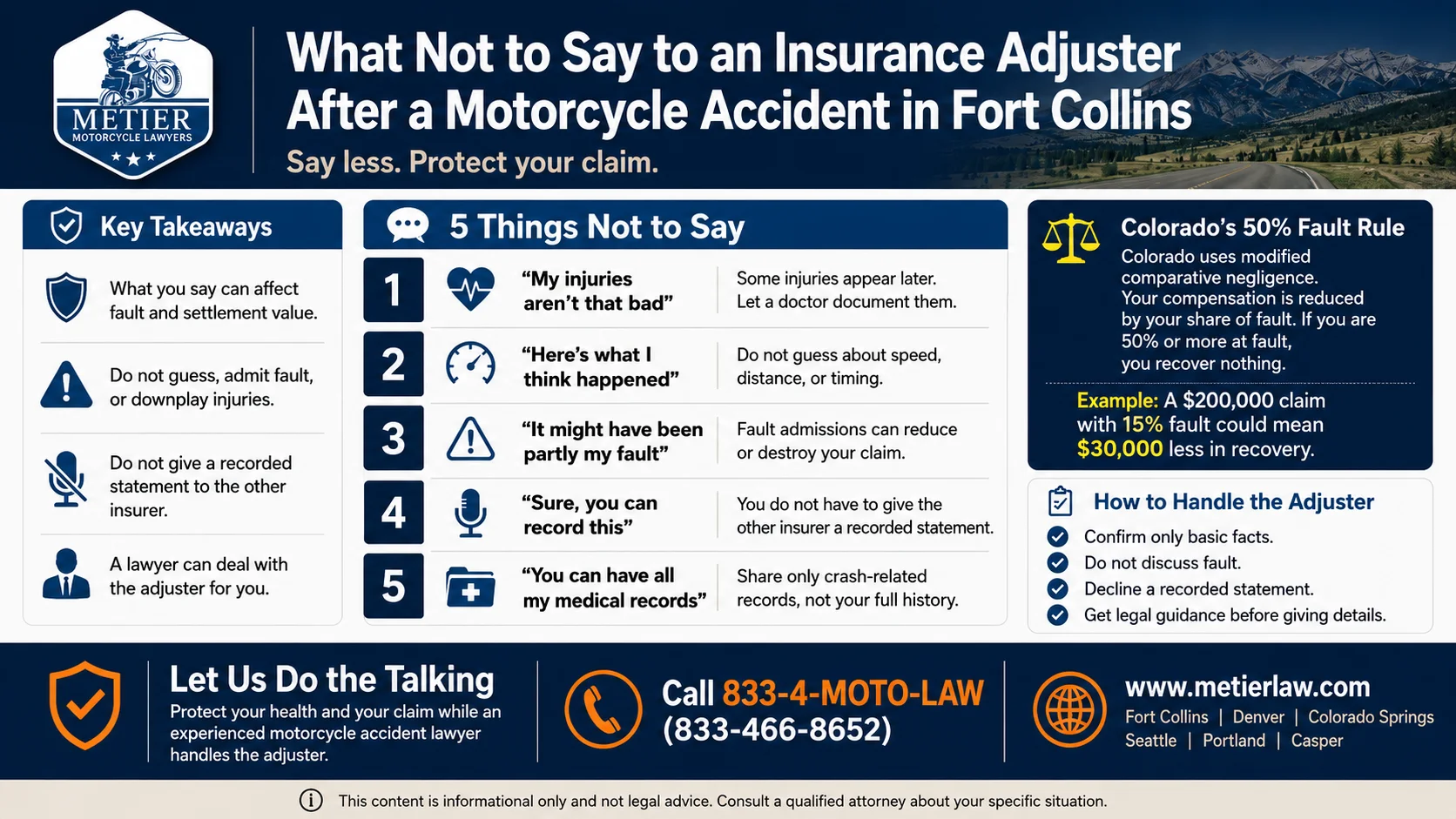
- Knowing what not to say to an insurance adjuster comes down to five things: how badly you're hurt, your theory of the crash, any admission of fault, a recorded statement, and open access to your medical records.
- Under Colorado's modified comparative negligence rule, reaching 50 percent fault means you recover nothing, so one careless sentence about fault can shrink or even end your recovery.
- You are not required to give the at-fault driver's insurer a recorded statement, and you decide which medical records they see.
- A Fort Collins motorcycle accident lawyer can deal with the adjuster while you focus on healing.
The call from the insurance adjuster usually comes within a day or two of them being notified about your crash, while you're still sore and piecing together what happened. The adjuster sounds friendly and says they just want your side of the story, but that friendly tone can be the set-up to decrease the value of your claim. Everything you say goes into the insurer's file, and it can shape what your claim ends up being worth. I'm Patrick DiBenedetto, a partner at Metier Law Firm and a rider myself, and we represent injured motorcyclists across Fort Collins, Larimer County and the state of Colorado. Riders are exposed in a way drivers aren't. Motorcycles were about 3 percent of registered vehicles but 16.2 percent of all U.S. traffic deaths in 2024, according to the National Safety Council's analysis of federal crash data. Adjusters know those numbers, and they know an injured rider is easy to lead into a statement that hurts the claim.
I tell every rider the same thing: the first phone call isn't about helping you, it's about locking in your version before you've seen a doctor or talked to a lawyer. Stay polite, stay brief, and keep your options open. That single habit protects more claims than anything else I can share with you.

Five Things to Keep to Yourself After a Crash
Here's what not to say to an insurance adjuster after a motorcycle accident, and the reason each one matters.
"My Injuries Aren't That Bad"
You don't yet know how badly you're hurt. Adrenaline masks pain, and the injuries that show up most in motorcycle crashes, including concussions, internal bleeding, and spine and soft-tissue damage, can take hours or days to surface. Riders absorb crash forces with no enclosed vehicle around them, which is why the National Highway Traffic Safety Administration identifies motorcyclists as far more likely than other road users to be killed or seriously injured in a crash. If you tell the adjuster you're fine, that quote lands in the file and gets used to argue your injuries are minor. Get evaluated by a doctor and let your medical records describe your condition, not a phone call taken from a hospital bed.
"Here's What I Think Happened"
Speculation is a gift to the insurer. Guess at your speed, the distance, or the timing, and you hand them a version of events they can hold you to, even if it later proves wrong. Stick to facts you're certain of: the date, the location, that a crash occurred. "I'm not sure" and "I don't remember" are honest, complete answers. The reconstruction belongs to the evidence, not to a phone call.
"It Might Have Been Partly My Fault"
This is the costliest sentence a rider can say. Colorado follows modified comparative negligence under C.R.S. § 13-21-111. Your damages drop by your share of fault, and if your fault reaches 50 percent, you recover nothing. An adjuster who nudges you into accepting even 15 percent of the blame changes what you collect. On a $200,000 claim, that 15 percent is $30,000 gone. Fault is a legal conclusion built from evidence, not something to concede while you're still shaken. Our breakdown of how Colorado's 50 percent fault rule plays out against riders shows how fast that math turns against you.
"Sure, You Can Record This"
You are not required to give the at-fault driver's insurer a recorded statement. Your own policy may require reasonable cooperation with your insurer, but the other driver's carrier has no such right. A recorded statement freezes your first, foggy impression while your injuries and memory are still changing, and adjusters comb the transcript for anything that reads as inconsistent. Decline politely and say you'll follow up once you've had medical care.
"You Can Have All My Medical Records"
A blanket medical authorization lets the insurer pull your entire history, not just crash-related treatment. They use old records to argue your injuries pre-existed the crash. You control the scope. Share the records tied to this crash and nothing more. A Fort Collins motorcycle accident lawyer can sort out what's relevant and hand over exactly that.

How to Handle the Adjuster Without Hurting Your Claim
You don't have to dodge the adjuster. Keep it short. Confirm the basics: your name, that a crash happened, the date and location. Decline the recorded statement. Don't discuss your injuries or fault. Then get guidance before the conversation goes any further. If a carrier crosses the line, the Colorado Division of Insurance investigates complaints and can require an insurer to pay benefits it wrongfully withheld. Some carriers also stall, counting on a rider with bills piling up to accept the first offer, which is one reason it helps to understand how long a Fort Collins case can take. The strongest early move is simple: let a lawyer talk to the adjuster for you.
Frequently Asked Questions
Do I Have to Talk to the At-Fault Driver's Insurance Adjuster?
No. You are not obligated to give the at-fault driver's insurer a recorded statement or a detailed account. You can confirm basic facts and decline the rest. Your own insurer is different, because your policy usually requires reasonable cooperation.
What Should I Not Say to an Insurance Adjuster After a Motorcycle Accident?
Avoid downplaying your injuries, guessing how the crash happened, accepting any share of fault, agreeing to a recorded statement, and signing a blanket medical authorization. Each one can lower your motorcycle accident settlement or, under Colorado's fault rule, end your claim entirely.
Can Admitting Partial Fault Really Cost Me My Claim in Colorado?
Yes. Under C.R.S. § 13-21-111, if your fault reaches 50 percent you recover nothing, and below that your damages shrink by your percentage. Telling an adjuster you were "maybe going a little fast" can push that number against you.
Should I Give the Insurance Company My Medical Records?
Only the records connected to this crash. A blanket authorization lets the insurer dig through unrelated history to argue your injuries came from something else. Let your attorney decide what's relevant before you sign anything.
When Should I Call a Fort Collins Motorcycle Accident Lawyer?
Before you give any detailed statement. Early legal help means the adjuster talks to your lawyer instead of to you, and the fault and injury questions get handled with evidence rather than guesses.
Let Us Do the Talking
We ride the same roads you do, and we've watched good riders lose thousands over a sentence they didn't know mattered. You don't owe the at-fault driver's insurer your story, your theory, or your full medical history. Say little, protect your health, and let someone who knows the adjuster's playbook carry the rest.

Disclaimer: Past results discussed should not be considered a guarantee of your results as the factors of every case are individually unique. This content is for informational purposes only and does not constitute legal advice. Consult a qualified attorney from Metier Law Firm regarding your individual situation for legal advice.

Tell Us About Your Case – Free Case Review with a Personal Injury Lawyer
(866) 377-3800Our Locations
.webp)
Do I have a Case?
How Much Should I Be Offered?
Do I Need an Attorney?
If these questions have crossed your mind, let us help. You may need a little direction or may not need an attorney at all, but you deserve to be confident knowing your options. We can provide you with information about our Attorneys of the West® accident investigations and legal services. Your confidential consultation with us is totally free.
Keep up with us!
