


TL;DR: Key Takeaways
- Yes. In a Colorado civil action commenced on or after September 7, 2021, an employer's admission of vicarious liability for its driver doesn't bar direct negligence claims against it. C.R.S. 13-21-111.5(1.5)(a).
- For actions commenced before that date, Ferrer v. Okbamicael, 2017 CO 14M, still applies: the employer's admission bars claims for negligent hiring, training, supervision and entrustment.
- The 2021 statute permits "associated discovery," so we request the driver qualification file and driver investigation history file required by 49 CFR Part 391.
- Subsection (1.5)(b) confirms the statute doesn't permit recovering compensatory and exemplary damages more than once for the same injury.
- A claim for exemplary damages may not be included in the initial claim for relief and may be added only by amendment under C.R.S. 13-21-102(1.5)(a).

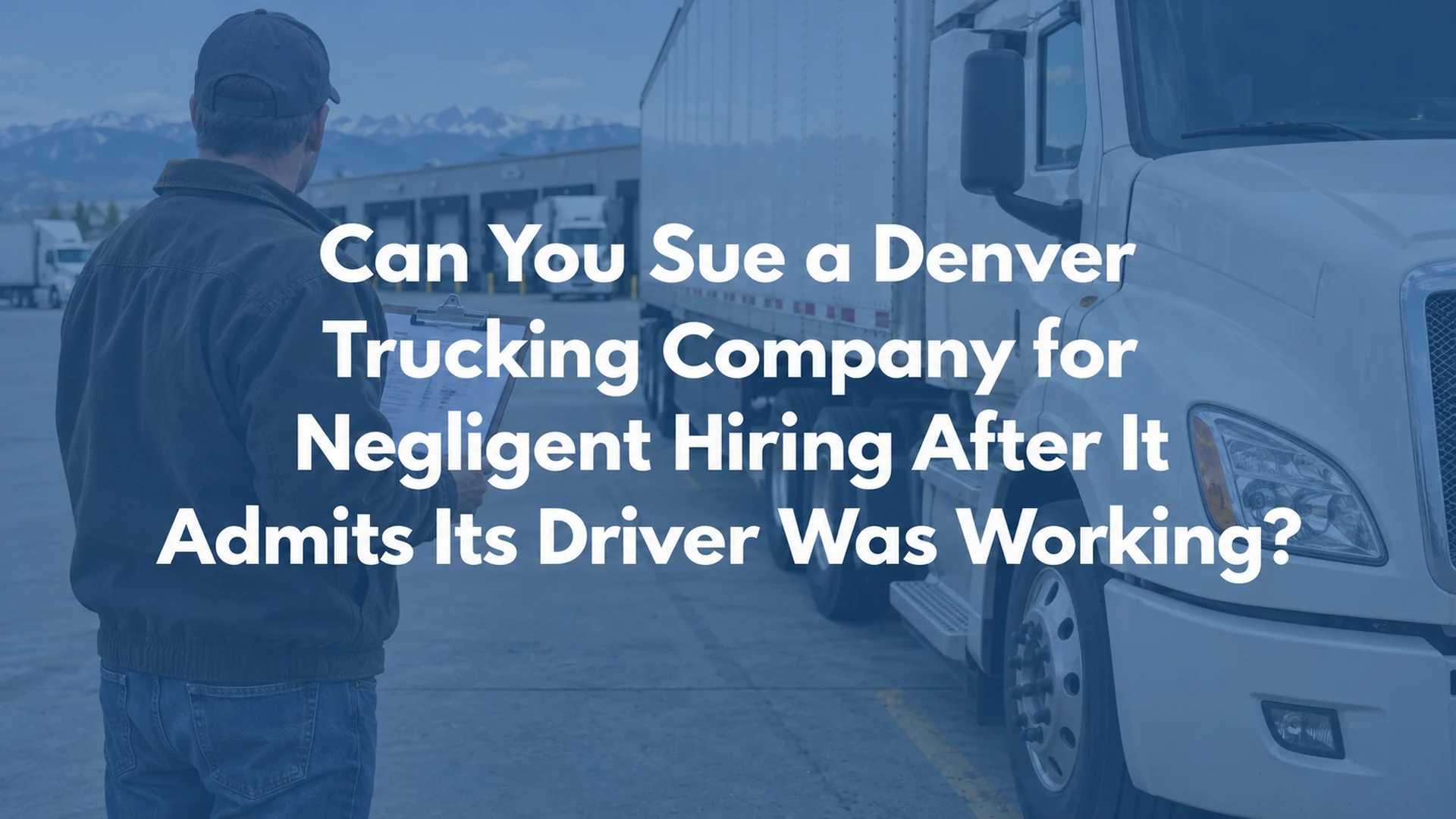
A trucking company sued over a crash on I-25 or I-70 in Denver can admit in its answer to the lawsuit that the driver was its employee, acting within the course and scope of employment. The company is then liable for any negligence by the driver. Under Ferrer, a 2017 Colorado Supreme Court decision, the admission also barred claims about the carrier's own hiring and supervision. C.R.S. 13-21-111.5(1.5) ended that bar for actions commenced on or after September 7, 2021.
"An admission of course and scope resolves only whether the company is legally responsible for the driver's negligence," says Emily N. Benight, a Partner at Metier Law Firm. She focuses on commercial truck crashes and has been licensed in Colorado since 2013. "It doesn't address whether the company reviewed the driver's record before hiring. Colorado's 2021 statute permits discovery on that question, so we request the carrier's hiring records."
What the Carrier's Admission Covers
Respondeat superior is the rule that makes an employer legally responsible for an employee's negligence committed within the course and scope of employment. It's a form of vicarious liability, which is liability for another person's conduct. After the admission, you don't have to prove the driver was acting as the carrier's employee.
The admission concerns the driver's conduct only. Direct negligence claims address what the company did: its hiring, training and supervision of the driver, and its decision to retain a driver whose record showed violations or crashes.
How Ferrer Barred Direct Negligence Claims
A taxi struck Jessica Ferrer and a companion as they crossed a street in Denver, and Ferrer sued the driver and the cab company. The company admitted the driver was its employee acting within the course and scope of employment. In Ferrer v. Okbamicael (2017), the Colorado Supreme Court affirmed the dismissal of Ferrer's direct negligence claims. The court held that where an employer acknowledges vicarious liability for its employee's negligence, the plaintiff's direct negligence claims against the employer are barred. The holding reached all employers, including trucking companies.

The 2021 Statute That Reversed Ferrer
The General Assembly enacted House Bill 21-1188 in 2021, adding subsection (1.5) to C.R.S. 13-21-111.5. Paragraph (a) reads:
"Notwithstanding any provision of subsection (1) of this section to the contrary, when an employer or principal acknowledges vicarious liability for an employee's or agent's negligence, a plaintiff's direct negligence claims against the employer or principal are not barred. A plaintiff may bring such claims, and conduct associated discovery, in addition to claims and discovery based on respondeat superior."
Paragraph (c) states the legislature's intent "to reverse the holding in Ferrer v. Okbamicael."
The statute took effect September 7, 2021, and it applies to civil actions commenced on or after that date.
Records at Issue in a Denver Trucking Company Negligent Hiring Lawsuit
Federal regulations require motor carriers to create and keep records of how each driver was screened, and we request those records in discovery. Our article on negligent hiring in semi truck crashes covers the regulations.
Within 30 days of a driver's start date, the carrier must obtain the driver's motor vehicle record from each licensing state for the prior three years. The same deadline applies to its inquiry to DOT-regulated employers from the prior three years about the driver's safety history, including accidents. 49 CFR 391.23 sets both duties. Each prior employer's response, or documentation of the carrier's good faith effort to obtain one, must go in the driver investigation history file under 49 CFR 391.53.
A separate driver qualification file is required by 49 CFR 391.51. It must contain the employment application, motor vehicle records, road test certificate or accepted equivalent, annual driving record review, and proof of medical certification. Under 391.51(c), the carrier must keep the file for the driver's employment and three years after. Section 391.51(d) lets the carrier remove annual driving records and medical certificates three years after they're executed.
We start with a spoliation letter, which demands that the carrier preserve both files. Once the files are produced in discovery, we compare the application against the motor vehicle records and the prior employers' responses to see what the carrier had on file about the driver. If a file has neither a prior employer's response nor proof of a good faith effort to get one, that supports the claim that the carrier didn't make the inquiry 49 CFR 391.23 requires. Drug and alcohol testing records fall under 49 CFR Part 382, and we request them separately. We explain Part 382 in our article on truck driver drug testing.
If you or a loved one was injured in a crash with a commercial truck, call us at 866-377-3800 or schedule a free consultation at www.metierlaw.com.

No Double Recovery for One Injury
Subsection (1.5)(b) provides that nothing in subsection (1.5) permits a plaintiff "to recover compensatory and exemplary damages more than once for the same injury." A direct negligence claim is another ground for holding the company liable for the same injury. The statute doesn't permit a second award for it.
Subsection (1) of the same statute limits each defendant's liability to its own percentage of the fault that produced the injury, with an exception in subsection (4).
When Exemplary Damages Are Available
Colorado calls punitive damages exemplary damages, and C.R.S. 13-21-102 governs them. Under subsection (1)(a), they're available only when the injury is attended by circumstances of fraud, malice, or willful and wanton conduct. Subsection (1.5)(a) of that statute excludes them from the initial claim for relief. They may be added by amendment only after initial disclosures under C.R.C.P. 26 and the plaintiff's prima facie proof of a triable issue. The court decides whether the evidence meets that standard when it rules on the motion to amend.
Frequently Asked Questions
What does the trucking company's admission change in my case?
The admission means you don't have to prove the driver was an employee acting within the course and scope of employment. For an action commenced on or after September 7, 2021, it doesn't bar direct negligence claims against the company. C.R.S. 13-21-111.5(1.5)(a). Those claims include negligent hiring, training, supervision and retention.
Which cases does the 2021 statute cover?
It applies to a civil action commenced on or after September 7, 2021, in Denver District Court or any other Colorado state court. Ferrer controls earlier actions.
Can I recover damages twice by bringing claims against both the driver and the company?
No. C.R.S. 13-21-111.5(1.5)(b) confirms the 2021 statute doesn't permit a double recovery for the same injury.
What records show whether the carrier screened its driver?
The driver qualification file (49 CFR 391.51) documents the application, driving record and medical certification. Prior employers' safety history responses go in the driver investigation history file (49 CFR 391.53).
Talk With a Denver Truck Accident Lawyer About the Carrier's Records
After a crash on I-76 or I-270, our Denver truck accident lawyers can explain how a carrier's admission affects a Denver trucking company negligent hiring lawsuit. Our Colorado truck accident team represents clients throughout Colorado. Call Metier Law Firm at 866-377-3800 or schedule your free consultation today at www.metierlaw.com.
Disclaimer: Past results discussed should not be considered a guarantee of your results as the factors of every case are individually unique. This content is for informational purposes only and does not constitute legal advice. Consult a qualified attorney from Metier Law Firm regarding your individual situation for legal advice.
Related Blog Posts
Tell Us About Your Case – Free Case Review with a Personal Injury Lawyer
(866) 377-3800Our Locations

Do I have a Case?
How Much Should I Be Offered?
Do I Need an Attorney?
If these questions have crossed your mind, let us help. You may need a little direction or may not need an attorney at all, but you deserve to be confident knowing your options. We can provide you with information about our Attorneys of the West® accident investigations and legal services. Your confidential consultation with us is totally free.
Keep up with us!
