.svg)


TL;DR - Key Takeaways
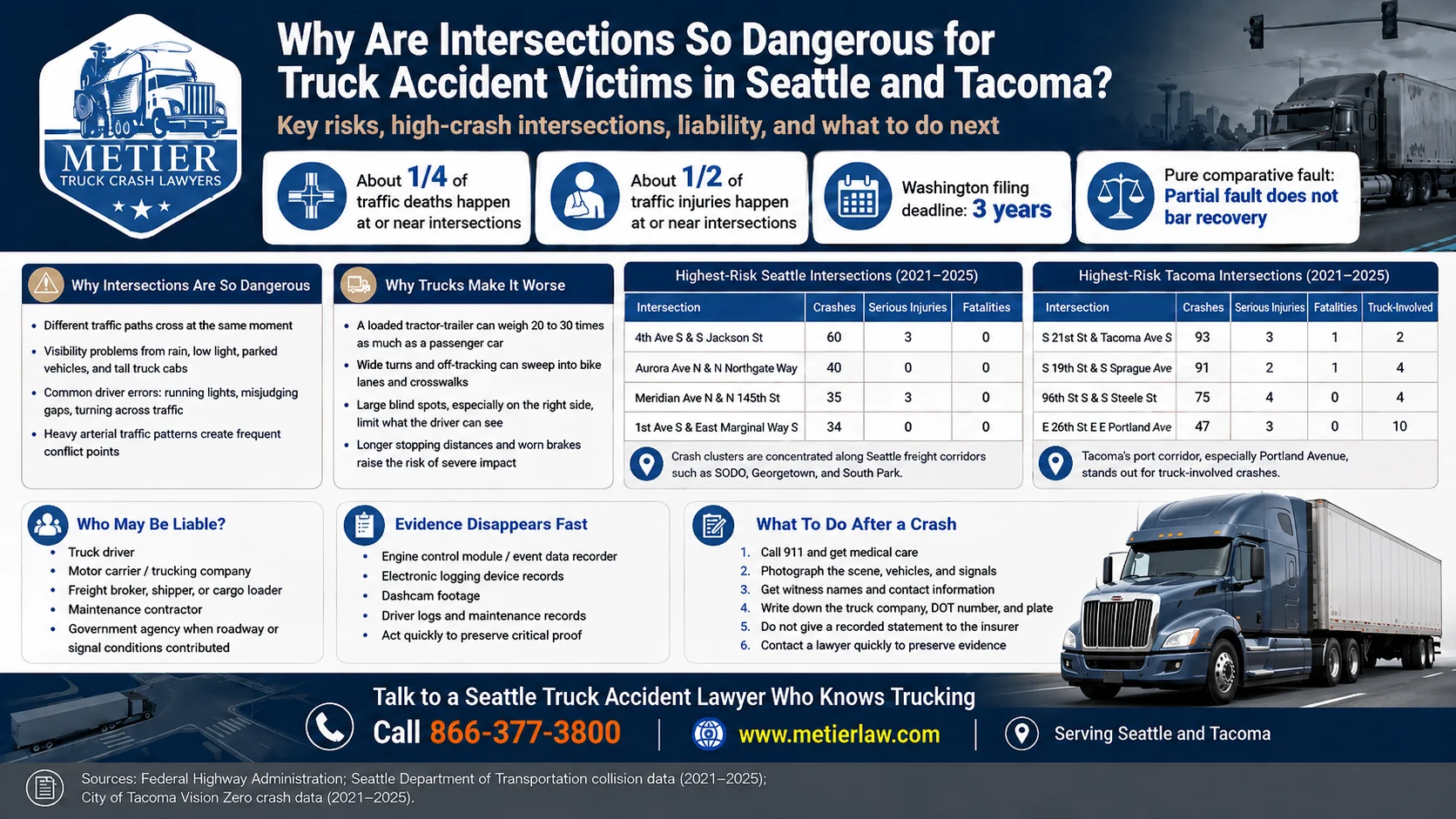
- Intersections are an important part of the road network, and the Federal Highway Administration links about a quarter of all traffic deaths and roughly half of all traffic injuries to them.
- Trucks turn ordinary intersection crashes into catastrophic ones because of wide turns, deep blind spots, and long stopping distances.
- Seattle's freight corridors, including East Marginal Way S and the SODO truck streets, put heavy commercial traffic right where people cross and turn.
- The City of Tacoma's Vision Zero program flags corridors like South Tacoma Way and 6th Avenue as high-risk, and the Tideflats near the Port of Tacoma concentrates truck traffic.
- Washington gives you three years to file a personal injury claim, and its pure comparative fault rule means partial fault does not end your case.
- Truck evidence disappears fast. Onboard data, dashcam video, and driver logs need to be locked down quickly.
Intersections are an integral part of the pavement we travel on, but they carry a huge share of the harm. The Federal Highway Administration ties roughly one quarter of traffic deaths and about half of all traffic injuries to crashes at or near intersections. Now add a loaded commercial truck to a busy Seattle or Tacoma arterial, and the risk climbs higher. I'm Mike Chaloupka, Managing Partner at Metier Law Firm, and I hold a Class A commercial driver's license. I've spent years learning how these trucks move through tight urban corners, and I've seen what happens when a driver misjudges one. If you were hurt in an intersection truck accident in Seattle or Tacoma, you deserve to understand why it happened and who should answer for it.
What Makes Intersections So Dangerous?
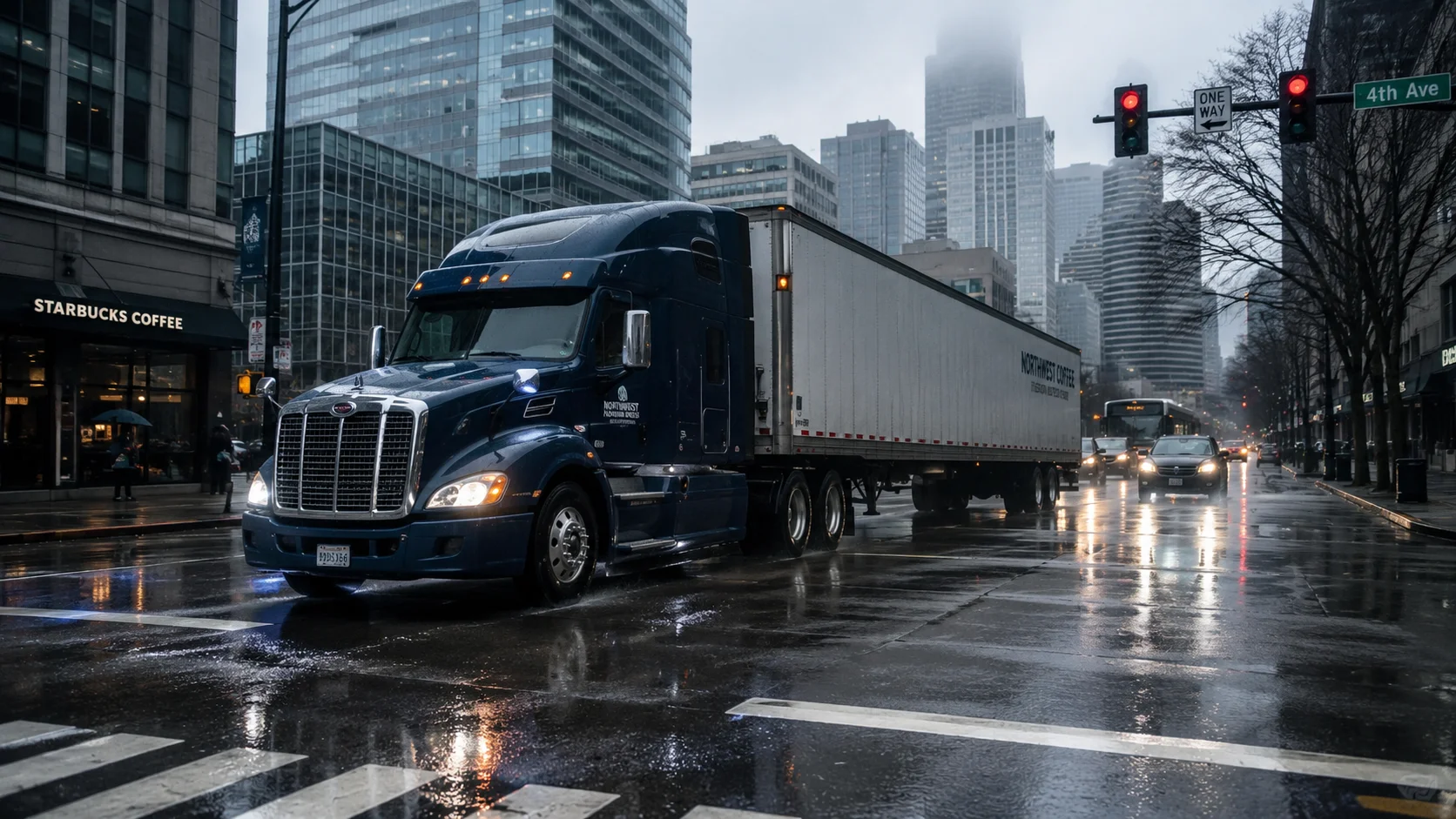
An intersection is the one spot on the road where vehicles moving in different directions have to share the same space at the same moment. Every turn, every signal change, and every crossing creates a point where paths can collide. Drivers have to judge speed and distance, watch for people on foot and on bikes, and react in a second or less. Miss one of those judgments and a crash follows.
Three things drive most intersection crashes in the Seattle and Tacoma area. Visibility is the first. Rain, low winter light, parked vehicles, and the sheer height of a truck cab all block sightlines. The second is driver error, which usually means someone ran a light, misread a gap, or turned across oncoming traffic. The third is traffic pattern, meaning the way our arterials funnel heavy volume through a handful of busy crossings during commute hours. When all three stack up at the same corner, serious crashes stop being rare.
The Most Common Causes of Intersection Truck Accidents in Seattle and Tacoma
Most of these crashes trace back to a handful of repeat problems. Left-turn conflicts lead the list. A truck or a passenger driver turns left across oncoming traffic and misjudges an approaching vehicle's speed. Red-light and stale-yellow running comes next, and it hits harder with a truck because the driver often cannot stop in time once the light changes. Distraction plays a role in a large number of these wrecks, whether it is a phone, a dispatch screen, or a driver looking away at the wrong instant.
Speed makes all of it worse. A truck moving too fast for the approach cannot scrub off enough momentum before the conflict point. Poor maintenance shows up too, especially worn brakes that stretch an already long stopping distance. These are the same failures we walk through in our overview of truck crash dangers near Seattle, and they matter because each one points to negligence a victim can prove.
The Most Dangerous Intersections in the Seattle and Tacoma Areas
Public safety agencies track where crashes cluster. In Seattle, SDOT maps a network of Major Truck Streets and, through its Vision Zero program, a High Injury Network where about half of the city's serious and fatal crashes happen on a small fraction of the streets. In Pierce County, the City of Tacoma's Vision Zero program tracks a High-Risk Network of corridors based on crash history.
The intersections below come straight from those government crash records, counting reported collisions at each intersection from 2021 through 2025. Seattle's figures come from the SDOT Collisions dataset on Seattle's open data portal and count all vehicles, because that dataset does not flag trucks at the individual crash level. Tacoma's come from the City's Vision Zero crash data, which does flag truck-involved crashes, so we show that column for Tacoma.
Seattle intersections with the most reported crashes, 2021 to 2025:
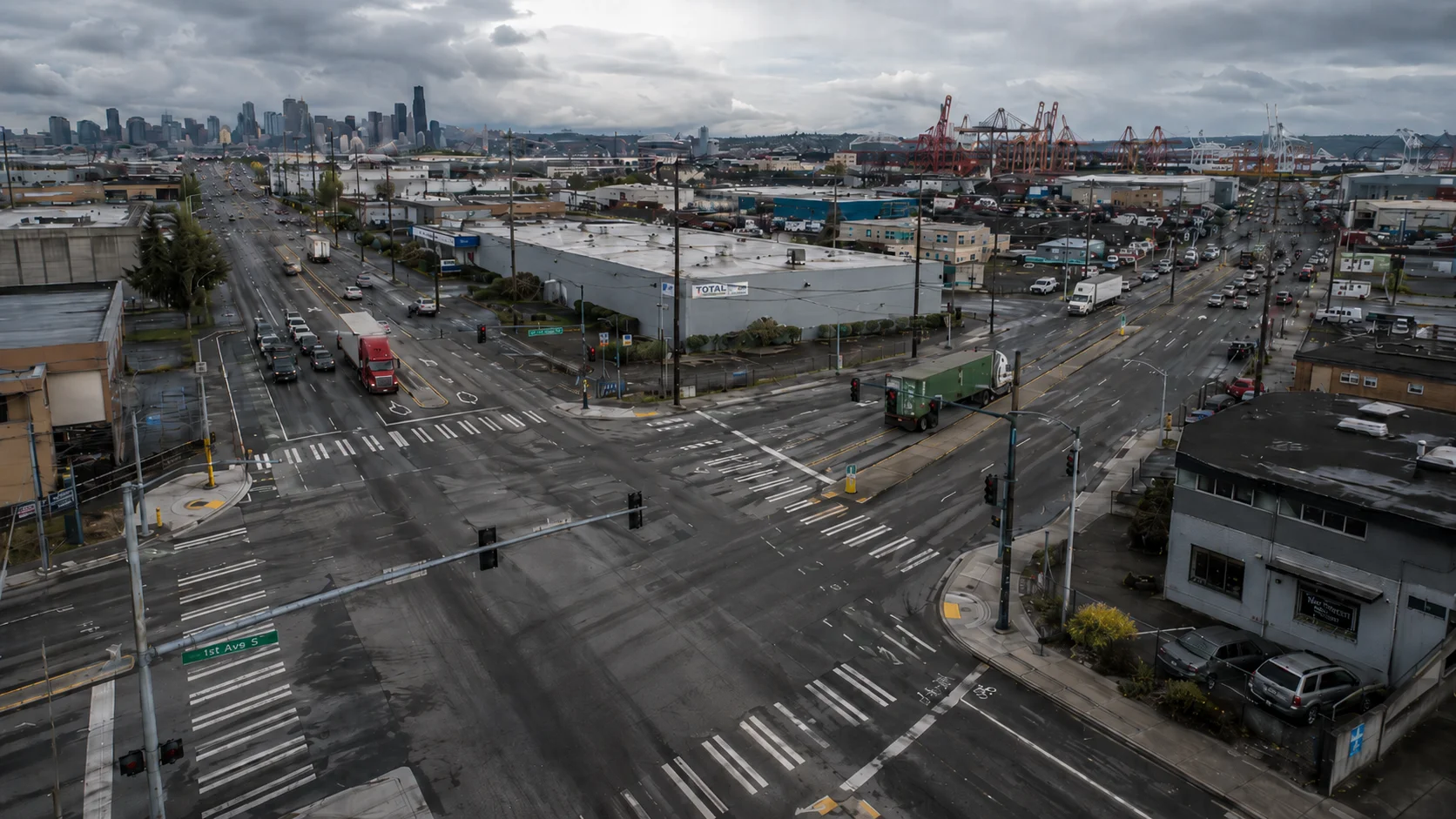
Look at where those crashes cluster. East Marginal Way, West Marginal Way, 1st Ave S, and 4th Ave S are all designated freight and truck routes running through SODO, Georgetown, and South Park, the industrial core where the Port of Seattle's truck traffic concentrates. For truck crashes at Seattle intersections, this is the ground zero.
Tacoma intersections with the most reported crashes, 2021 to 2025:
In Tacoma the truck story runs down Portland Avenue toward the Port. That corridor carries more truck-involved crashes than any other in the city, and the single intersection of E 26th St and E Portland Ave logged 10 of them in five years. The crossing at E 72nd St and McKinley Ave stands out for a grimmer reason: three people died there in the same window.
A word on what these numbers are. They count all reported crashes, so a busy intersection can rank high partly because so much traffic moves through it. Read the serious-injury and fatality columns next to the totals, and treat the list as a map of where conflicts concentrate rather than a verdict on any single corner.
Why Trucks Make Intersections Even More Dangerous
A fully loaded tractor-trailer can weigh 20 to 30 times what your car weighs. That difference changes everything about a crash at an intersection.
Start with the turn itself. A truck cannot swing through a corner the way a car does. The trailer tracks a tighter path than the cab, which is called off-tracking, so a right turn can sweep across a bike lane or a crosswalk that looked clear. Drivers who do not give a truck room on the right get squeezed. Then there are the blind spots. A large truck has no-zones directly in front, directly behind, and along both sides, and the right side is the worst. If the driver cannot see you at the moment they start a turn, they cannot react to you.
Stopping distance is the last piece. A loaded truck needs far more room to stop than a passenger vehicle, and worn brakes make it worse. When a light turns yellow at the wrong time, a car can stop and a truck sometimes cannot. That is how T-bone and underride crashes happen at intersections, and both are among the deadliest wrecks on the road. These are the same forces we break down in our look at logging truck crashes in Washington, where load and momentum drive the outcome.
If you or a loved one was injured in a crash with a commercial truck, call us at 866-377-3800 or schedule a free consultation at www.metierlaw.com.
Who Is Liable in a Seattle or Tacoma Intersection Truck Accident?
Truck cases rarely come down to one person. The driver is the obvious starting point, but the motor carrier that employs the driver is often on the hook too, for the driver's conduct and sometimes for its own failures in hiring, training, or scheduling. Beyond that, a freight broker, a shipper, a cargo loader, or a maintenance contractor can share fault depending on what went wrong. When a signal or a road design contributed, a government agency may be involved, though those claims carry strict notice deadlines and a higher bar.
Washington law helps injured people here. The state uses pure comparative fault under RCW 4.22.005, which means you can recover even if you were partly at fault. Your award is reduced by your share of the blame, but it is not erased. So even if an insurer claims you entered the intersection late or missed something, you may still have a strong claim.
The hard part is proof, and proof in truck cases lives in evidence that does not last. A truck's engine control module and event data recorder capture speed and braking in the seconds before impact. Electronic logging devices record hours of service, and federal rules require carriers to keep those records for only six months. Dashcam footage is often recorded on a loop that overwrites itself within days. This is why moving fast matters. A Seattle truck accident lawyer can send a preservation letter and secure that data before it is gone.
What to Do After an Intersection Truck Accident in Seattle or Tacoma
Your first job is safety and health. Call 911, get out of traffic if you can, and accept medical care even if you feel alright, because truck-crash injuries often surface hours or days later. After that, a few steps protect your case. Photograph the scene, the vehicles, the signals, and the final resting positions. Get names and numbers from witnesses. Write down the truck's company name, its DOT number, and the plate.
Be careful with the trucking company's insurer. Their adjuster may call quickly and ask for a recorded statement. You are not required to give one, and it usually helps them more than you. Washington gives you three years to file under RCW 4.16.080, but do not treat that as a reason to wait. The evidence that wins an intersection truck accident case is often gone long before that deadline. The sooner a lawyer starts, the more of it survives.
Frequently Asked Questions
How long do I have to file a truck accident claim in Washington?
You generally have three years from the date of the crash under RCW 4.16.080. That said, waiting is risky. Onboard truck data and dashcam video can disappear in days or weeks, so contacting a lawyer early gives you the best chance to preserve what your claim depends on.
Who can be held liable after an intersection truck crash?
Often more than one party. The truck driver, the motor carrier, a freight broker, a cargo loader, and a maintenance company can all share fault. A truck accident lawyer sorts out who did what by pulling logs, maintenance records, and the truck's own data.
What if I was partly at fault for the intersection crash?
You can still recover in Washington. The state follows pure comparative fault, so your compensation is reduced by your percentage of fault rather than blocked entirely. Even a driver found partly responsible can pursue a claim.
What evidence matters most in an intersection truck accident?
The truck's engine control module and event data recorder, its electronic logging device records, dashcam footage, and the intersection's signal timing. Much of it is volatile, which is why quick action to preserve it is so important.
Talk to a Seattle Truck Accident Lawyer Who Knows Trucking
Intersection truck crashes are among the hardest cases to work and the most serious in their consequences. They demand someone who understands how these trucks move, what federal rules the carrier had to follow, and where the evidence hides. We bring that to every intersection truck accident case, in Seattle and out in Tacoma, and we work both cities from our Seattle office. If a truck driver or a trucking company put you or your family through this, let us carry the legal fight while you focus on healing.
Call Metier Law Firm at 866-377-3800 or schedule your free consultation today at www.metierlaw.com.
Disclaimer: Past results discussed should not be considered a guarantee of your results as the factors of every case are individually unique. This content is for informational purposes only and does not constitute legal advice. Consult a qualified attorney from Metier Law Firm regarding your individual situation for legal advice.
Tell Us About Your Case – Free Case Review with a Personal Injury Lawyer
(866) 377-3800Our Locations
.webp)
Do I have a Case?
How Much Should I Be Offered?
Do I Need an Attorney?
If these questions have crossed your mind, let us help. You may need a little direction or may not need an attorney at all, but you deserve to be confident knowing your options. We can provide you with information about our Attorneys of the West® accident investigations and legal services. Your confidential consultation with us is totally free.
Keep up with us!
