


TL;DR: Key Takeaways
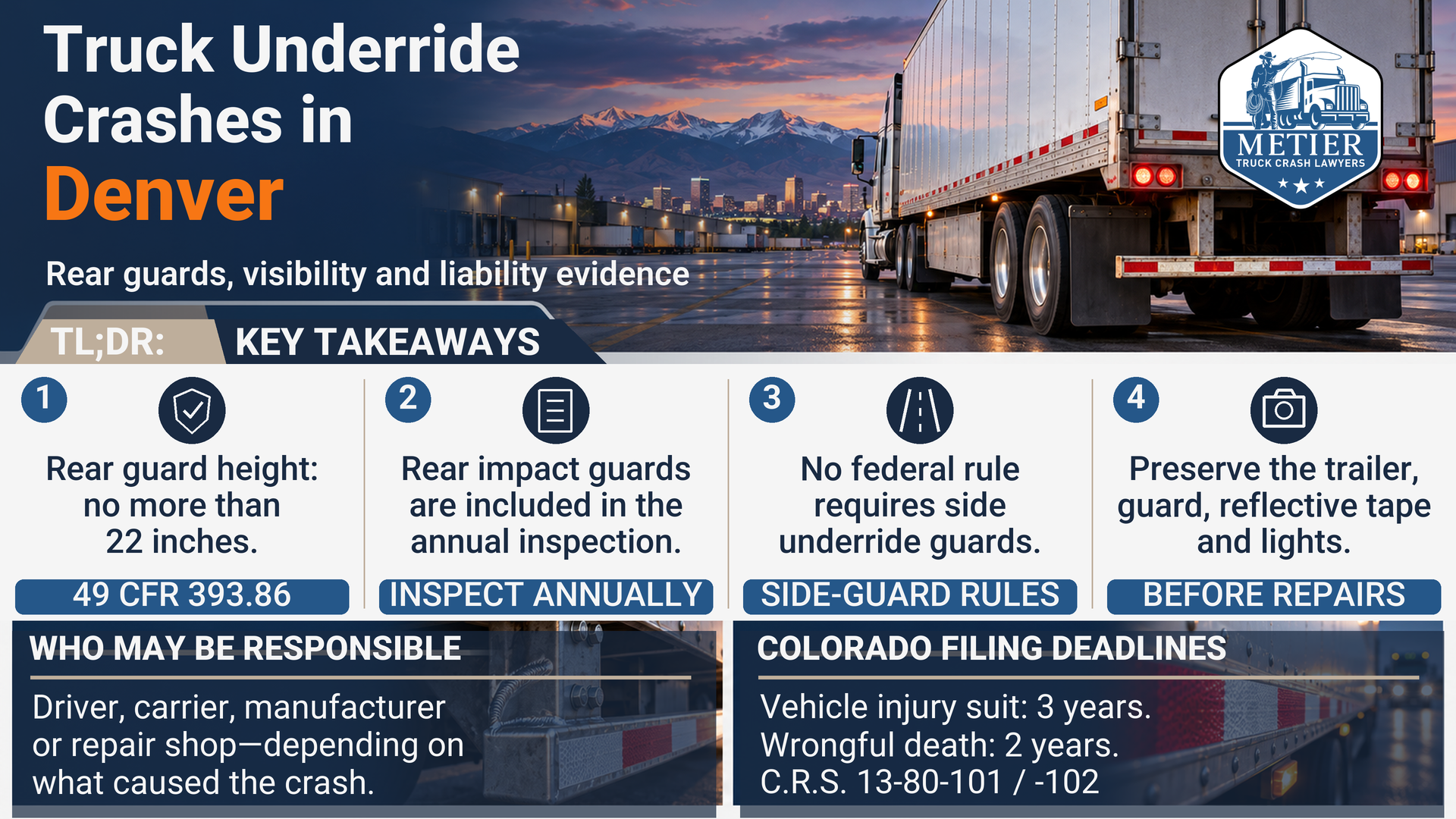
- An underride crash happens when a car slides under a truck or trailer, so the trailer strikes the passenger compartment instead of the car's front crash structure.
- Federal law requires rear impact guards on most trailers built since January 26, 1998. Trailers built on or after July 15, 2024 must meet a stronger 35 mph standard.
- No federal rule requires side underride guards. NHTSA hasn't proposed one, and the Stop Underrides Act 2.0 remains in committee.
- The trucking company, the driver and, in some cases, the trailer or guard maker can be liable after a Denver truck underride accident.
- In Colorado, injury claims from a vehicle crash must be filed within 3 years. Wrongful death claims must be filed within 2 years of the date of death.
- The trailer, its guard, its reflective tape and its lights are the core evidence, so a preservation demand should go out before the trailer is repaired or sold.
The U.S. Government Accountability Office counted an average of about 219 underride deaths a year from 2008 through 2017 and reported that the true number is likely higher, because police crash reports don't record underride consistently. In 2024, 5,340 people died in large truck crashes nationwide, and 62% of them were in cars and other passenger vehicles, according to the Insurance Institute for Highway Safety.
Families who come to us after a Denver truck underride accident ask why the trailer didn't stop the car and who is responsible for that failure.
"I hold a Class A CDL and have driven a tractor-trailer myself," says Mike Chaloupka, Managing Partner at Metier Law Firm. "In the underride cases we've handled, the first thing I want to see is the guard: how high it sat, whether the welds and mounts held, and whether anyone inspected it in the past 12 months. The answers show us which companies we need to investigate."
What Is a Truck Underride Crash?
An underride crash happens when a passenger vehicle slides partly or fully beneath a truck or trailer. Air bags, seat belts and a crumple zone are designed to work when the front of the car strikes something solid. In an underride, the front of the car passes beneath the trailer, so the trailer strikes the windshield and roof pillars and pushes into the passenger compartment. In 2017 IIHS side guard tests, a midsize car that struck a guarded trailer at 35 mph and again at 40 mph did not go under it, while the car in the 35 mph test without a guard slid beneath the trailer and lost part of its roof.
Rear underride
A rear underride crash happens when a car strikes the back of a trailer that is stopped, parked or moving well below traffic speed. A loaded semi climbing I-70 west of Denver, the same corridor that sees runaway truck crashes on the descent, is one example. The rear impact guard is there to stop this crash. A car can still slide beneath the trailer if the guard is missing, mounted too high, bent from an earlier impact or weakened by rust.
Side underride
Side underride occurs when a trailer blocks a car's path. That happens when a semi turns across several lanes or pulls out of a driveway. A driver backing into a dock from the street or a trailer jackknifed across a highway can block traffic the same way. The space between the tractor's rear wheels and the trailer's wheels stays open unless the trailer has a side guard.
Front underride
In a front underride crash, the front of the tractor rides over a smaller vehicle. These crashes occur in head-on collisions and when a semi strikes a car from behind.
What Federal Rules Require for Underride Guards
Rear impact guards
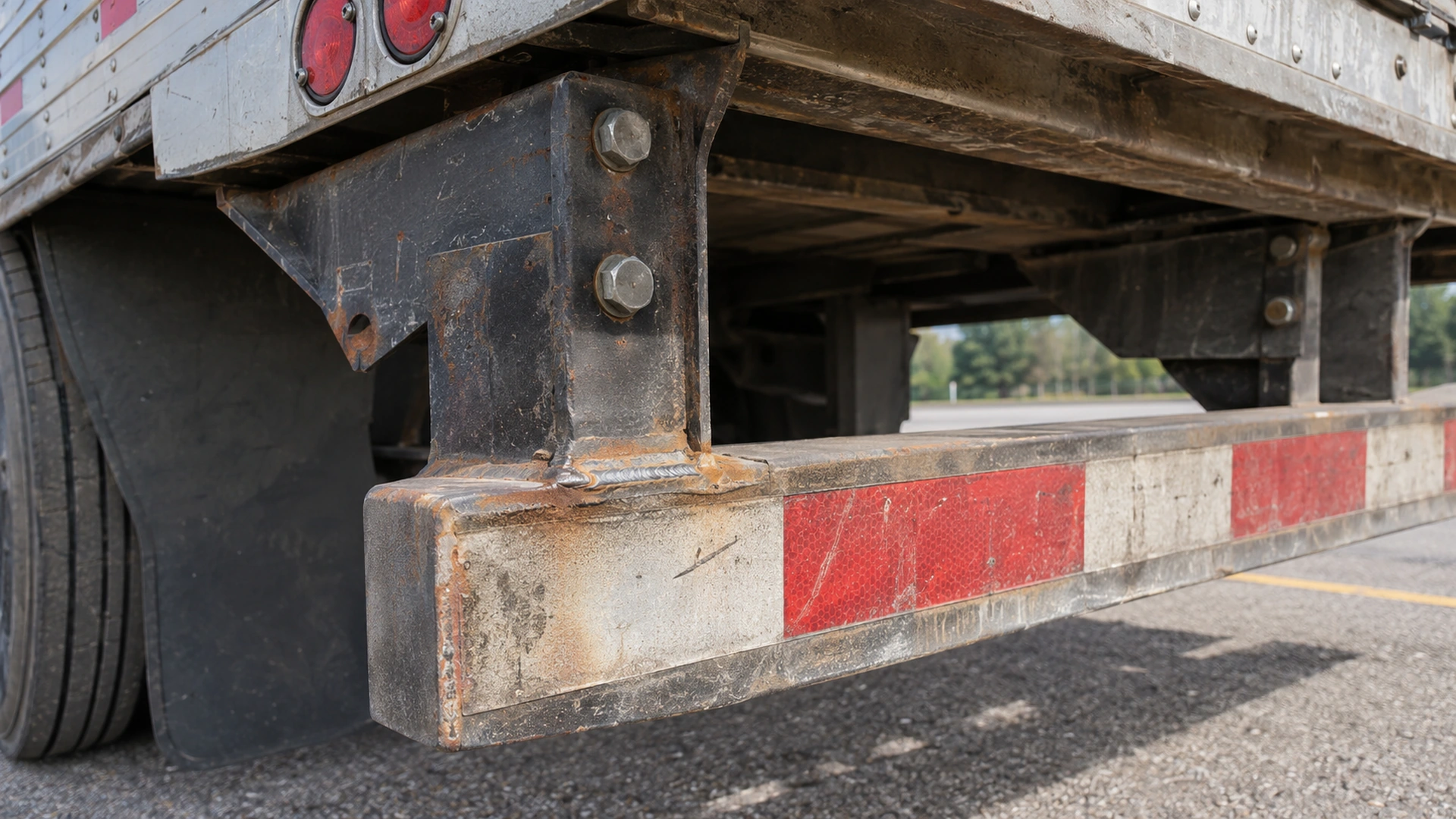
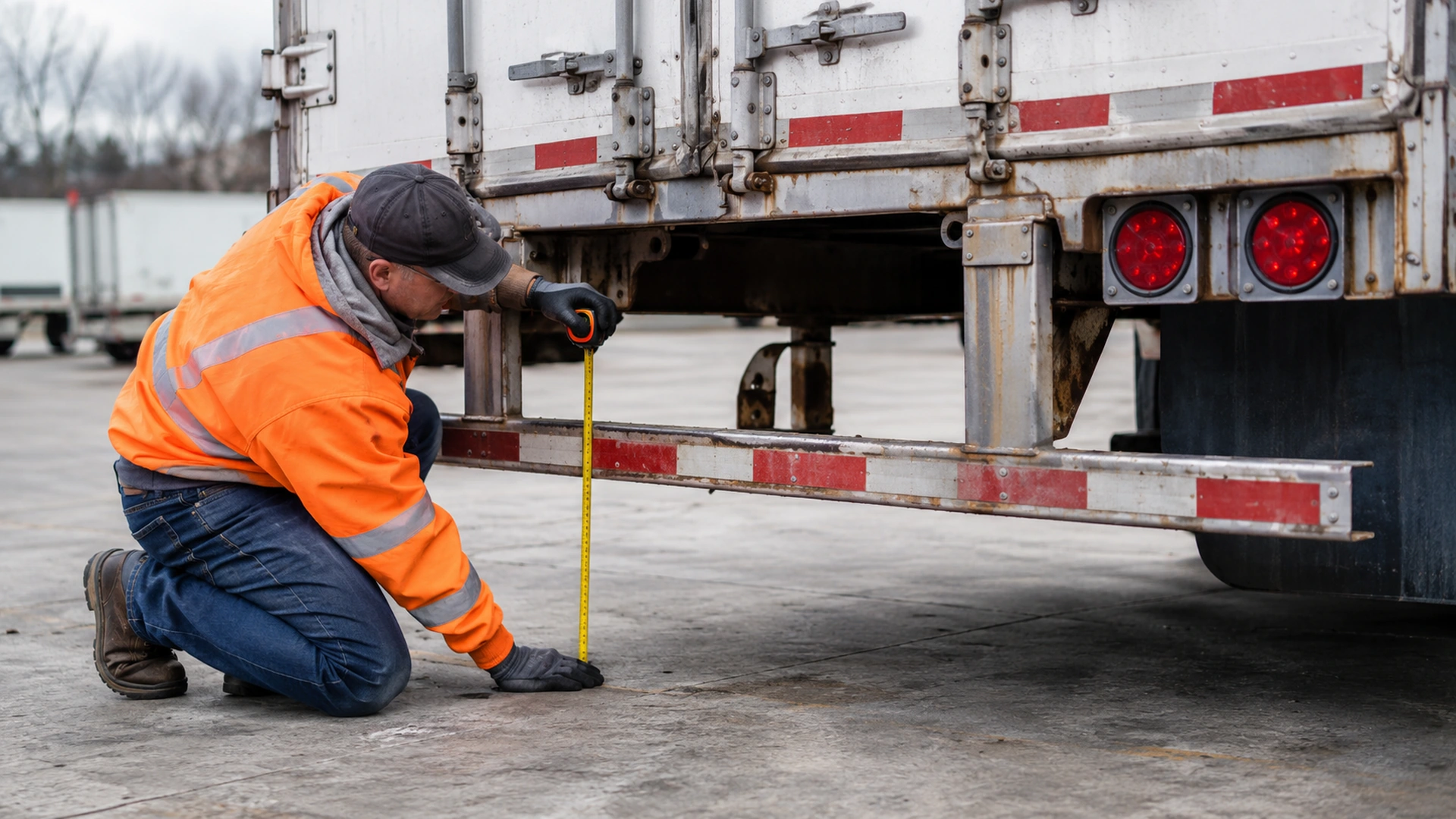
49 CFR 393.86 requires trailers and semitrailers with a gross vehicle weight rating of 10,000 pounds or more, built on or after January 26, 1998, to carry a rear impact guard that met the federal standards in effect when the trailer was made. The guard's bottom edge can sit no more than 22 inches off the ground, and the guard must extend to within 4 inches of each side of the trailer.
NHTSA raised the standard in 2022: trailers built on or after July 15, 2024 need a guard that prevents a compact or subcompact car from underriding at 35 mph, both when the car strikes the center of the trailer and when it overlaps half the trailer's width. The rule doesn't cover older trailers or single-unit trucks such as box and dump trucks. It also doesn't test a crash where only 30% of the car's width strikes the trailer, which IIHS does test in its TOUGHGUARD rating.
Annual inspection of the guard
Since December 9, 2021, FMCSA's annual inspection has included the rear impact guard. A trailer built on or after January 26, 1998 fails if the guard is missing or its horizontal bar sits more than 22 inches above the ground, and a carrier can't use a trailer that hasn't passed within the previous 12 months. Drivers' daily inspection reports under 49 CFR 396.11 don't list the guard, so the annual inspection record is one of the first documents we request.
Side underride guards
No federal rule requires side guards on trailers or trucks. NHTSA asked for public comment in April 2023 and hasn't proposed a rule, and its June 2024 report to Congress estimated that side guards would save about 17 lives a year at a cost exceeding the benefits. IIHS estimated in 2023 that a mandate could prevent about 160 to 220 passenger vehicle occupant deaths a year. As of October 2026, the Stop Underrides Act 2.0, introduced in February 2026 to require side guards on new trailers and single-unit trucks, remains in committee.
If you or a loved one was injured in a crash with a commercial truck, call us at 866-377-3800 or schedule a free consultation at www.metierlaw.com.
Reflective Tape, Lights and Seeing a Trailer in the Dark
A study published by NHTSA found that crashes into the back of a truck happen in the dark more often than other truck crashes. In its 2008 data, 44.6% of the fatal ones involving tractor-trailers occurred in darkness, and the researchers concluded that adverse weather did not play a role. In Denver, the sun sets around 4:35 p.m. in early December, so most of the evening rush hour on I-25 and I-70 falls after sunset.
Federal conspicuity rules address that risk. Under 49 CFR 393.11, trailers 80 inches or wider, rated over 10,000 pounds and built on or after December 1, 1993 must carry retroreflective sheeting on the sides, the rear and the rear impact guard, and older trailers had to be retrofitted by June 1, 2001. NHTSA's 2001 evaluation of the tape found that it reduced side and rear crashes into trailers by 41% on dark, unlit roads and lowered injury and fatal crashes in dark conditions by 44%.
Our investigation documents the condition of the tape and the trailer's lights at the time of the crash. If the trailer was stopped, we also confirm whether the driver turned on the hazard flashers and set out warning triangles as 49 CFR 392.22 requires.
Who Can Be Liable for a Denver Truck Underride Accident?
Underride crash liability can extend to more than one party.
The trucking company
Federal rules require carriers to keep a trailer's parts and accessories, including the guard, tape and lights, in safe working condition. A missing guard, a guard bent from an earlier impact, peeling tape or burned-out marker lights are evidence that the carrier didn't meet that duty. When the driver is an employee on the job at the time of the crash, the company is also responsible for the driver's negligence.
The driver
A driver who leaves a trailer stopped in a lane or on a shoulder without hazard flashers and warning triangles, or who turns across traffic without room to clear it, can be held liable.
The trailer or guard manufacturer
When a guard fails because of how it was designed, built or repaired, the manufacturer or the repair shop can share responsibility. Proving that requires an engineer's inspection of the guard, its welds and its mounts.
Colorado Law After a Denver Truck Underride Accident
Filing deadlines
Injury lawsuits from a motor vehicle crash must be filed within 3 years under C.R.S. 13-80-101(1)(n)(I). Wrongful death claims must be filed within 2 years of the date of death under C.R.S. 13-80-102(1)(d), and Colorado law also sets rules on who can file a wrongful death claim and in what order.
Comparative fault
Under C.R.S. 13-21-111, you recover nothing if you're 50% or more at fault. Below that line, your award is reduced by your percentage of fault. If you sue more than one defendant, Colorado courts compare your fault to the combined fault of all the defendants. Each defendant pays only its own share under C.R.S. 13-21-111.5, and a defendant can assign fault to a nonparty, such as a trailer maker, by filing notice within 90 days after the case begins. In a rear underride crash, expect the trucking company to argue that the car's driver should have seen the trailer. We answer that argument with evidence of the guard's condition and the trailer's visibility.
Damage caps
For claims that accrue on or after January 1, 2025, HB24-1472 caps noneconomic damages at $1.5 million in injury cases and $2.125 million in wrongful death cases, with inflation adjustments starting in 2028. Medical bills, lost income and other economic losses aren't capped.
Preserve the Trailer Before It's Repaired or Sold
After a Denver truck underride accident, once police release the trailer, the company that owns it can repair it, return it to service or sell it. We send a preservation demand as soon as we're hired. We then confirm the trailer's manufacture date to establish which guard standard applied, have an engineer measure the guard and document its welds and mounts before any repair, and request the annual inspection report, maintenance records and the truck's logging and engine data.
Families can help by preventing the car from being sold at a salvage auction. They should also decline recorded statements to the trucking company's insurer and keep photos, medical records and the names of witnesses.
Frequently Asked Questions
Are side underride guards required on trucks?
No. Federal rules require rear impact guards on most trailers but don't require side guards. NHTSA hasn't proposed a side guard rule, and the Stop Underrides Act 2.0 remains in committee as of late October 2026.
Can I sue if the rear guard was bent or missing?
Yes. Covered trailers built since January 26, 1998 must have a rear impact guard, and a missing or damaged guard is evidence the carrier failed to maintain its equipment. If the guard failed because of how it was built, the manufacturer can share responsibility.
How long does a family have to file a wrongful death claim in Colorado?
Two years from the date of death under C.R.S. 13-80-102(1)(d). The 3-year deadline for vehicle injury lawsuits doesn't apply.
Why We Start With the Trailer
The key evidence in an underride case is on the trailer itself, and the carrier's inspection and maintenance records show whether that equipment was kept in working order. Our Colorado truck accident lawyers know what a compliant guard looks like and what a federal inspector checks, and Mike went through the same Class A CDL training that truck drivers complete. If someone in your family was hurt or killed in an underride crash, talk with a Denver truck accident lawyer while the trailer can still be inspected.
Call Metier Law Firm at 866-377-3800 or schedule your free consultation today at www.metierlaw.com.
Disclaimer: Past results discussed should not be considered a guarantee of your results as the factors of every case are individually unique. This content is for informational purposes only and does not constitute legal advice. Consult a qualified attorney from Metier Law Firm regarding your individual situation for legal advice.
Tell Us About Your Case – Free Case Review with a Personal Injury Lawyer
(866) 377-3800Our Locations

Do I have a Case?
How Much Should I Be Offered?
Do I Need an Attorney?
If these questions have crossed your mind, let us help. You may need a little direction or may not need an attorney at all, but you deserve to be confident knowing your options. We can provide you with information about our Attorneys of the West® accident investigations and legal services. Your confidential consultation with us is totally free.
Keep up with us!
