.svg)



TL;DR – Key Takeaways
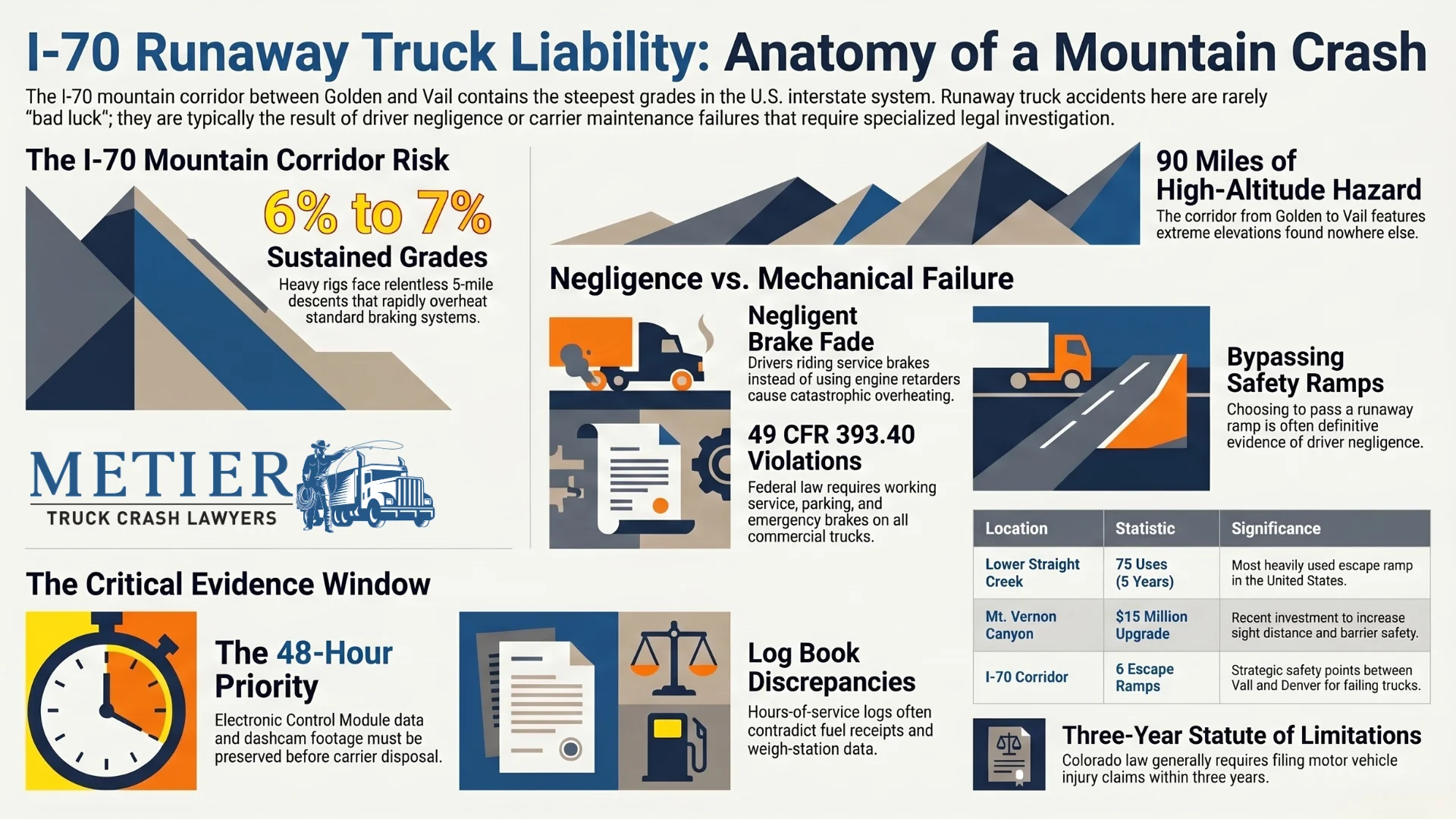
- The Lower Straight Creek runaway truck ramp at mile marker 209, just west of the Eisenhower-Johnson Tunnels, is the most heavily used escape ramp in the United States.
- The 90 miles of I-70 between Golden and Vail include some of the steepest sustained grades in the interstate system, with 6% to 7% drops over five-plus miles in places like Floyd Hill and Straight Creek Canyon.
- Runaway truck crashes are almost never bad luck. They usually trace back to overheated brakes, skipped pre-trip inspections, riding the service brake instead of using engine retarders, or hauling loads that exceed safe descent speeds.
- Federal rules under 49 CFR 393.40 require every commercial truck to have working service, parking, and emergency brakes, and those records become evidence after a crash.
- A truck accident lawyer Denver victims trust will move fast to preserve the truck's electronic control module data, brake inspection logs, and driver hours-of-service records before the carrier disposes of them.
The grades on I-70 west of Denver punish trucks that aren't properly maintained, properly loaded, or driven by someone who understands what happens to brake drums on a long mountain descent. Charlie Stubblefield of Mountain Recovery, the towing company that pulls trucks off these ramps, told CBS Colorado that the 80-mile stretch from Golden to Vail has extreme grades and elevations that "doesn't exist anywhere else." As experienced truck accident lawyers, we've spent years studying how commercial vehicles behave on grades like these, and our firm has handled enough crashes on this corridor to know the patterns by heart.
If you were hit by a runaway truck on the I-70 mountain corridor, or you lost someone in a crash like the 2019 Lakewood pileup, this is for you. We've spent decades representing victims of crashes caused by negligent trucking companies, and the I-70 corridor between Golden and Vail produces some of the worst we see.

Why I-70 West of Denver Is So Hard on Trucks
I-70 climbs out of the Denver metro through Mount Vernon Canyon, hits Floyd Hill near Idaho Springs, keeps climbing through Georgetown and Silver Plume, peaks at the Eisenhower-Johnson Memorial Tunnels at 11,158 feet, then drops sharply through Straight Creek Canyon toward Silverthorne. From there it goes over Vail Pass and down into the Vail Valley.
That's roughly 90 miles of relentless climbing and descending, with grades up to 7% sustained over 5.5 miles in places. According to the Colorado Department of Transportation, the eastbound descent through Mount Vernon Canyon alone runs 6% for five straight miles before flattening briefly and continuing.
Brake drums on a fully loaded 80,000-pound rig start heating up almost immediately on a descent like that. If the driver rides the service brake instead of using the engine brake, the Jake brake, and a properly low gear, the brakes get hot. Hot brakes fade. Faded brakes don't stop trucks.
That's the mechanism behind almost every runaway truck crash we've handled on this corridor.
The Runaway Ramps That Save Lives, and the Drivers Who Don't Use Them
Colorado has 13 runaway truck ramps statewide, according to CDOT. Six of them sit on I-70 between Vail and Denver. The Lower Straight Creek ramp at mile marker 209, west of the Eisenhower-Johnson Tunnels above Silverthorne, is the most-used escape ramp in the country. CDOT reported to the Aspen Times that the two ramps west of the tunnels were used at least 57 times between 2016 and 2019, and the Colorado Sun reported that Lower Straight Creek alone stopped 75 trucks over a five-year span.
Here's the problem: a ramp only works if the driver uses it.
In April 2019, a semi hauling lumber lost its brakes coming down I-70 east of Idaho Springs. The driver, Rogel Aguilera-Mederos, blew past at least one runaway ramp option and slammed into stopped traffic at Denver West Parkway in Lakewood. Four people were killed. He was eventually convicted on dozens of counts.
That crash is part of the reason CDOT rebuilt the eastbound Mount Vernon Canyon escape ramp at mile marker 257, increasing sight distance, expanding the ramp footprint, adding larger barriers, and improving signage. CBS Colorado reported the project cost roughly $15 million. Colorado State Patrol Major JP Burt told CBS Colorado that despite the upgrades, truckers still aren't using the ramps as often as they should. In November 2025, a truck hauling baking soda lost its brakes coming down that same eastbound stretch, passed the rebuilt ramp, exited at Morrison, and ended up in a CDOT lot east of Highway 93. Different crash, same root cause.
When a driver passes a ramp and keeps rolling, that's a choice. And that choice is almost always evidence of negligence.
What Causes Brake Failure on the I-70 Mountain Corridor
People assume runaway truck crashes are mechanical bad luck. Most of the time, they aren't. From our experience handling these cases, here's what we usually find:
Brake fade from improper descent technique
A driver who relies on the service brake instead of downshifting and using the engine retarder will overheat the drums within a few miles. By the time you smell the brakes, you're already in trouble. The Federal Motor Carrier Safety Administration trains drivers on proper mountain descent, and any CDL holder is supposed to know it. Drivers from flat states often don't. We've seen this same dynamic on similar grades elsewhere, including in jackknife truck accidents on I-70 and I-80.
Skipped or falsified pre-trip inspections
Federal regulations under 49 CFR 393.40 require every commercial truck to have functioning service, parking, and emergency brake systems. Drivers are required to inspect brakes before every trip. When we pull the logs after a crash, we sometimes find inspections were never actually done, or the driver checked a box on a form without ever leaving the cab.

Out-of-adjustment slack adjusters
Air-brake systems on heavy trucks rely on slack adjusters that have to be within spec. Out-of-adjustment brakes can pass a casual look but fail under sustained use on a 7% grade. The FMCSA's Compliance, Safety, Accountability program tracks these violations, and they're one of the most common findings during roadside inspections in Colorado.
Overweight or improperly secured loads
A truck running over weight, or with a load that has shifted, behaves nothing like the truck the driver trained on. Stopping distances grow. Brake demand grows.
Carriers pushing drivers past hours-of-service limits
A fatigued driver who hasn't slept properly is going to make worse decisions on the way down a mountain. We've handled cases where the carrier's electronic logs told one story and the driver's text messages told another.
If you or a loved one was injured in a crash with a commercial truck, call us at 866-377-3800 or schedule a free consultation at www.metierlaw.com.
What a Truck Accident Lawyer Denver Victims Need on Their Side
Truck cases aren't car cases with bigger numbers. The evidence is different, the regulations are different, and the defense lawyers and insurance teams the carrier sends in are very different. If you're trying to understand the work involved, our firm has a full breakdown of what a truck accident lawyer actually does on a complex commercial case.
When our firm takes on a runaway truck case from the I-70 corridor, the first 48 hours matter the most. We want:
- A spoliation letter to the carrier preserving the truck's electronic control module data, dashcam footage, and any onboard telematics.
- The driver qualification file, including CDL history, medical card, training records, and prior violations.
- Hours-of-service logs cross-checked against fuel receipts, weigh-station data, and toll records.
- Maintenance and inspection records for the brake system going back at least a year.
- Dispatch communications showing what the carrier knew about the route and the driver's familiarity with mountain grades.
- The post-crash inspection report from Colorado State Patrol's commercial vehicle unit.
Without that material, the carrier's insurer will tell a different story than the evidence does. With it, the truth comes out. Our case results reflect what's possible when the evidence is preserved early.
Your Rights as a Crash Victim in Colorado
Colorado is an at-fault state, which means the negligent driver and the carrier are responsible for compensating victims for medical bills, lost wages, future earning capacity, pain and suffering, and in fatal cases, wrongful death damages.
In Colorado, personal injury claims involving a motor vehicle generally must be filed within three years of the crash date. Wrongful death claims have their own specific deadlines that differ from the motor vehicle injury statute, so families who lost someone should talk to a lawyer right away to make sure they don't miss the window. Waiting too long can end a case before it starts. If you were hit while traveling I-70 anywhere from Genesee to Vail, the clock is already running.
The Federal Motor Carrier Safety Administration also tracks every interstate carrier through its SAFER system, where you can pull a carrier's safety rating, crash history, and inspection record. We pull this on every truck case we open, and what we find often becomes a major part of the case.
Frequently Asked Questions
What's the most common cause of runaway truck accidents on I-70?
Most of these crashes come down to overheated brakes. When a driver tries to control speed on a long, steep grade by riding the brake pedal instead of slowing the truck with engine compression and a low gear, the brakes get hot fast. Once they're too hot, they stop working. Skipped inspections and poorly maintained equipment make it worse. Bad luck plays a much smaller role than people think.
Where are the runaway truck ramps on I-70 west of Denver?
There are six along the I-70 mountain corridor: Mount Vernon Canyon (eastbound, mile marker 257), Lookout Mountain area, Upper and Lower Straight Creek (westbound near MP 209 and 212 west of the Eisenhower Tunnels), and two on westbound Vail Pass. The Lower Straight Creek ramp is the most-used in the country.
What should I do if a truck hit me on I-70 in the mountains?
Get medical attention first, even if you feel okay. Call Colorado State Patrol so an official report is generated. Photograph the scene, the truck, the cab number, and the DOT number on the door if you can. Don't give a recorded statement to the trucking company's insurer. Then call a truck accident lawyer Denver families trust before evidence disappears.
How long do I have to file a truck accident claim in Colorado?
Personal injury claims involving a motor vehicle in Colorado generally have to be filed within three years of the crash date. Wrongful death claims fall under different deadlines, which is one reason to talk to a lawyer early rather than guessing where your case fits. Evidence also disappears fast in truck cases, so getting started quickly matters even when the deadline feels far off.
Can the trucking company be sued, or just the driver?
Both. Under federal regulations, the motor carrier is responsible for the driver's conduct on the job. Beyond that, carriers can have direct liability for negligent hiring, negligent training, negligent maintenance, and pushing drivers past hours-of-service limits. The carrier almost always has more insurance than the driver, which matters when injuries are catastrophic.
Let's Talk About What Happens Next
The I-70 mountain corridor isn't going to get easier on trucks. Traffic keeps growing, and the grades aren't moving. What can change is how seriously we hold negligent carriers accountable when they put unprepared drivers and unmaintained equipment on these descents.
If you were hurt or you lost someone in a runaway truck crash anywhere from Genesee to Vail, we want to hear what happened. We'll review the crash report, pull the carrier's safety record, and tell you honestly whether you have a case worth pursuing. There's no fee unless we recover for you.
Call Metier Law Firm at 866-377-3800 or schedule your free consultation today at www.metierlaw.com.
Disclaimer: Past results discussed should not be considered a guarantee of your results as the factors of every case are individually unique. This content is for informational purposes only and does not constitute legal advice. Consult a qualified attorney from Metier Law Firm regarding your individual situation for legal advice.
Tell Us About Your Case – Free Case Review with a Personal Injury Lawyer
(866) 377-3800Our Locations
.webp)
Do I have a Case?
How Much Should I Be Offered?
Do I Need an Attorney?
If these questions have crossed your mind, let us help. You may need a little direction or may not need an attorney at all, but you deserve to be confident knowing your options. We can provide you with information about our Attorneys of the West® accident investigations and legal services. Your confidential consultation with us is totally free.
Keep up with us!
