.svg)


TL;DR - Key Takeaways
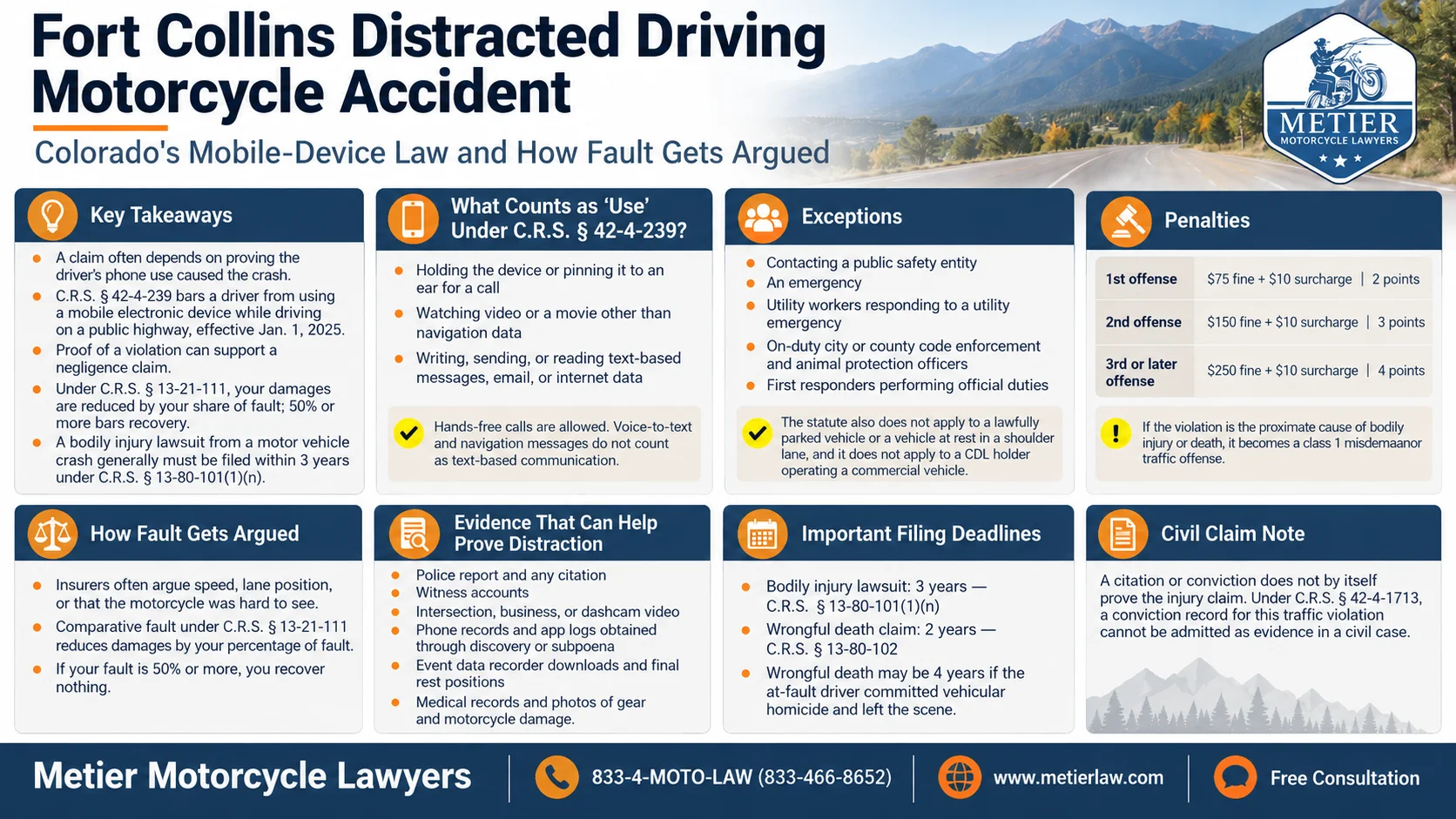
- A Fort Collins distracted driving motorcycle accident claim depends on proving the driver's phone use caused the crash.
- Under C.R.S. § 42-4-239 (effective January 1, 2025), a driver can't use a mobile electronic device while driving on a public highway, except in five listed situations.
- "Use" means holding the phone or pinning it to an ear for a call, watching non-navigation video, or writing, sending, or reading text-based messages.
- Proof that the driver violated the statute supports your negligence claim. Under C.R.S. § 13-21-111, any fault assigned to you reduces your damages in proportion, and 50% or more bars recovery.
- A bodily injury lawsuit from a motor vehicle crash must be filed within three years after the claim accrues under C.R.S. § 13-80-101(1)(n).
You're riding through a Fort Collins intersection when a driver drifts or turns without seeing you. Later you learn the driver's phone was in hand. Or a witness saw the driver looking down at a screen. The claim turns on proving distraction and answering the insurer's attempt to blame your lane position or speed.
In the Fort Collins distracted driving motorcycle accident cases we handle at Metier Motorcycle Lawyers, drivers rarely admit they were on a phone. "A phone in the driver's hand is strong evidence the driver wasn't watching the road," says Patrick DiBenedetto, Partner at Metier Law Firm and a rider himself. "Colorado law says a driver can't hold a phone or text while driving. When an adjuster blames the rider, we ask what the driver was looking at in the seconds before impact."
Colorado's Mobile-Device Rule Under C.R.S. § 42-4-239
Senate Bill 24-065 repealed and reenacted C.R.S. § 42-4-239, and the new version applies to conduct on or after January 1, 2025. It bars anyone from using a mobile electronic device while driving on a public highway. The Colorado Department of Transportation summarizes the rule on its hands-free law page.
Under the statute, "use" means:
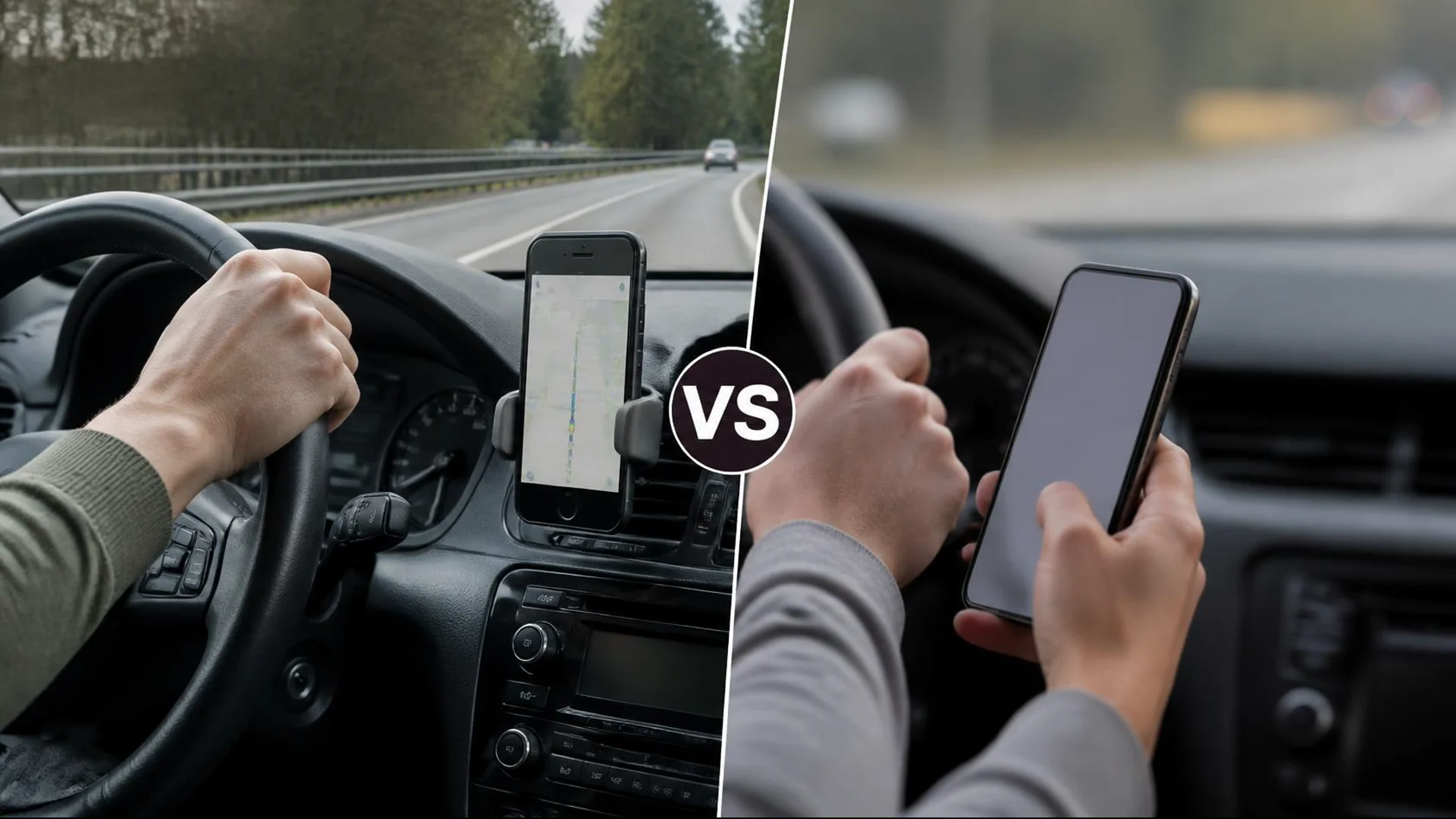
- Holding the device in hand or pinning it to an ear to conduct a voice call
- Watching a video or movie other than navigation data
- Writing, sending, or reading a text, instant message, email, or internet data
A call through a hands-free accessory isn't "use," and voice-to-text and navigation messages don't count as text-based communication. The statute defines that accessory as working without either hand. Its definition allows a single touch or swipe to activate, deactivate, or start a feature. Systems built into the vehicle's electronics aren't covered devices.
Penalties and What a Citation Means in a Civil Claim
A violation is a class A traffic infraction. Fines rise with each offense in a 24-month window: $75 for the first, $150 for the second, and $250 for the third or later, each plus a $10 surcharge. The point schedule in C.R.S. § 42-2-127 assigns 2, 3, and 4 license points to those convictions. If the driver's actions are the proximate cause of bodily injury or death to someone else, the violation becomes a class 1 misdemeanor traffic offense.
A citation, or even a conviction, doesn't prove the injury claim. Under C.R.S. § 42-4-1713, a conviction record for any violation of Article 4 of Title 42 can't be admitted as evidence in a civil case. That article includes the mobile-device statute. The rule's only exception covers habitual-offender license proceedings. We prove the phone use directly and tie it to how the crash happened.
Exceptions to the Mobile-Device Rule
Subsection (3) lists five exceptions:
- Contacting a public safety entity
- An emergency, as the statute defines it
- Utility workers responding to a utility emergency
- On-duty city or county code enforcement and animal protection officers
- First responders performing official duties
Under subsection (5), the statute doesn't apply to a commercial driver's license holder operating a commercial vehicle. The ban also doesn't reach a driver whose vehicle is at rest in a shoulder lane or lawfully parked. An exception means the driver hasn't violated § 42-4-239. Whether the rider was at fault is a separate question.
How Insurers Argue Fault in a Fort Collins Distracted Driving Motorcycle Accident
Even when phone use is clear, the at-fault driver's insurer looks for ways to raise your share of fault under C.R.S. § 13-21-111. That statute bars recovery when your negligence equals or exceeds that of the party you're seeking recovery from. At 50% or more, you recover nothing, and below that line your damages are reduced by your percentage. The arguments we see most are speed, lane position, and the claim that the motorcycle was hard to see.
After a Fort Collins crash, we move to secure evidence that answers them:
- The police report and any mobile-device or careless-driving citation
- Witness accounts of the driver looking at or holding a phone
- Intersection, business, or dashcam video
- The driver's phone records and app logs, obtained through discovery or subpoena after suit is filed
- Event data recorder downloads and final rest positions that establish reaction timing
- Medical records and photos of your gear and motorcycle damage
If the driver turned left across your path, our post on left-turn motorcycle collisions in Fort Collins covers fault in that crash. For the statute itself, see our explainer on Colorado's mobile-device driving law.
If you've been hurt in a motorcycle crash and need answers, call us at 833-4-MOTO-LAW (833-466-8652) or schedule a free consultation at www.metierlaw.com.
Filing Deadlines and Early Steps
C.R.S. § 13-80-101(1)(n) applies to tort actions for bodily injury arising out of the use or operation of a motor vehicle. Those lawsuits must be filed within three years after the cause of action accrues. Wrongful death claims follow C.R.S. § 13-80-102. The deadline is two years, or four years if the at-fault driver committed vehicular homicide and left the scene.
Evidence disappears sooner than that. Businesses record over video, and witnesses forget details. Get your medical care documented early and keep every photo of the scene. If the at-fault driver's insurer asks for a recorded statement, talk with a lawyer before you give one.
Frequently Asked Questions
How does Colorado's mobile-device law affect fault if a driver on a phone hits my motorcycle in Fort Collins?
C.R.S. § 42-4-239 bars drivers from using a mobile electronic device while driving on a public highway, with five listed exceptions. Proof the driver held a phone or was texting strengthens your negligence claim. Your own share of fault still counts under C.R.S. § 13-21-111: it reduces your damages in proportion, and 50% or more bars recovery.
What evidence proves distraction when the insurer blames the rider?
Distraction is proven with eyewitness accounts, video of the driver's hands or eyes, and phone records obtained through discovery or subpoena. Crash reconstruction then sets the timing. If the record shows the driver looking at a screen in the seconds before impact, the insurer's lane-position argument gets weaker.
Is hands-free phone use allowed under Colorado law?
Under C.R.S. § 42-4-239, a voice call through a hands-free accessory isn't "use" because the driver isn't holding the phone or pinning it to an ear. Writing, sending, or reading a text is still "use" even when the phone is mounted, unless it's voice-to-text or about navigation. Watching non-navigation video is also "use."
Can I still recover if I was partly at fault?
Yes, if your fault is less than 50% under C.R.S. § 13-21-111. Your award is reduced by your percentage, and a finding of 50% or more bars recovery.
How long do I have to file after a Fort Collins distracted driving motorcycle accident?
A bodily injury lawsuit from a Fort Collins distracted driving motorcycle accident must be filed within three years after the claim accrues, under C.R.S. § 13-80-101(1)(n). Wrongful death claims have a separate two-year deadline under C.R.S. § 13-80-102, with a four-year exception in subsection (2).
When the Driver Was Looking at a Phone
A Fort Collins distracted driving motorcycle accident claim rests on proof of what the driver was doing with the phone. Once that's established, the comparative fault statute decides how much of your damages you can recover. Before you give the insurer a statement or accept an early offer, talk to our Fort Collins motorcycle accident lawyer team at Metier Law Firm.
Call Metier Motorcycle Lawyers at 833-4-MOTO-LAW (833-466-8652) or schedule your free consultation today at www.metierlaw.com.
Disclaimer: Past results discussed should not be considered a guarantee of your results as the factors of every case are individually unique. This content is for informational purposes only and does not constitute legal advice. Consult a qualified attorney from Metier Law Firm regarding your individual situation for legal advice.

Tell Us About Your Case – Free Case Review with a Personal Injury Lawyer
(866) 377-3800Our Locations
.webp)
Do I have a Case?
How Much Should I Be Offered?
Do I Need an Attorney?
If these questions have crossed your mind, let us help. You may need a little direction or may not need an attorney at all, but you deserve to be confident knowing your options. We can provide you with information about our Attorneys of the West® accident investigations and legal services. Your confidential consultation with us is totally free.
Keep up with us!
