


TL;DR - Key Takeaways
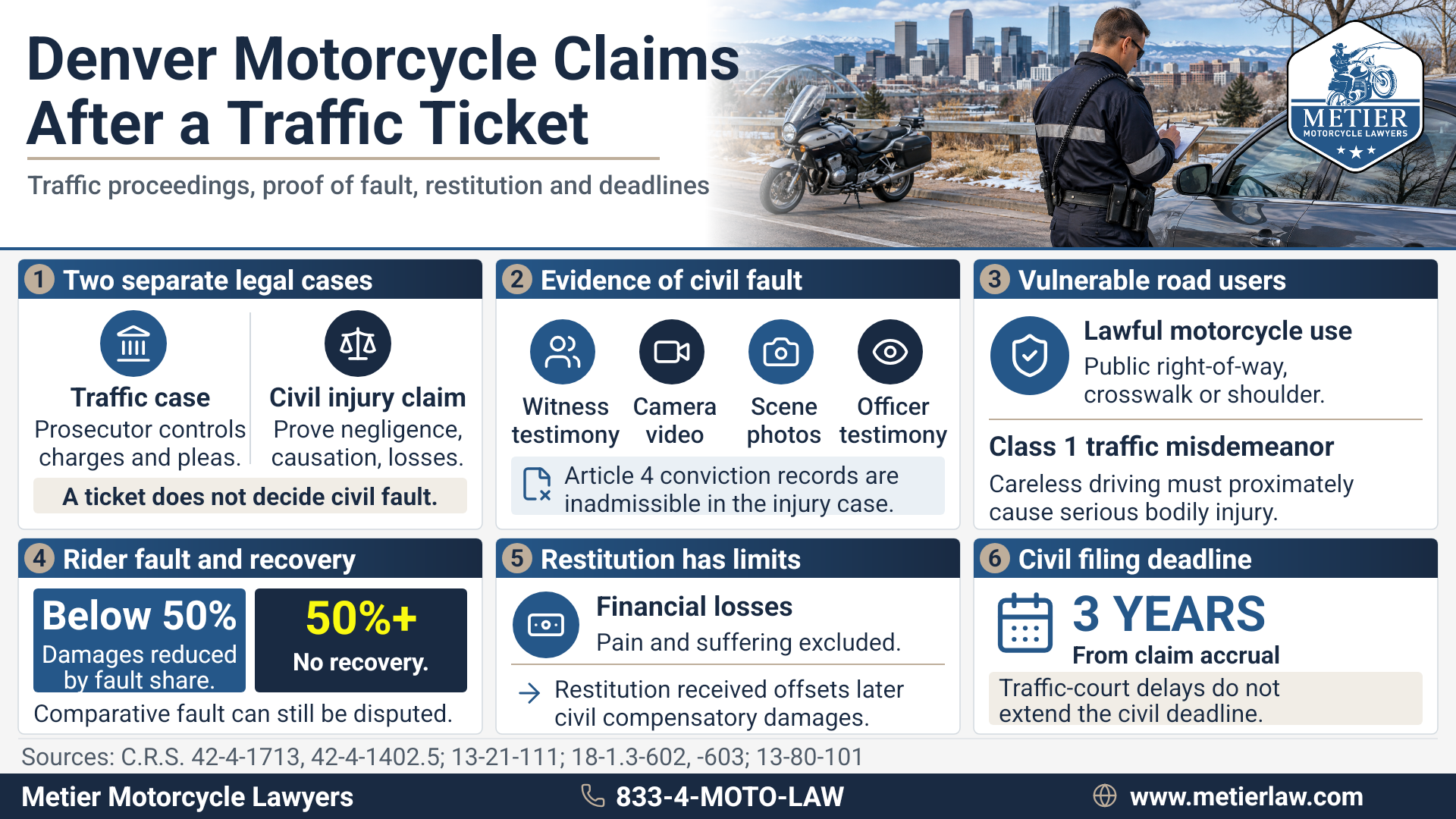
- A careless driving ticket opens a traffic case against the driver. Your injury claim is a separate civil case, and you still have to prove fault in it.
- Under C.R.S. § 42-4-1713, a record of the driver's conviction for a violation of Article 4 of Title 42, which includes careless driving, isn't admissible as evidence in a civil action.
- C.R.S. § 42-4-1402.5 lists a person lawfully using a motorcycle on a public right-of-way as a "vulnerable road user." Careless driving that is the proximate cause of serious bodily injury to that rider is a class 1 misdemeanor traffic offense.
- Under C.R.S. § 18-1.3-602(3)(a), restitution ordered in the traffic case doesn't include damages for pain and suffering. Any restitution you're paid is set off against compensatory damages you recover later in a civil case under C.R.S. § 18-1.3-603(6).
- The three-year filing deadline in C.R.S. § 13-80-101(1)(n)(I) keeps running while the traffic case is pending.
The crash report shows that the driver who turned across your lane was cited for careless driving. That citation doesn't decide fault in your injury claim.
In a Denver motorcycle accident where the driver was ticketed for careless driving, you still have to prove fault in a separate civil case. "C.R.S. § 42-4-1713 makes the conviction record inadmissible in a civil action," says Patrick DiBenedetto, Partner at Metier Law Firm and a rider himself. "We prove fault through testimony and physical evidence."
The Traffic Case and the Civil Claim Are Separate Proceedings
If the driver is charged under state law for a crash in the City and County of Denver, the ticket opens a traffic case in Denver County Court. You're the victim in that case, not a party. The prosecutor can subpoena you as a witness and controls the charge, any plea offer, and whether the case goes to trial.
Your injury claim is a civil matter against the driver and anyone else legally responsible for the driver's conduct. You have to prove that the driver's negligence caused your injuries and losses.
Charges That Apply to the Driver
Careless driving
Colorado's careless driving statute, C.R.S. § 42-4-1402, makes it an offense to drive "in a careless and imprudent manner." The base offense is a class 2 misdemeanor traffic offense. It becomes a class 1 misdemeanor traffic offense under subsection (2)(b). That subsection applies when the driver's actions are the proximate cause of bodily injury to another person.
Senate Bill 25-281 amended the statute for offenses committed on or after June 2, 2025. Subsection (2)(c)(I) already covered death. It now also covers serious bodily injury, as defined in C.R.S. § 18-1-901. The driver's actions must be the proximate cause. The charge applies whether or not the injured person is a vulnerable road user. It's a class 1 misdemeanor traffic offense.
Infliction of serious bodily injury to a vulnerable road user
Colorado's vulnerable road user law lists the motorcycle expressly. A person "lawfully using" a motorcycle on a public right-of-way, crosswalk, or shoulder of the roadway is a vulnerable road user under C.R.S. § 42-4-1402.5(1)(f)(VIII).
Subsection (2) applies when a driver violates the careless driving statute. The driver's actions must also be the proximate cause of serious bodily injury to a vulnerable road user. Serious bodily injury has the meaning given in C.R.S. § 42-4-1601(4)(b). A violation is a class 1 misdemeanor traffic offense. Under subsection (3)(c), a convicted driver is subject to license suspension and a restitution order.
Why the Conviction Is Inadmissible in Your Civil Case
Both charges fall under Article 4 of Title 42, Colorado's traffic code. Section 42-4-1713 says that "no record of the conviction of any person for any violation of this article shall be admissible as evidence in any court in any civil action." Its only exception refers to the habitual traffic offender statutes, C.R.S. §§ 42-2-201 to 42-2-208.
In Alhilo v. Kliem, 2016 COA 142, ¶ 19, the Colorado Court of Appeals read that exception narrowly. It held that the exception applies only in habitual traffic offender proceedings. The court declined to extend it to other civil actions.
The jury in your injury case won't see a conviction record for either offense. When a careless driving ticket follows a motorcycle accident, we still have to gather the evidence of fault and present it.
What We Use to Prove Fault
A police crash report can help explain what happened after a motorcycle crash. In a Colorado injury trial, the judge decides which parts of the report the jury can see because it may contain inadmissible hearsay. The responding officer can testify about what they personally observed at the scene. If the officer offers a crash reconstruction opinion based on specialized training, the officer must qualify as an expert.
We use the report to prepare the case, retain experts, and interview the officers who investigated. At Metier Motorcycle Lawyers, we build the case on admissible evidence:
- Witnesses named in the report, who can testify to what they saw
- Video from businesses, traffic cameras, dash cameras, and body cameras
- The responding officer's testimony
- Photographs and measurements of the scene and of the damage to both vehicles
If no report was filed, our guide to making a police report after an accident explains the process.
A citation doesn't prevent the driver's insurer from arguing that you were partly at fault. Colorado's comparative fault statute, C.R.S. § 13-21-111, reduces your damages by your percentage of fault. If your fault is 50% or more, you recover nothing. We explain that rule in our post on Denver comparative fault in motorcycle claims.
If you've been hurt in a motorcycle crash and need answers, call us at 833-4-MOTO-LAW (833-466-8652) or schedule a free consultation at www.metierlaw.com.

Restitution Is Separate From Your Injury Claim
A restitution order in the traffic case is narrower than civil damages. Section 18-1.3-602(3)(a) limits restitution to pecuniary loss. It excludes damages for physical or mental pain and suffering, loss of consortium, loss of enjoyment of life, loss of future earnings, and punitive damages.
On a non-felony traffic conviction, C.R.S. § 18-1.3-603(8)(a) narrows it further. The court can order restitution only for financial losses that insurance, self-insurance, an indemnity agreement, or a risk management fund cannot cover. The court may also award restitution for your insurance deductible.
You can still pursue a civil claim after the court orders restitution. Under C.R.S. § 18-1.3-603(6), any restitution you actually receive is credited against compensatory damages you later recover in a civil proceeding.
The Filing Deadline Runs During the Traffic Case
C.R.S. § 13-80-101(1)(n)(I) gives you three years to file a lawsuit for bodily injury arising out of the use or operation of a motor vehicle. The three years run from the date the cause of action accrues. A continuance or a delayed trial date in the traffic case doesn't extend them. Our post on the Colorado personal injury statute of limitations covers the deadline in more detail.
Frequently Asked Questions
Does a careless driving ticket prove fault in my injury claim?
No. After a Denver motorcycle accident where the driver was ticketed for careless driving, we must prove the driver's negligence in your civil case with admissible evidence.
Does Colorado's vulnerable road user law cover motorcyclists?
Yes. C.R.S. § 42-4-1402.5(1)(f)(VIII) covers a person lawfully using a motorcycle on a public right-of-way, crosswalk, or shoulder of the roadway.
Can my lawyer use the driver's traffic conviction in my case?
Not the conviction record. C.R.S. § 42-4-1713 makes a record of conviction for any Article 4 violation inadmissible in a civil action. We prove the same conduct through witnesses and physical evidence.
Should I go to the driver's traffic court date?
You have the right to attend when the charge is a covered crime under Colorado's Victim Rights Act. That includes careless driving under C.R.S. § 42-4-1402(2)(c) that results in serious bodily injury or death. For serious bodily injury, the offense must have been committed on or after June 2, 2025. C.R.S. § 24-4.1-302.5(1)(b) gives the victim the right to be informed of, and present for, the critical stages of the case. Those stages are listed in C.R.S. § 24-4.1-302(2), and some are limited to notice.
What Metier Law Firm Does After the Driver Is Cited
The citation shows that an officer charged the driver with a traffic offense. Our Denver motorcycle accident lawyers gather the admissible evidence your claim requires. That work begins while the traffic case is pending. The firm's Colorado motorcycle accident lawyers represent riders from offices in Denver, Fort Collins, and Colorado Springs.
Call Metier Motorcycle Lawyers at 833-4-MOTO-LAW (833-466-8652) or schedule your free consultation today at www.metierlaw.com.
Disclaimer: Past results discussed should not be considered a guarantee of your results as the factors of every case are individually unique. This content is for informational purposes only and does not constitute legal advice. Consult a qualified attorney from Metier Law Firm regarding your individual situation for legal advice.
Related Blog Posts
Tell Us About Your Case – Free Case Review with a Personal Injury Lawyer
(866) 377-3800Our Locations

Do I have a Case?
How Much Should I Be Offered?
Do I Need an Attorney?
If these questions have crossed your mind, let us help. You may need a little direction or may not need an attorney at all, but you deserve to be confident knowing your options. We can provide you with information about our Attorneys of the West® accident investigations and legal services. Your confidential consultation with us is totally free.
Keep up with us!
