.svg)


TL;DR Key Takeaways
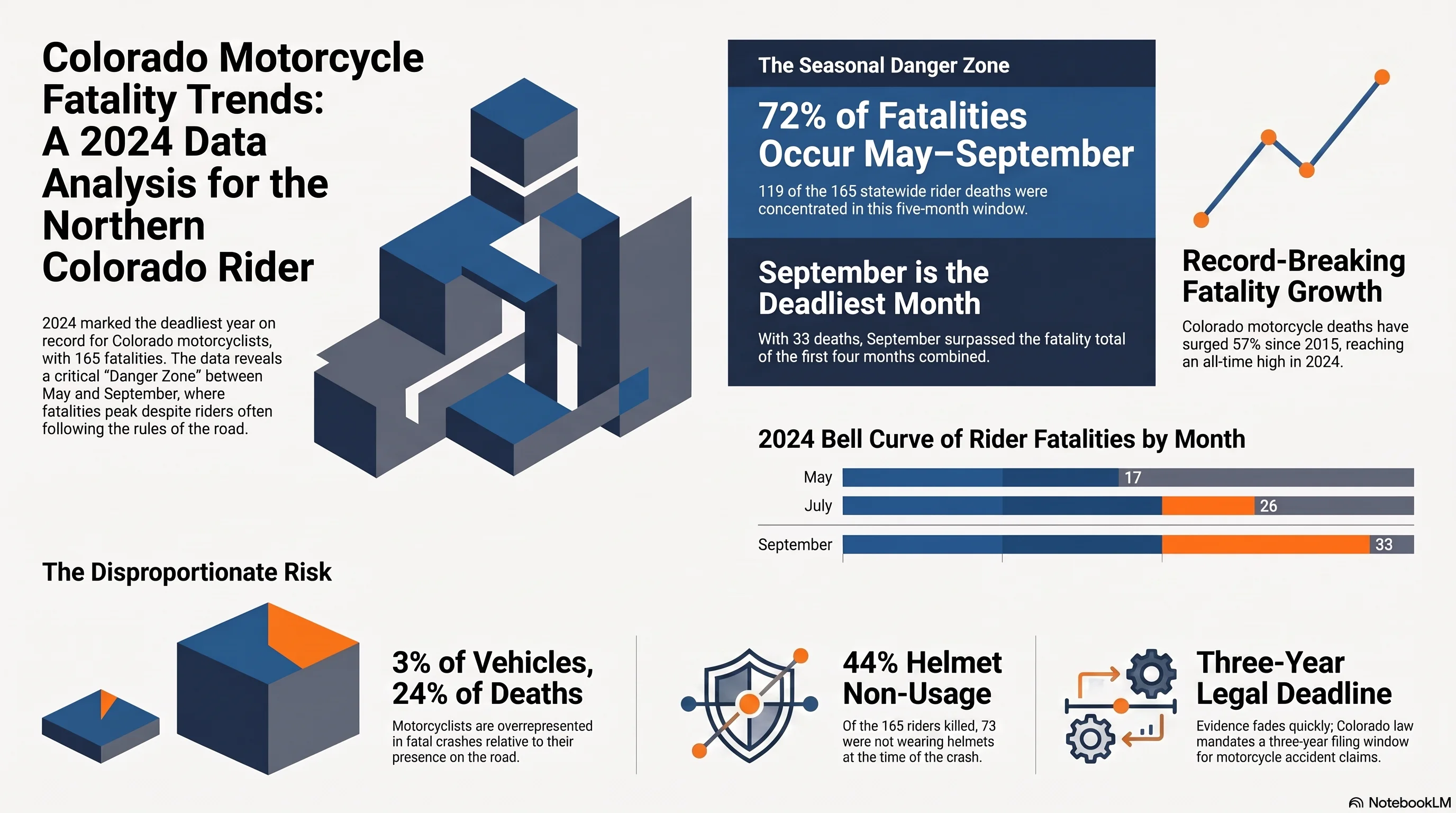
- About 72% of Colorado's motorcycle deaths in 2024 (119 of 165) happened between May and September, the exact window most northern Colorado riders are out on their bikes.
- September was the single deadliest month statewide, with 33 rider deaths, more than the first four months of the year combined.
- Fort Collins motorcycle accident statistics can't be separated from the statewide trend: Colorado just recorded its highest rider death toll ever, and motorcyclists made up 24% of all traffic deaths while being roughly 3% of vehicles.
- The riders getting hurt aren't only the reckless ones. National data shows a big share of fatal crashes involve riders who were doing the riding right but sharing the road with drivers who weren't.
- If you've been hit, the calendar and the numbers matter for your claim. Evidence fades fast, and the three-year filing deadline runs whether you're ready or not.
Ask any rider in northern Colorado when they feel most exposed, and most will say the same thing: summer. The roads fill up, the weather finally cooperates, and everybody wants to be out. The data backs that instinct. In 2024, Colorado lost 165 motorcyclists, the most the state has ever recorded, and those deaths didn't spread evenly across the year. They bunched up in a tight stretch that every Fort Collins rider already knows by feel.
I'm Patrick DiBenedetto, a partner at Metier Law Firm and a rider myself. Here's what I tell people who ask: "The calls start the week the weather breaks, and they don't let up until the leaves turn. Most of these riders were doing everything right. The problem is who they're sharing the road with, and there are a lot more of those drivers out there in July than in January." When you put Fort Collins motorcycle accident statistics next to the statewide picture, a clear story shows up. It's less about which road you took and more about when you rode, who was on the bike, and how little protection a motorcycle gives you when a driver makes a mistake.
Call Metier Law Firm at 833-4MOTO-LAW (883-466-8652) or schedule your free consultation today at www.metierlaw.com

When Colorado Riders Are Most at Risk
The clearest pattern in the data is seasonal. The Colorado Department of Transportation publishes a month-by-month breakdown of rider deaths, and 2024 reads like a bell curve. January saw zero motorcycle fatalities. February had three. Then the numbers climb: 17 in May, 20 in June, 26 in July, 23 in August, and a brutal 33 in September before dropping back to single digits by November.
Add up May through September and you get 119 of the year's 165 rider deaths. That's about 72% of the total packed into five months. For anyone asking when do most motorcycle accidents happen in Colorado, that's your answer in one number. It lines up with simple exposure. More riders, more miles, more cars, more chances for someone to turn left across your lane.
Why September Hits Hardest
September being the deadliest month surprises people. The weather's gorgeous, traffic eases off after the summer rush, and riders relax. That relaxation is part of the risk. Colorado State Patrol points to speed and impairment as the two biggest contributing factors in fatal rider crashes, and both creep up when riders are squeezing the last good weeks out of the season. For Fort Collins riders chasing those final clear days through the foothills, the riding season's tail end carries more risk than the calendar suggests.
Call Metier Law Firm at 833-4MOTO-LAW (833-466-8652) or schedule your free consultation today at www.metierlaw.com
What Larimer County's Numbers Show
Here's where I'll be straight with you about the data. Colorado doesn't publish motorcycle-only crash breakdowns at the county level, so there's no clean Larimer County motorcycle crash data set that splits out rider age, time of day, and injury severity for our area alone. Anyone who hands you those exact local figures is probably guessing. What we do have is solid.
Larimer County recorded 35 traffic deaths across all vehicle types in 2024, ranking it among the highest-fatality counties in the state. Fort Collins logged 14, placing it among Colorado's deadlier cities for its size. The local fatal motorcycle crashes that show up in the public record follow the same calendar as the statewide trend, concentrated in the warm-weather months rather than scattered through the year. The statewide pattern is the right lens for our area, and it points the same direction every time. If you want the road-level picture, our breakdown of the most dangerous intersections in Fort Collins covers where local crashes cluster.

Who's Getting Hurt, and Why It Matters
The "when" is only half the story. The "who" tells you something too. Nationally, the National Highway Traffic Safety Administration reports 6,228 motorcyclists killed in 2024, about 16% of all traffic deaths. Roughly 35% of the riders in fatal crashes didn't hold a valid motorcycle license, which says a lot about training and experience. Around 92% of those killed were male, and close to 38% of fatalities happened in single-vehicle crashes where no other driver was involved.
Rider age matters in a way most people miss. Younger riders on high-performance bikes and older riders on cruisers and touring bikes show up in the fatality data for different reasons, which is why blanket "ride safe" advice misses the mark. The risk profile changes with the rider. That's the same lesson behind why Colorado Springs is a hotspot for motorcycle crashes: the mix of who's riding and who they're sharing the road with drives the numbers more than the scenery does.
If you've been hurt in a motorcycle crash and need answers, call us at 833-4MOTO-LAW (833-466-8652) or schedule a free consultation at www.metierlaw.com.
The Severity Problem No Statistic Softens
The hardest truth in the Colorado motorcycle fatality statistics is how lopsided the injuries are. Riders made up 24% of all Colorado traffic deaths in 2024 while being about 3% of vehicles on the road. Statewide, motorcycles were involved in 774 serious-injury crashes that year. When a car and a motorcycle meet, physics doesn't negotiate.
Of the 165 riders killed, 73 (44%) weren't wearing a helmet. Colorado doesn't require helmets for adult riders, so that's a legal choice, but it shapes outcomes. None of this means an injured rider is to blame. It means the margin for error on a bike is thin, and the same patterns that drive crashes in Denver, covered in our look at the most dangerous roads for Denver motorcyclists, show up here too. A skilled Fort Collins motorcycle accident attorney builds the case around that reality instead of letting an insurer use your bike against you.
Frequently Asked Questions
When do most motorcycle accidents happen in Colorado?
Most happen between May and September. In 2024, about 72% of the state's rider deaths fell in that five-month stretch, with September the deadliest single month at 33 fatalities. It tracks with how many riders are on the road and how many cars they're sharing it with.
What do Fort Collins motorcycle accident statistics actually tell riders?
They tell you the danger is seasonal and severe. Larimer County ranks among Colorado's higher-fatality counties, and the statewide rider numbers hit their record in 2024. There's no reliable county-only motorcycle data set, so the statewide trend is the honest measure, and it points to summer and early fall as the riskiest months for local riders.
Are Colorado motorcycle fatality statistics getting worse?
Yes. Rider deaths have climbed 57% since 2015, and 2024's total of 165 was the highest the state has ever recorded. That happened even as overall traffic deaths in Colorado trended down, which makes the motorcycle trend stand out even more.
Does riding without a helmet hurt my injury claim in Colorado?
Not automatically. Colorado doesn't require helmets for adult riders, and not wearing one doesn't cause a crash. Under Colorado's comparative fault rule, you can still recover as long as you're less than 50% at fault, though an insurer may argue a lack of a helmet increased your injuries. A lawyer who handles rider cases knows how to push back on that.
What These Numbers Mean If You're the One Who Got Hit
Statistics are useful right up until you become one. Then it's just your crash, your bills, and your recovery. The data tells us when and how riders get hurt around Fort Collins, but it can't tell your story or fight your insurer. That part takes someone who rides, who knows these roads, and who knows what a serious motorcycle injury actually costs over time. We've spent decades doing exactly that for riders across Colorado, and we'd rather you call before an adjuster talks you into less than you're owed.
As a trusted motorcycle accident lawyer team, we bring that same approach to riders throughout the state. Our Fort Collins motorcycle accident lawyers know these roads firsthand, and our Colorado Springs motorcycle accident lawyers apply that same local knowledge further south. In the Denver metro, our Denver motorcycle accident lawyers handle claims with the same urgency, no matter how far the ride home is. We represent riders well beyond Colorado too, with a Seattle motorcycle accident lawyer and a Portland motorcycle accident lawyer on our team ready to fight for you closer to the Pacific Northwest.
Call Metier Motorcycle Lawyers at 833-4MOTO-LAW (833-466-8652) or schedule your free consultation today.
Disclaimer: Past results discussed should not be considered a guarantee of your results as the factors of every case are individually unique. This content is for informational purposes only and does not constitute legal advice. Consult a qualified attorney from Metier Law Firm regarding your individual situation for legal advice.
If You've Been Injured In A Motorcycle Crash, Call Today - (833) 4MOTO-LAW
Tell Us About Your Case – Free Case Review with a Personal Injury Lawyer
(866) 377-3800Our Locations
.webp)
Do I have a Case?
How Much Should I Be Offered?
Do I Need an Attorney?
If these questions have crossed your mind, let us help. You may need a little direction or may not need an attorney at all, but you deserve to be confident knowing your options. We can provide you with information about our Attorneys of the West® accident investigations and legal services. Your confidential consultation with us is totally free.
Keep up with us!
