.svg)


TL;DR / Key Takeaways
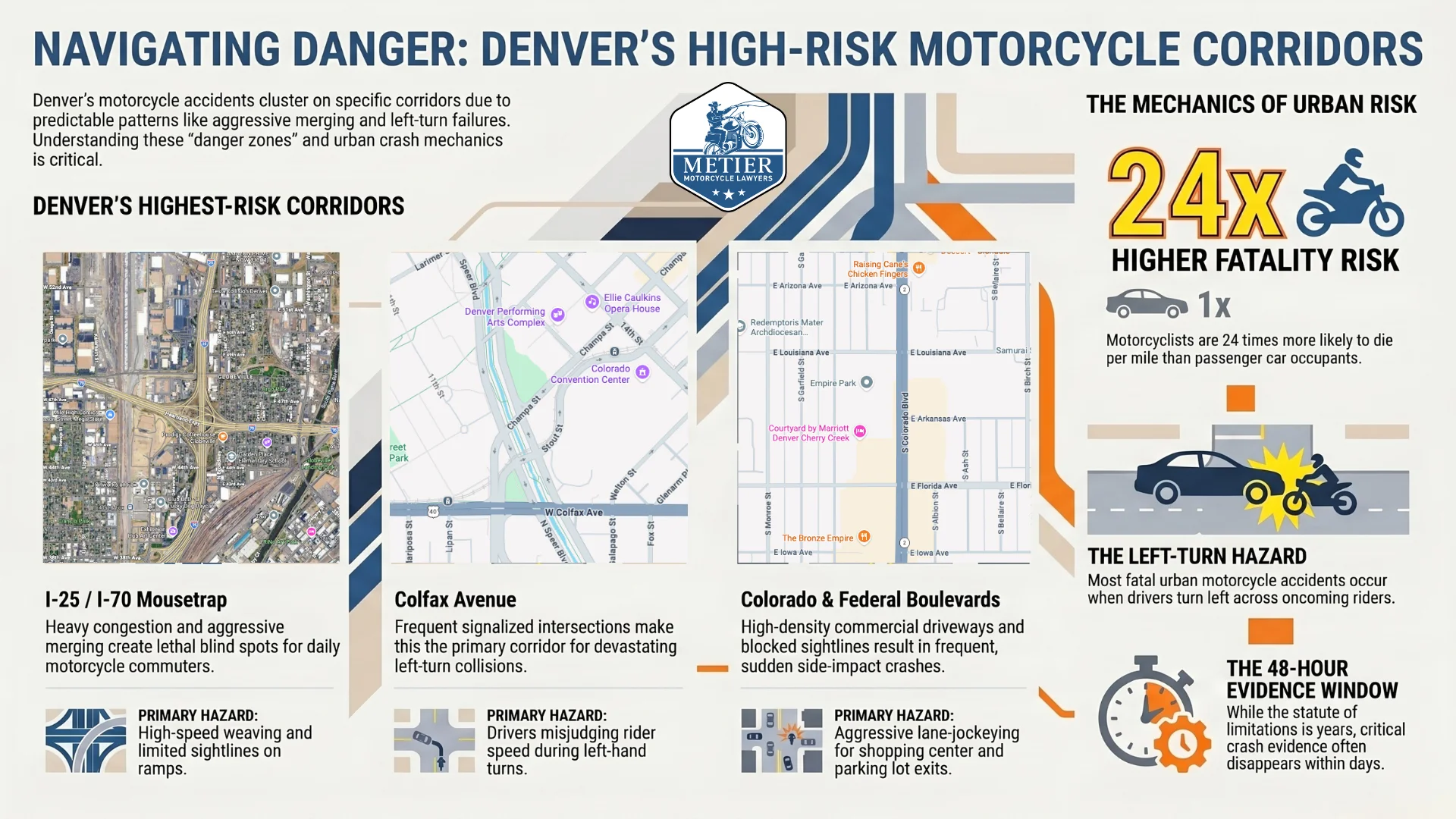
- I-25 through downtown, Colfax Avenue, Colorado Boulevard, and the I-70/I-25 Mousetrap rank among Denver's most dangerous corridors for riders
- Motorcyclists are 24 times more likely to die per mile than people in passenger cars, according to NHTSA
- Left-turn crashes at signalized intersections cause most fatal Denver motorcycle accidents
- Urban roads with constant lane changes shrink the margin that keeps riders alive
- Colorado's statute of limitations is three years, but crash evidence can disappear in days
Denver traffic doesn't forgive small mistakes. The stacked interchanges, packed arterials, and constant merge zones create places where a Denver motorcycle accident can happen before a rider even sees it coming. These roads follow patterns. They produce crashes for the same reasons, at the same spots, again and again.
"I ride these roads all the time," says Patrick DiBenedetto, Partner at Metier Motorcycle Lawyers, with 15 years representing injured riders across Colorado. "The Denver motorcycle accidents we handle aren't scattered across the city at random. They cluster on specific corridors, at specific intersection types, and most of it is preventable."
Where Denver Motorcycle Accidents Happen Most
I-25 Through Downtown
Aggressive merging defines I-25 from Broadway through 20th Street. Commuters cut across lanes in tight gaps. Big trucks create blind spots that swallow motorcycles whole. Riders get boxed between vehicles making split decisions, with no room to go and no time to react. This stretch produces a huge share of the Denver motorcycle accident cases we see from riders who commute daily.
The I-70/I-25 Mousetrap
Two interstates stacked north of downtown create one of Colorado's most brutal interchanges. CDOT tracks it as one of the state's most congested spots. Weaving lanes, high speeds on the ramps, and limited sightlines make it rough for anyone on two wheels. When traffic slows and drivers start threading between lanes, motorcycles vanish into the noise.
Colfax Avenue
Colfax cuts east-west across Denver for miles and crosses dozens of signalized intersections. The left-turn collision rules this road. A driver turns left across oncoming traffic, misjudges a rider's speed, and a broadside hit follows. NHTSA flags left-turn collisions as a leading cause of fatal motorcycle crashes across the country. At Federal Boulevard, at Sheridan, heading east past Colorado Boulevard, Colfax generates more Denver motorcycle accident cases than almost any other corridor.
Colorado Boulevard
Colorado Boulevard runs through some of the densest commercial zones in the city. Driveways and parking lot exits break the rhythm of the road constantly. Drivers cut lanes without signaling, jockeying for turns into shopping centers and fast food lots. Signal timing rewards aggressive gap-filling. Riders end up squeezed into shrinking spaces at speed, with no clean way out when a vehicle moves without warning.
Federal Boulevard and Speer Boulevard
Federal carries heavy bus and truck traffic, with rough pavement and sightlines blocked by parked vehicles at intersections. Speer runs diagonally through central Denver, which throws drivers off when they expect standard perpendicular turns. Neither road tolerates inattention. Both create the close-quarter conditions where a Denver motorcycle accident turns ugly in seconds.

Why Urban Corridors Kill Riders
Multi-lane arterials multiply the risk. More lanes mean more drivers making decisions at once. Every signalized intersection sets up the left-turn scenario that kills riders. Distracted drivers at red lights don't look for motorcycles before they go.
NHTSA puts the math plainly: motorcyclists are 24 times more likely to die per mile than people in passenger cars. Denver's dense, stop-and-go traffic doesn't soften those numbers. The Insurance Institute for Highway Safety confirms that urban intersections cause a big share of fatal motorcycle crashes, with multi-vehicle wrecks far outpacing single-vehicle ones in city riding. The Motorcycle Safety Foundation tells riders to treat every city intersection as a possible collision point. On Colfax or I-25, that's not paranoia. That's an honest read of what's out there.
If you've been hurt in a motorcycle crash and need answers, call us at 833-4MOTO-LAW (833-466-8652) or schedule a free consultation at www.metierlaw.com.
What to Do After a Denver Motorcycle Accident
After a Denver motorcycle accident, the first 48 hours shape everything. Call the police. Document the scene before anything moves: skid marks, road debris, signal positions, and weather conditions. Get witness names and numbers before they leave. See a doctor right away. Soft tissue injuries and internal trauma often don't show up for days.
Don't talk to the other driver's insurer before you call an attorney. Adjusters are trained to collect statements that shrink payouts. Good-faith answers get used against your claim.
Colorado gives injured riders three years from the crash date to file a personal injury lawsuit. Crash evidence doesn't wait that long. Surveillance footage gets overwritten in days. Witnesses move on. Physical evidence disappears. Start early.
For more on what injured riders can recover, read about how much a motorcycle accident settlement is worth in Colorado. For a broader picture of statewide crash severity, see how many motorcycle accidents result in serious injury or death. If you're not sure whether calling a lawyer makes sense, start with common myths about motorcycle crash lawyers.
Frequently Asked Questions
What causes most Denver motorcycle accidents?
Left-turn collisions at signalized intersections cause the largest share of fatal motorcycle crashes in urban areas. A driver turns left without yielding to an oncoming rider, and the result is a broadside hit at speed. Distracted driving and lane changes without mirror checks are close behind.
Do I need a lawyer if the other driver was clearly at fault?
Yes. Insurers fight liability even in clear-cut cases. A Denver motorcycle accident attorney will lock down evidence, bring in crash reconstruction experts, and fight for payment that reflects your real losses, not the minimum the adjuster offers.
How long do I have to file after a crash in Colorado?
Colorado's statute of limitations for personal injury is three years from the crash date. Missing that deadline usually ends your right to recover. Call an attorney early. Crash evidence won't hold itself.
Can I recover damages if I wasn't wearing a helmet?
Colorado doesn't require helmets for riders 18 and older, so riding without one doesn't block your claim on its own. An insurer may argue it made your injuries worse. An experienced attorney can push back with medical evidence.
What if dangerous road conditions contributed to my crash?
Government agencies can be liable for failed signals, rough pavement, or missing signs. These claims carry strict notice deadlines and short filing windows. An attorney needs to look at this right after the crash.

Denver Riders Deserve Serious Representation
Every road on this list has produced crashes that didn't have to happen. I-25 through downtown. The Mousetrap on a busy Friday. A Tuesday afternoon on Colfax. These aren't abstract numbers. They're real corridors where Denver motorcycle accidents have ended lives and changed others for good.
At Metier Motorcycle Lawyers, we ride these roads. We know the merge zones, the blind-spot corridors, and the intersection angles that put riders on the ground. When driver negligence causes a Denver motorcycle accident, we build the case to hold them accountable.
You pay no attorney fees unless we win.
Call Metier Motorcycle Lawyers at 833-4MOTO-LAW (833-466-8652) or schedule your free consultation today at www.metierlaw.com.
Disclaimer: Past results discussed should not be considered a guarantee of your results as the factors of every motorcycle crash case are individually unique. This content is for informational purposes only and does not constitute legal advice. Consult a qualified motorcycle accident lawyer from Metier Law Firm regarding your individual situation for legal advice.
Tell Us About Your Case – Free Case Review with a Personal Injury Lawyer
(866) 377-3800Our Locations
.webp)
Do I have a Case?
How Much Should I Be Offered?
Do I Need an Attorney?
If these questions have crossed your mind, let us help. You may need a little direction or may not need an attorney at all, but you deserve to be confident knowing your options. We can provide you with information about our Attorneys of the West® accident investigations and legal services. Your confidential consultation with us is totally free.
Keep up with us!
