.svg)


TL;DR - Key Takeaways
- PTSD after a Denver motorcycle accident is a real, diagnosable injury, and it shows up in crash survivors far more often than most people expect.
- Symptoms in the first month are usually acute stress, which can turn into post-traumatic stress disorder when they don't fade after about four weeks.
- PTSD wrecks sleep, focus, relationships, and the ability to work, and those effects carry real financial weight.
- Colorado lets injured riders recover for psychological injuries, including both treatment costs and pain and suffering.
- We've ridden these roads, and we treat the mental toll of a crash as seriously as the broken bones.
The first ride after a bad wreck is the one that tells you something's wrong. You throw a leg over the seat, your hands are steady, the bike's fine, and then your chest locks up at the first intersection. That reaction has a name, and for a lot of riders it's the start of something that needs real attention. I'm Patrick DiBenedetto, a partner here at Metier Law Firm and a rider myself, and I've sat across from too many people in Denver who walked away from a crash with their body mostly intact and their head anything but.
"The bruises heal on a schedule. The fear doesn't. I've watched careful, experienced riders avoid their own garage for months because the trauma never got treated, and the insurance company acted like it never happened."
That's the gap we want to close here. A motorcycle crash trauma can rewire how you feel on the road and off it, and post-traumatic stress disorder is one of the most common ways that damage shows up.
Call Metier Law Firm at 833-4MOTO-LAW (833-466-8652) or schedule your free consultation today at www.metierlaw.com
Why Motorcycle Accident Survivors Are at High Risk for PTSD
Riders don't have a steel cage around them. When a car turns left across your path, there's nothing between your body and the pavement, and your brain knows it in the half second before impact. The National Highway Traffic Safety Administration notes that motorcyclists are heavily overrepresented in serious crashes precisely because they lack the protective structure of a car. That exposure makes the event more violent, and the severity of a crash is one of the strongest predictors of who develops PTSD.
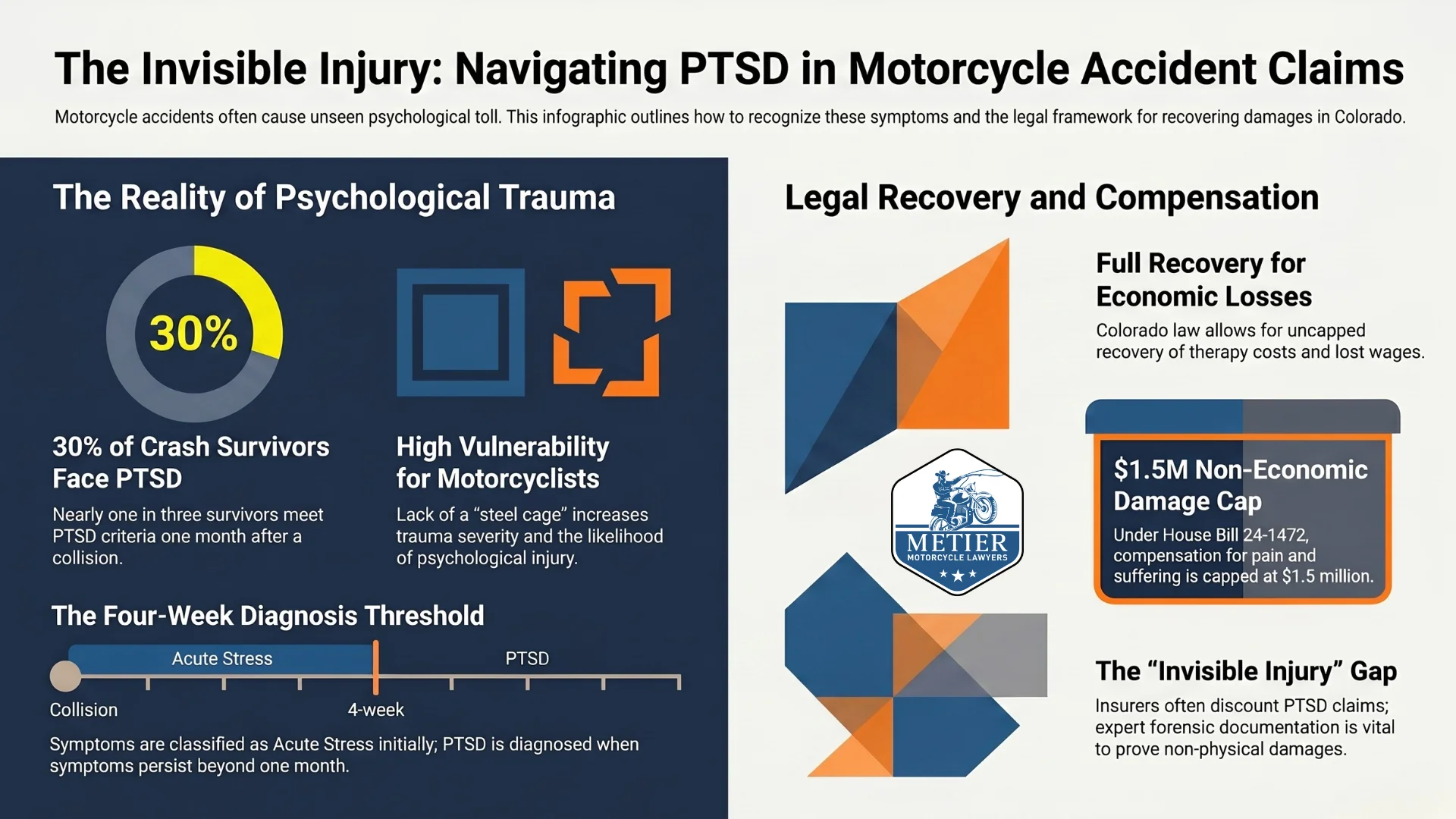
The research backs this up. A recent meta-analysis of road traffic crash survivors found that close to 30% met the criteria for PTSD a month after the wreck, with nearly one in five still meeting them three months out. Riders tend to sit at the rougher end of that range, because their crashes are usually worse.
Call Metier Law Firm at 833-4MOTO-LAW (833-466-8652) or schedule your free consultation today at www.metierlaw.com
Common PTSD Symptoms Riders Experience After a Crash
PTSD symptoms cluster in a few recognizable ways:
- Intrusive memories or flashbacks of the moment the car appeared
- Nightmares and trouble sleeping
- Avoiding the road where it happened, or quitting riding altogether
- Feeling keyed up and jumpy, quick to anger over small things
- Emotional numbness, like the world lost its color
These signs get missed because survivors hide them, and because an injury that doesn't bleed is easy to wave off. We covered that exact pattern in our piece on common myths about motorcycle crash claims, and emotional distress fits it perfectly. The pain you can't photograph is still real.
How PTSD Is Diagnosed After a Traumatic Motorcycle Accident
Timing is the part most people get wrong. In the first month after a crash, these symptoms are usually classified as acute stress disorder, not PTSD. PTSD gets diagnosed when the symptoms last longer than a month and keep interfering with your life. The VA's National Center for PTSD explains that most people feel shaken after a trauma and start to settle within a few weeks, and that when it drags past a month and keeps causing problems, it could be PTSD.
A licensed psychologist or psychiatrist makes that call, usually by measuring your symptoms against the four recognized clusters: re-experiencing, avoidance, negative shifts in mood and thinking, and heightened arousal. Getting that diagnosis on the record early matters for your recovery and for any claim you bring.
If you've been hurt in a motorcycle crash and need answers, call us at 833-4MOTO-LAW (833-466-8652) or schedule a free consultation at www.metierlaw.com.
The Impact of PTSD on Daily Life and Work After a Crash
Psychological injuries don't stay in their lane. PTSD bleeds into your job, your marriage, and whether you can drive your kid to school without your hands shaking. People lose work because they can't concentrate or can't get behind the wheel. They pull back from friends. The emotional distress becomes its own injury stacked on top of the physical one.
That daily damage carries a dollar value. Lost wages, reduced earning capacity, and the cost of therapy and medication are economic losses tied straight to the crash. Pain and suffering and the loss of everyday enjoyment are non-economic losses. Both belong in your claim.

Can You Recover Compensation for PTSD After a Motorcycle Accident?
Yes. Colorado recognizes psychological injuries as compensable. Your therapy bills, medication, and any income you lost because you couldn't work are economic damages, and Colorado generally doesn't cap those in a motorcycle case. Your pain and suffering and emotional distress are non-economic damages, and those are capped. For civil actions filed on or after January 1, 2025, the state raised the non-economic cap to $1.5 million under House Bill 24-1472.
Fault changes the math. Colorado uses modified comparative negligence, so if an insurer pins enough blame on you, it shrinks every part of your recovery, including the pain and suffering tied to your PTSD. We break that rule down in our guide to Denver comparative fault. What your case is actually worth depends on the injuries, the available coverage, and the evidence, which we walk through in our breakdown of motorcycle accident settlement value in Colorado.
Why Psychological Injuries Are Often Undervalued in Accident Claims
Adjusters love a clean X-ray. A fracture is easy to price, so they pay it. PTSD isn't, so they discount it, question it, or pretend it has nothing to do with the crash. They'll point to a gap in your treatment, argue you were anxious before the wreck, or suggest you're playing it up. Without documentation and the right experts, psychological injuries get written off.
That's a choice insurers make because it saves them money, and it works on people who don't have anyone pushing back.
Call Metier Law Firm at 833-4MOTO-LAW (833-466-8652) or schedule your free consultation today at www.metierlaw.com
How Metier Law Firm Handles Emotional Damage in Motorcycle Cases
We treat the mental toll as a real injury, because it is one. At Metier Motorcycle Lawyers we build the psychological side of a case with the same care as the orthopedic side. We bring in treating clinicians and, when a case calls for it, forensic experts who can tie your PTSD symptoms directly to the crash and explain the impact to a jury. We document how your life actually changed. We tell the part of the story the insurance company would rather skip.
Being riders ourselves, we understand why someone tries to tough it out. We also know that toughing it out alone tends to cost people both their recovery and their claim.
Frequently Asked Questions About PTSD After a Motorcycle Accident
How soon after a crash can PTSD be diagnosed?
PTSD is diagnosed when symptoms last longer than about a month and keep disrupting your life. In the first few weeks, the same symptoms are usually called acute stress disorder, which can develop into PTSD if it doesn't ease up.
What are the most common PTSD symptoms riders report?
Intrusive memories or flashbacks, nightmares, trouble sleeping, avoiding the crash site or riding entirely, feeling constantly on edge, irritability, and emotional numbness. Many riders notice several of these at the same time.
Can I get compensation for PTSD after a Denver motorcycle accident?
Yes. You can recover the cost of treatment and lost income as economic damages, plus pain and suffering and emotional distress as non-economic damages. A Denver motorcycle accident lawyer can document the psychological injury and fight to keep its full value in your claim.
How long do I have to file a claim in Colorado?
Colorado generally gives you three years from the date of a motor vehicle crash to file an injury claim. Evidence fades fast, though, so it pays to talk with a lawyer well before that deadline.
Will the insurance company take my PTSD seriously?
Often they won't, not without pressure. Psychological injuries get discounted because they're harder to measure than a broken bone. Solid medical documentation and experienced legal help change that.
Get Help From Riders Who Understand the Whole Injury
A crash can take more than your bike and a few weeks of mobility. It can take your sleep, your nerve, and your sense of safety on a road you used to love. Those losses are real, they're treatable, and under Colorado law they're compensable. You shouldn't have to prove your pain to an adjuster who's hoping you'll just give up, and getting compensation for PTSD starts with someone treating it like the injury it is.
Call Metier Motorcycle Lawyers at 833-4MOTO-LAW (833-466-8652) or schedule your free consultation today at www.metierlaw.com.
Disclaimer: Past results discussed should not be considered a guarantee of your results as the factors of every case are individually unique. This content is for informational purposes only and does not constitute legal advice. Consult a qualified attorney from Metier Law Firm regarding your individual situation for legal advice.
If You've Been Injured In A Motorcycle Crash, Call Today - (833) 4MOTO-LAW
Tell Us About Your Case – Free Case Review with a Personal Injury Lawyer
(866) 377-3800Our Locations
.webp)
Do I have a Case?
How Much Should I Be Offered?
Do I Need an Attorney?
If these questions have crossed your mind, let us help. You may need a little direction or may not need an attorney at all, but you deserve to be confident knowing your options. We can provide you with information about our Attorneys of the West® accident investigations and legal services. Your confidential consultation with us is totally free.
Keep up with us!
