.svg)


TL;DR: Key Takeaways
- Casper sits at the center of Wyoming's Powder River Basin energy corridor, putting it in the path of some of the heaviest and most hazardous commercial truck traffic in the region.
- Oilfield trucks are not generic freight haulers: crude tankers, water haulers, brine trucks, and pneumatic frac sand trailers carry different loads, behave differently in a crash, and create different injury patterns.
- Federal law under 49 CFR § 395.1(d) carves out special hours-of-service accommodations for oilfield drivers, which means fatigue rules that apply to most truckers don't apply to them the same way.
- Lease-operator arrangements in the energy sector blur the lines between employer and independent contractor, making it harder for injured victims to identify who's actually responsible.
- Small oilfield carriers frequently carry only minimum-required insurance, leaving catastrophic injury victims exposed if they don't know where else to look for coverage.
- Evidence in oilfield crash cases, including ELD records, dispatch logs, and lease agreements, disappears fast. Getting a lawyer involved early isn't just helpful, it's often the difference between a full recovery and none.
Every other week, you can watch a crude tanker roll through downtown Casper heading south on I-25, or a pneumatic trailer loaded with frac sand grinding north on US-20/26 toward the Powder River Basin. This isn't incidental traffic. Casper has been the staging ground for Wyoming's oil and gas industry for over a century, going back to the Salt Creek oilfield north of town, which was among the largest producing fields in the country in the early 1920s. The basin never really went quiet, and neither did the trucks that serve it.
Call Metier Law Firm at 866-377-3800 or schedule your free consultation today at www.metierlaw.com
As a former resident of Wyoming for many years, I've seen how oilfield operations and the vehicles involved in that industry work. These aren't the same trucks you see on I-80 hauling freight to Denver. The vehicles, the routes, the regulatory environment, and the risk patterns are all different. When one of these trucks is involved in a crash near Casper, the legal questions that follow are also different from your average semi accident, and most attorneys don't know that.

The Roads and the Traffic
The routes feeding Casper's energy sector run in almost every direction. I-25 north toward Buffalo carries oilfield traffic headed into the Powder River Basin. US-20/26 west through Midwest, Wyoming and on toward Shoshoni and Riverton is the main energy corridor, with tanker after tanker moving crude or water to and from active lease sites. US-87 north toward Midwest, WY and Glenrock serves oilfield operations that have been active since the Salt Creek days. WY-220 southwest toward Rawlins handles refinery-related traffic and lease access out of the Casper dome area.
These are two-lane roads in many stretches. They carry vehicles that gross 80,000 pounds or more. They're icy several months a year, and when you combine that with driver fatigue or overloaded tankers, the results are severe. WYDOT's crash data publications document Wyoming's heavy-truck crash problem at the statewide level, and Natrona County, as one of the state's most industrialized counties by truck volume, is consistently represented in those numbers. We've also tracked a broader pattern in what's happening on Wyoming's roads in 2026.
Call Metier Law Firm at 866-377-3800 or schedule your free consultation today at www.metierlaw.com
What Makes Oilfield Trucks Different
When someone says "truck accident," most people picture an 18-wheeler hauling consumer goods. Oilfield trucks are their own category.
Crude Tankers
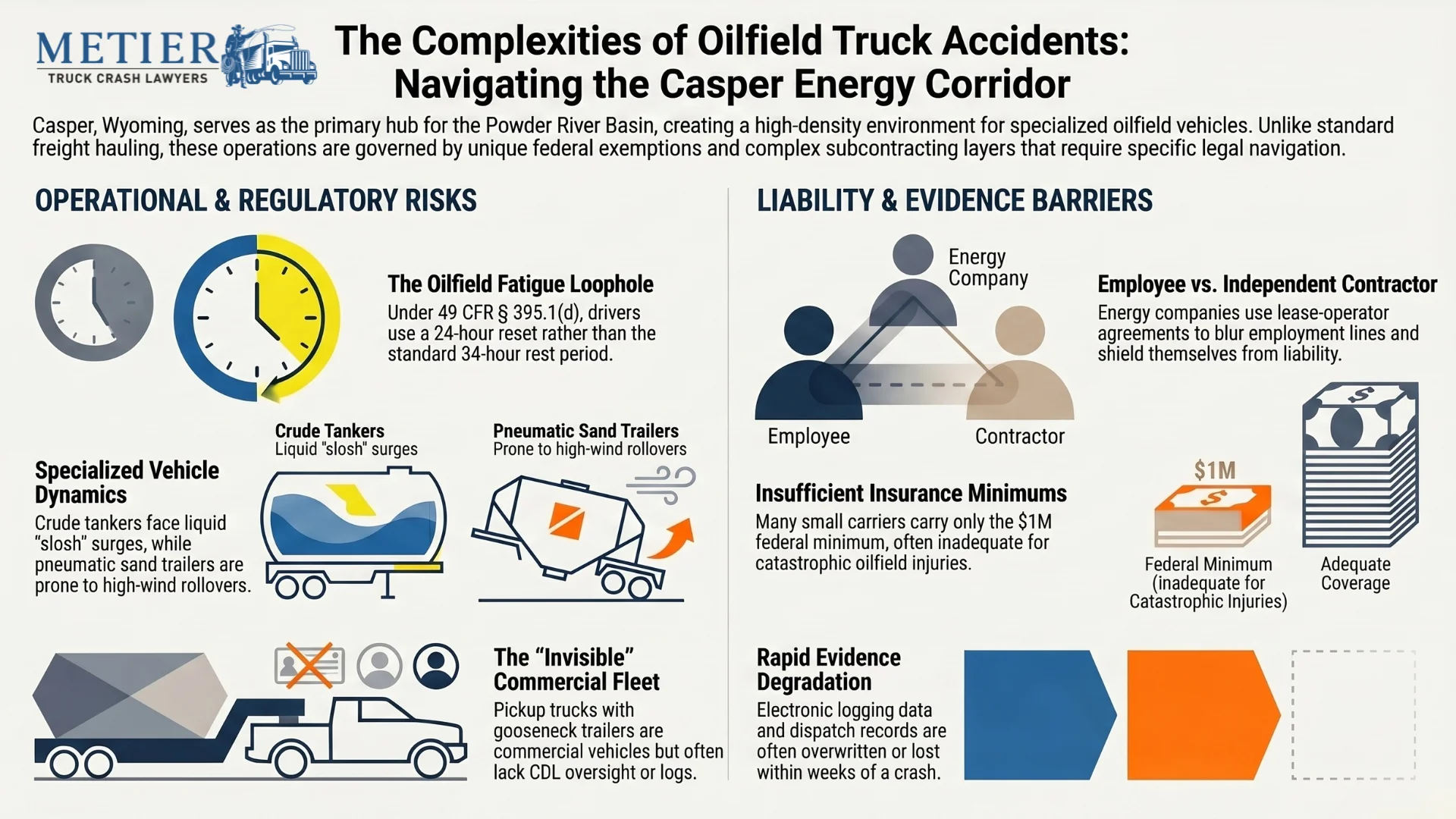
Crude tankers can carry up to 130 barrels, with the liquid load shifting on curves and grades. A partially loaded tanker is actually more dangerous than a full one because the fluid sloshes. On a tight curve on US-87, that surge of weight can overwhelm a driver and send the trailer into a rollover or jackknife.
Water Haulers and Brine Trucks
Water haulers and brine trucks run constantly on Powder River Basin lease roads and then transition to state highways around Casper. They're often heavy, frequently overloaded, and driven by operators who are in a hurry because they're paid by the load, not the hour.
Pneumatic Frac Sand Trailers
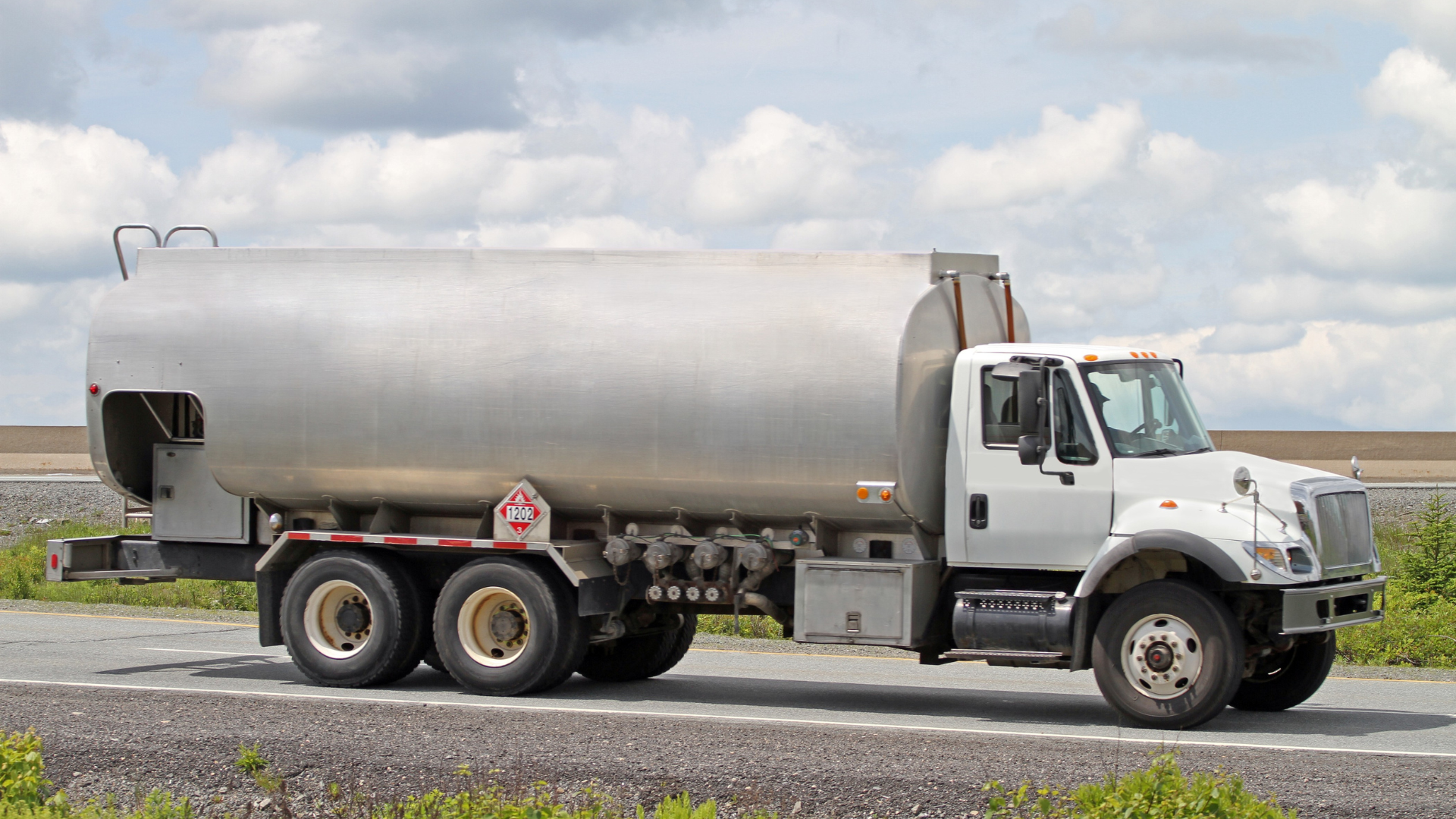
Pneumatic frac sand trailers are long, top-heavy, and carry tens of thousands of pounds of proppant. They can lose stability quickly on uneven road surfaces or in crosswinds, which anyone who's driven WY-220 in January knows is a real factor.
Lease-Operator Pickups with Gooseneck Trailers
Lease-operator pickups with gooseneck trailers are the ones people overlook entirely. A half-ton truck pulling a 20,000-pound gooseneck with pipe or equipment on board is a commercial vehicle under federal law, but the driver often has no CDL, no log, and no real oversight. These show up in crashes on roads north of Casper regularly, and the injury severity is high.
The Regulatory Angle Most Attorneys Miss
Federal hours-of-service rules under 49 CFR Part 395 are supposed to limit how many hours a commercial driver can operate before mandatory rest. Those rules exist because fatigued drivers kill people. FMCSA's own Large Truck Crash Causation Study identified fatigue as a material factor in serious truck crashes.
Here's what most people don't know: oilfield drivers operate under a special exemption. Under 49 CFR § 395.1(d), drivers of commercial vehicles used exclusively in transporting oilfield equipment or servicing field operations can reset their 8-day consecutive duty clock with a 24-hour off-duty period, rather than following the standard 34-hour restart. A second provision allows waiting time at a well site to be logged as "off-duty" for specially trained operators of specially constructed oil-well service vehicles.
What this creates in practice is a driver population that can work through duty cycles that look compliant on paper but produce chronic fatigue over days and weeks. A driver who's been on and off lease roads around Casper for six straight days, sleeping in short irregular stretches, logging wait time as off-duty, can still be legally "within hours" right before a crash on US-20/26. That's the real exposure, and it's the kind of thing you only catch if you know what to look for in the records.
We handle jackknife crashes and rollover accidents involving Wyoming and Colorado oilfield trucks, and the HOS records are one of the first things we request.
Call Metier Law Firm at 866-377-3800 or schedule your free consultation today at www.metierlaw.com
Who's Actually Responsible
Oilfield trucking is full of lease operators: owner-operators who own their equipment and contract out to an energy company or a mid-tier hauling company that itself contracts to a producer. When there's a crash, the company that paid the driver will often claim he was an independent contractor, not an employee, and try to limit their exposure.
This is where experience matters. The lease agreement, dispatch records, load tickets, and communication logs can establish whether that "independent contractor" was actually functioning as an employee. If the company controlled what he hauled, when he hauled it, what routes he took, and how he logged his time, there's a real argument for employer liability regardless of what the contract says.
Insurance coverage in this sector is another problem. Many small oilfield carriers in the Casper area carry only the federal minimum, which for hazardous liquids like crude oil is $1 million. For a catastrophic spinal cord injury or a wrongful death, that number gets consumed quickly. Our job is to work through every layer, including the energy company that hired the carrier, to find the coverage that actually matches the harm.
If you or a loved one was injured in a crash with a commercial truck, call us at 866-377-3800 or schedule a free consultation at www.metierlaw.com.
Frequently Asked Questions
What makes an oil and gas truck accident in Casper, Wyoming different from a regular truck crash?
The vehicles, the regulations, and the liability structure are all different. Oilfield trucks like crude tankers, water haulers, and frac sand trailers have different load dynamics and crash patterns than standard freight trucks. The drivers may operate under special federal HOS exemptions under 49 CFR § 395.1(d) that don't apply to most truckers. And the operators are often lease contractors, not direct employees, which complicates who's actually liable.
Can I sue an energy company if their contracted truck driver caused my crash?
Potentially, yes. If the evidence shows the energy company exercised control over how the driver operated, what they hauled, and when they worked, there's a real argument for liability even if the driver was technically an independent contractor. This is a fact-intensive analysis that requires reviewing the lease agreement, dispatch records, and communication logs.
What is the FMCSA oilfield hours-of-service exemption and how does it affect my case?
Under 49 CFR § 395.1(d), drivers transporting oilfield equipment or servicing field operations can reset their consecutive duty cycle with a 24-hour off-duty period, which differs from the standard rules for other truckers. A second provision lets operators of specially constructed oil-well service vehicles count certain well-site wait time as off-duty. These provisions can create situations where a driver is technically within legal hours but still suffering from cumulative fatigue. That pattern is something we look for specifically when reviewing records after a Wyoming oilfield truck accident.
How much insurance does an oilfield trucking company in Wyoming typically carry?
Many smaller carriers in the Casper area operate at or near the federal minimum, which for trucks carrying hazardous liquids like crude oil is $1 million per incident. For serious injuries or wrongful death cases, that amount is often inadequate. An experienced Casper truck accident lawyer will work through every layer of the contracting chain, from the lease operator to the energy producer, to identify all available coverage.
How soon should I contact a lawyer after an oil and gas truck accident in Casper?
As soon as possible. While federal regulations have mandates for how long records must be kept, electronic logging data, load records, dispatch logs, and inspection reports can be overwritten or lost quickly. Getting a preservation letter out to the carrier quickly is one of the most important things an attorney can do to protect your case. The sooner we get involved, the better the chance of preserving the evidence you'll need.
What Evidence You Need and When
The clock starts running the moment the crash happens. Oilfield carriers aren't always large enough to have sophisticated compliance departments, and records get lost or overwritten quickly. Electronic logging device data, dispatch communications, pre-trip inspection reports, load manifests, weigh tickets, and lease agreements can all be gone within weeks if no one preserves them.
Wyoming's Casper truck accident lawyers at our firm send preservation letters fast. We know what to ask for and where it lives in an oilfield operation.
Call Metier Law Firm at 866-377-3800 or schedule your free consultation today at www.metierlaw.com
Why You Need a Lawyer Who Knows This Industry
This is an industry where the details matter enormously. The wrong Casper truck crash lawyer will treat an oil and gas truck accident in Casper the same way they'd treat a fender-bender with a box truck in Cheyenne. The regulatory structure is different. The vehicle dynamics are different. The insurance architecture is different. The corporate structure is different.
Metier Law Firm's truck crash lawyers have a deep knowledge and experience with these types of truck crashes. We know how an overloaded water hauler handles on a wet WY-220, and we know how to read a set of HOS logs to find what the driver and carrier are hoping you won't notice. That's not something you get from a trucking textbook. It's what many years of handling these cases builds.
If you lost a family member or suffered a life-changing injury in a crash with an oilfield truck near Casper, on I-25, US-20/26, US-87, or WY-220, or anywhere in the Powder River Basin, we want to hear from you. You don't have to figure out the lease structure or the insurance layers on your own.
Call Metier Truck Crash Lawyers at 866-377-3800 or schedule your free consultation today at www.metierlaw.com.
Disclaimer: Past results discussed should not be considered a guarantee of your results as the factors of every case are individually unique. This content is for informational purposes only and does not constitute legal advice. Consult a qualified attorney from Metier Law Firm regarding your individual situation for legal advice.
Tell Us About Your Case – Free Case Review with a Personal Injury Lawyer
(866) 377-3800Our Locations
.webp)
Do I have a Case?
How Much Should I Be Offered?
Do I Need an Attorney?
If these questions have crossed your mind, let us help. You may need a little direction or may not need an attorney at all, but you deserve to be confident knowing your options. We can provide you with information about our Attorneys of the West® accident investigations and legal services. Your confidential consultation with us is totally free.
Keep up with us!
