.svg)


TL;DR: Key Takeaways
- Hours-of-service (HOS) violations under 49 CFR Part 395 are a primary cause of fatigued driving crashes on I-25 through Colorado Springs.
- Part 395 governs driving hour limits. It's a separate regulation from Part 392, which covers general vehicle operation. If you've read our FMCSA Part 392 article, know that this post goes deeper into a different set of rules specific to time behind the wheel.
- Federal law caps truck drivers at 11 hours of driving within a 14-hour on-duty window, with a mandatory 10-hour rest period before the next shift.
- Electronic logging devices (ELDs) replaced paper logs, but violations still happen, and the data those devices capture can be powerful evidence in your case.
- A carrier's CSA score with a flagged Hours-of-Service Compliance BASIC is a significant indicator of a systemic safety problem, not just a one-time mistake.
- The I-25 corridor through Colorado Springs, specifically the Monument Hill grade, the Powers interchange, and the stretch south toward Pueblo, concentrates fatigue risk at exactly the wrong moments for exhausted drivers.
- You have three years under Colorado's statute of limitations to file, but evidence like ELD data and dispatch records can disappear fast. Acting quickly matters.
Every mile of I-25 between Denver and Pueblo passes through or near Colorado Springs. That corridor carries a significant share of Colorado's commercial freight, and it does not let fatigued drivers off easy. Monument Hill north of the Air Force Academy drops sharply before flattening into the city. The Powers Boulevard interchange stacks exits. The construction zones near downtown compress lanes. A driver who should have been sleeping eight hours ago has no margin for error on any of it.
As a truck accident attorney who holds a Commercial Driver's License, I've spent years handling Colorado Springs cases where hours-of-service violations Colorado truck accident records confirmed what the crash scene already suggested: the driver was exhausted long before they got behind the wheel that day.
This blog focuses specifically on 49 CFR Part 395, the federal hours-of-service regulation, and what it means if you were injured in a crash with a commercial truck on I-25 or the surrounding roads. If you want background on the broader federal operating rules, our post on what FMCSA Part 392 means for your case covers that ground. Part 395 is a different regulation with an important focus: how many hours a driver is legally allowed to be on the road, and what happens when that limit gets pushed.
Call Metier Law Firm at 866-377-3800 or schedule your free consultation today at www.metierlaw.com
What the Federal Hours-of-Service Rules Actually Say
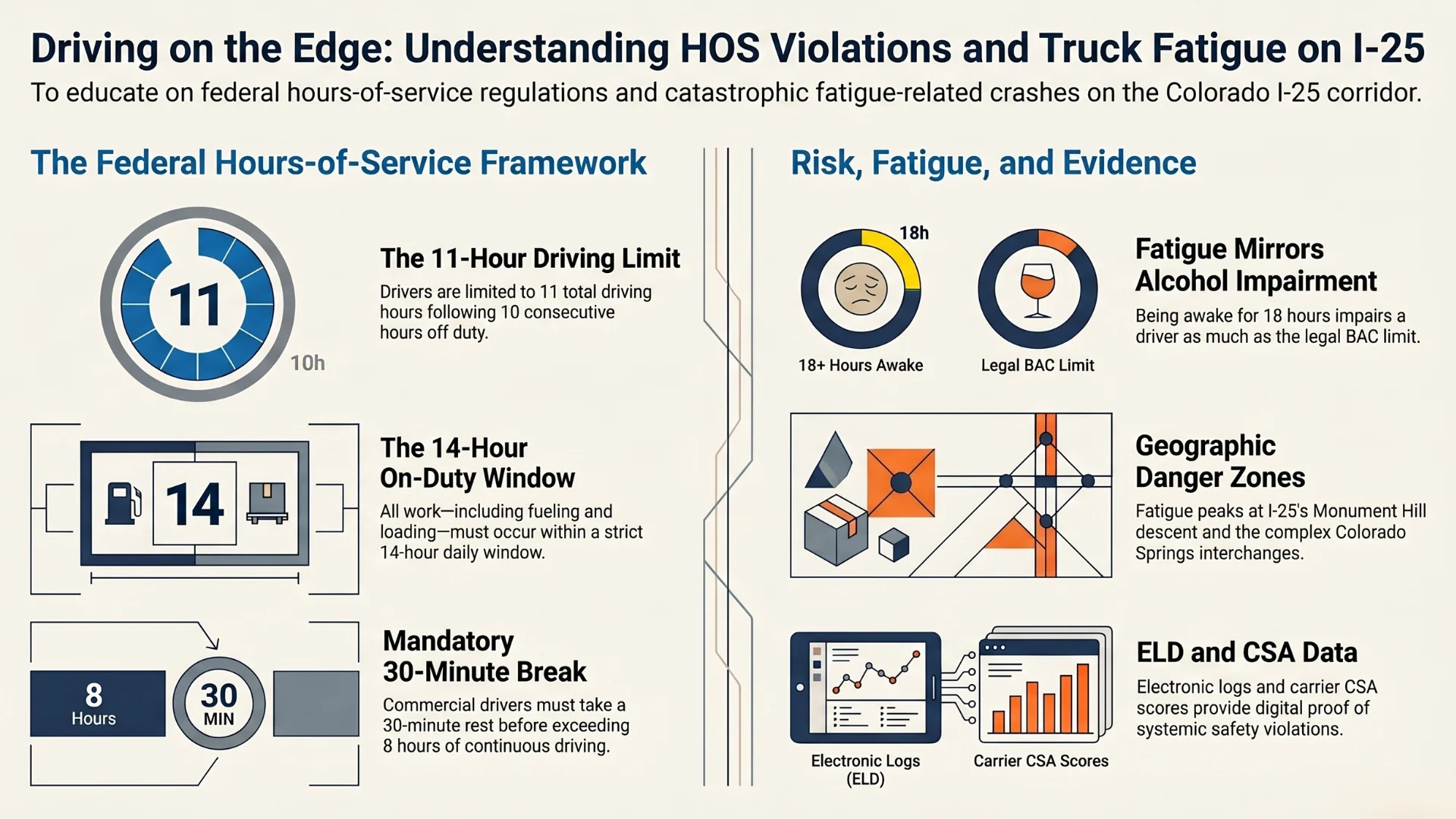
49 CFR Part 395 sets the driving hour limits that apply to nearly every commercial truck on an interstate highway. The core rules are not complicated to understand once you strip the regulatory language away:
11-hour driving limit
A driver can drive a maximum of 11 hours within any single shift, but only after taking 10 consecutive hours off duty.
14-hour on-duty window
That 11 hours of driving must happen within a 14-hour on-duty window that starts the moment the driver goes on duty, regardless of whether they're actually behind the wheel. Fueling, loading, paperwork, and pre-trip inspections all count against the clock. Once the window closes, the driver cannot legally drive again until they've completed another 10-hour rest period.
30-minute break requirement
Drivers must take a 30-minute break before driving beyond 8 continuous hours. After 8 hours of drive time without a genuine break, they stop.
Weekly hour caps
Drivers are limited to 60 hours over 7 consecutive days, or 70 hours over 8 consecutive days, depending on how the carrier operates. A driver running the Denver-Pueblo freight corridor every day of the week can hit that ceiling fast, especially when dispatch pressure says "be there by morning."
Call Metier Law Firm at 866-377-3800 or schedule your free consultation today at www.metierlaw.com
The I-25 Fatigue Problem Is Geographic
Colorado Springs sits almost perfectly at the midpoint between Denver and Pueblo on I-25. That position means the city absorbs truck traffic from two directions, and many of those drivers have already been on the road for hours before they reach El Paso County.
A northbound driver coming up from Pueblo or the industrial traffic on Highway 115 hits the Cimarron and Nevada Avenue interchanges before reaching downtown. A southbound driver who picked up freight in Denver faces Monument Hill, one of the steeper and longer descents in the Front Range corridor. Braking control on a loaded semi going downhill at 6 percent grade is demanding under ideal conditions. For a driver who's been awake since 3 a.m. to make a delivery window, it's genuinely dangerous.
Powers Boulevard functions as an alternative truck route through the east side of Colorado Springs, but the interchange density along Highway 24 east-west and the mixing with commuter traffic near the Garden of the Gods Road and Fillmore Street exits creates its own set of problems. Add the ongoing I-25 Gap project's construction and lane shifts between Monument and Castle Rock, and the corridor becomes even less forgiving.
If you or a family member was hurt in a crash on any of these roads, the driver's HOS records are among the first things we go after.
What an ELD Actually Records
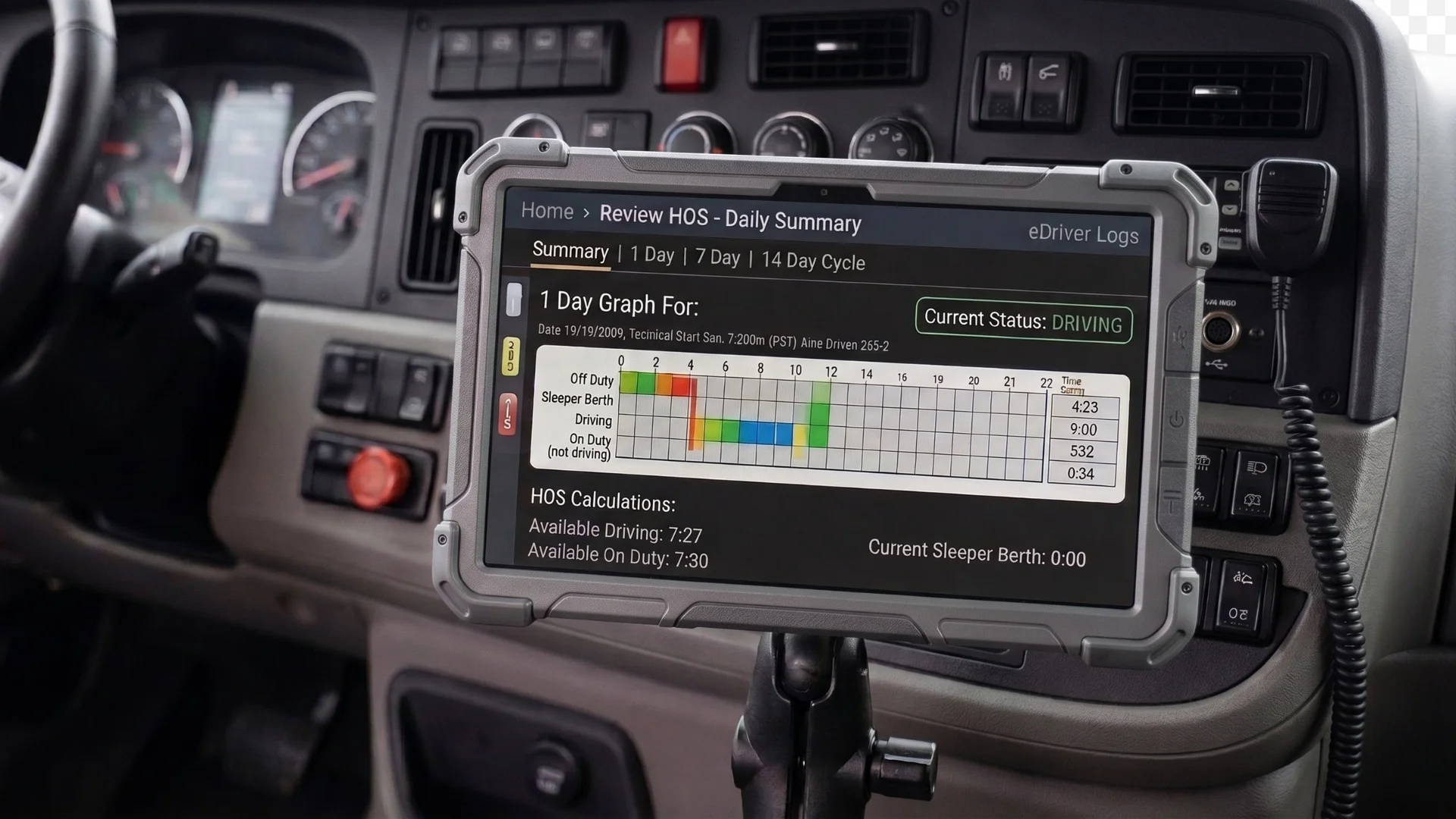
Before 2017, drivers kept paper logs. Paper logs were easy to falsify. The federal ELD mandate changed that. Now, most commercial trucks operating in interstate commerce carry an electronic logging device that connects directly to the truck's engine and records location, speed, on-duty time, and driving status automatically.
When we handle an hours of service violations Colorado truck accident case, the ELD data is one of our first requests. It tells us when the driver actually moved, how long they were driving without a break, and whether the logged rest periods match the reality of the trip. Dispatch communications, fuel receipts, and GPS records fill in the gaps.
What the ELD cannot always show is whether a driver manipulated their status by logging "off duty" while the truck was still running, or whether a carrier pressured dispatch to push drivers past compliant hours. That's where the investigation gets deeper. A corporate representative deposition, specifically what's called a 30(b)(6) deposition, can compel a carrier to answer under oath about scheduling practices, delivery windows, and what management knew about driver fatigue patterns.
If you or a loved one was injured in a crash with a commercial truck, call us at 866-377-3800 or schedule a free consultation at www.metierlaw.com.
What a CSA Score Tells Us About the Carrier
Every trucking company operating in the U.S. has a Compliance, Safety, Accountability record maintained by the FMCSA through the Safety Measurement System. That record scores carriers across several Behavior Analysis and Safety Improvement Categories, or BASICs.
When a carrier has a flagged Hours-of-Service Compliance BASIC, it means this is not the first time HOS violations have shown up in their inspection history. That flag is significant evidence. It suggests the company knew or should have known their drivers were running fatigued, and they let it happen anyway.
In many cases, an hours of service violations Colorado truck accident case is not just about one tired driver on one bad day. It's about a carrier that built their delivery model around pushing legal limits. That pattern matters enormously when we're establishing negligence. You can read more about the range of causes that put trucks and people into crashes in our post on truck accidents in Colorado Springs.
Why Fatigue Is So Dangerous at the Wheel of an 80,000-Pound Truck
The FMCSA's own research, which informed the Part 395 framework, confirms what experience shows: fatigued driving impairs reaction time, judgment, and situational awareness in ways that closely mirror alcohol impairment. A driver who's been awake for 18 straight hours has the functional impairment of someone with a blood alcohol content at the legal limit.
An 80,000-pound semi traveling at highway speed needs close to the length of two football fields to stop under normal conditions. A fatigued driver who microsleeps for even two seconds at 65 mph travels the length of a basketball court without any control. On Monument Hill's descent or in the compression zone around downtown Colorado Springs, that is not survivable for the vehicles around them.
Our post on the 10 common causes of truck accidents puts driver fatigue in the broader context of what makes large commercial trucks so dangerous. But in cases where HOS records exist and violations are documented, fatigue stops being a soft claim and becomes documented negligence.
What a CDL Attorney Does That Others Miss
Holding a CDL means I understand how the hours-of-service rules actually work in practice, not just in theory. I know what a properly completed ELD record looks like, what a gap in logging status suggests, and how dispatch pressure shows up in the data patterns. Most personal injury attorneys handling a truck crash case have never sat behind the wheel of a commercial vehicle or read a real log audit.
When I review a driver's records in an HOS violations Colorado truck accident case, I'm looking beyond whether the 11-hour limit was technically exceeded. Specifically:
- Whether the carrier was running their drivers to the edge of their legal limits every single day of the week, not just on the day of the crash.
- Whether the required 30-minute break was a genuine rest stop or a fuel stop logged as off-duty to satisfy the rule on paper.
- Whether the carrier's delivery windows made legal HOS compliance structurally impossible from the start.
Those details are what build a case that goes beyond the driver and reaches the company behind them.
Call Metier Law Firm at 866-377-3800 or schedule your free consultation today at www.metierlaw.com
You Have Time, But Not Unlimited Time
Colorado's statute of limitations for personal injury claims is three years from the date of the crash. Three years sounds like a long time, but ELD records, dispatch communications, and driver qualification files are not preserved forever. Trucking companies have investigators on the road within hours of a serious crash. Getting an attorney involved early preserves your access to that evidence before it's gone.
Frequently Asked Questions: Hours-of-Service Violations and Colorado Springs Truck Crashes
What are hours-of-service violations, and how do they cause truck crashes in Colorado Springs?
Hours-of-service violations occur when a truck driver exceeds the federally mandated driving or on-duty time limits set by 49 CFR Part 395. A driver legally limited to 11 hours of driving who continues beyond that limit is operating while fatigued. On demanding roads like the Monument Hill grade north of Colorado Springs or the construction zones on I-25 through the city, that impairment dramatically increases crash risk.
How is Part 395 different from Part 392?
Part 392 covers general vehicle operation rules: how a driver must operate the truck, inspect it, and handle hazardous conditions. Part 395 is specifically about time limits. It governs how many hours a driver can be behind the wheel, how long they must rest before driving again, and how all of that must be documented. Both regulations matter in a truck crash case, but they address different types of negligence.
Can ELD data actually prove a driver was fatigued during a crash?
ELD data shows exactly when the truck was moving, at what speed, and whether the driver logged any off-duty rest. If the data shows the driver exceeded their 11-hour driving limit, hadn't taken a required break, or had been awake well beyond the point of safe operation, that record becomes direct evidence of an HOS violation. Combined with dispatch records and fuel receipts, it builds a clear picture of what happened before the crash.
What is a CSA score, and why does it matter in my case?
The FMCSA's Compliance, Safety, Accountability program scores trucking companies on their inspection and violation history. A carrier with a flagged Hours-of-Service Compliance category has a documented pattern of HOS violations. In your case, that history supports the argument that the crash wasn't an isolated mistake but a foreseeable result of how the carrier operated.
How long do I have to file a truck accident claim in Colorado?
Colorado's statute of limitations for personal injury claims is generally three years from the date of the crash. However, critical electronic records and dispatch data may not be preserved for that long. Sending a spoliation letter early, through your attorney, is how you protect access to that evidence.
The Clock Started the Moment That Truck Hit You
Federal law set hours-of-service limits for a reason. When those limits get ignored, pushed, or gamed by dispatch pressure, the results land on people driving to work on I-25, taking the Highway 24 interchange home, or passing through Colorado Springs on a route they've driven a hundred times.
If you were hurt in a crash and you have any reason to believe the driver was fatigued, don't wait to find out whether the records back that up. We know what to look for, how to get it, and what it means when we find it.
As a Colorado Springs truck accident attorney team, we pull these records the same day a client calls. Our Denver truck accident lawyer and Fort Collins truck accident lawyer teams apply that same urgency for families further north along the Front Range.
Call Metier Law Firm at 866-377-3800 or schedule your free consultation today at www.metierlaw.com.
Disclaimer: Past results discussed should not be considered a guarantee of your results as the factors of every case are individually unique. This content is for informational purposes only and does not constitute legal advice. Consult a qualified attorney from Metier Law Firm regarding your individual situation for legal advice.
Tell Us About Your Case – Free Case Review with a Truck Accident Lawyer
Tell Us About Your Case – Free Case Review with a Personal Injury Lawyer
(866) 377-3800Our Locations
.webp)
Do I have a Case?
How Much Should I Be Offered?
Do I Need an Attorney?
If these questions have crossed your mind, let us help. You may need a little direction or may not need an attorney at all, but you deserve to be confident knowing your options. We can provide you with information about our Attorneys of the West® accident investigations and legal services. Your confidential consultation with us is totally free.
Keep up with us!
