.svg)


TL;DR: Key Takeaways
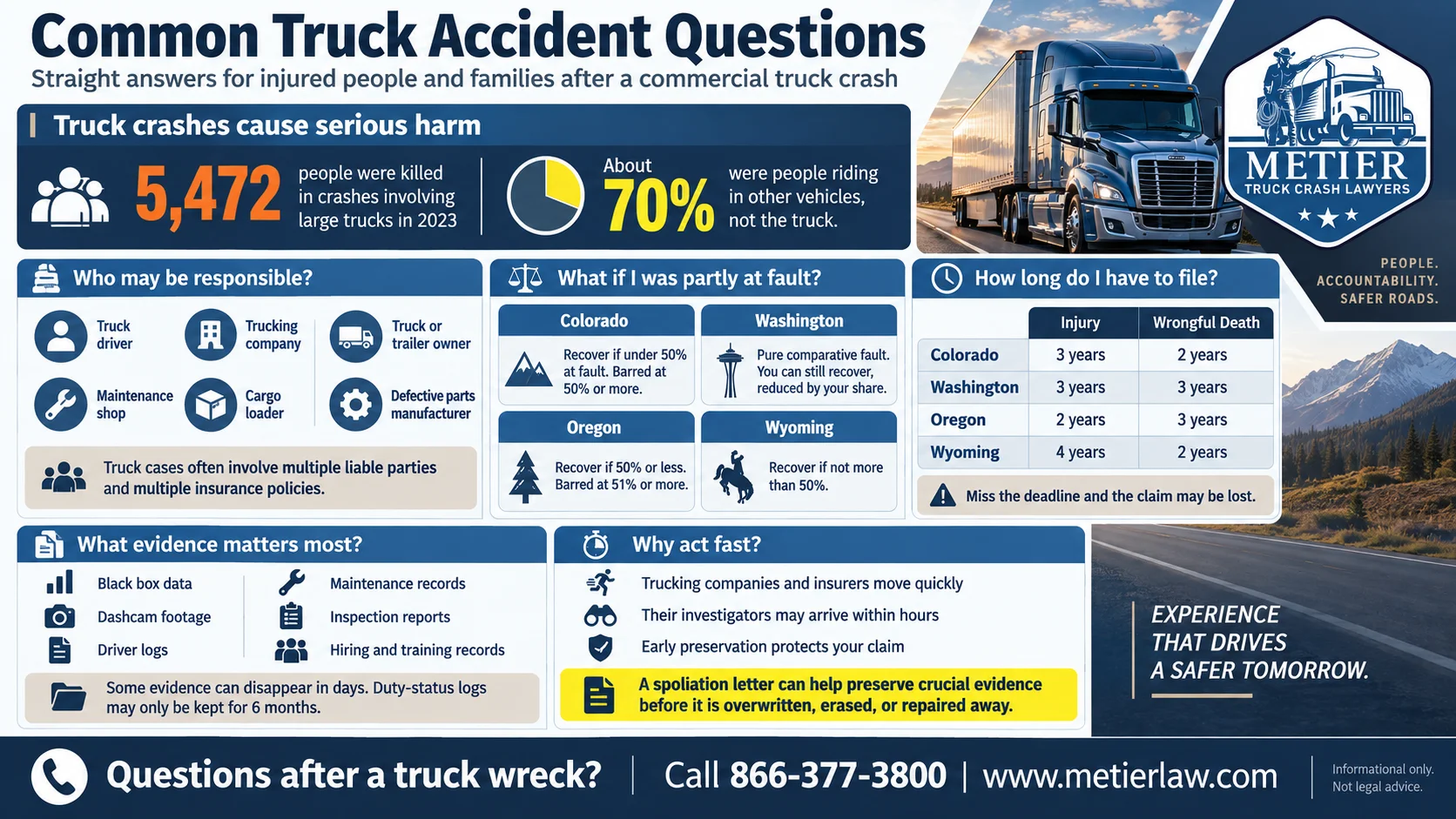
- In 2023, 5,472 people were killed in crashes involving large trucks, and about 70% of them were riding in other vehicles, not the truck.
- Fault in a truck wreck often spreads across several parties: the driver, the trucking company, a maintenance shop, a cargo loader, or a parts maker.
- Colorado, Washington, Oregon, and Wyoming each handle shared fault differently, and the rule that applies can change what you recover.
- Filing deadlines are not the same in every state, and wrongful death deadlines differ from injury deadlines, so the calendar matters from day one.
- Truck data disappears fast. A black box can be overwritten in days, while federal rules only require carriers to keep duty-status logs for six months.
- Motor carriers carry large insurance policies and fast-moving legal teams, which is why starting your own investigation early protects your claim.
A loaded tractor-trailer can weigh 80,000 pounds. When one hits a passenger car at highway speed, the people in the smaller vehicle usually pay for it. In 2023, 5,472 people were killed in crashes involving large trucks, and roughly 70% of them were riding in other vehicles, not the truck. I'm Phil Chupik, a partner at Metier Law Firm, and I've spent more than 20 years representing truck crash victims across Colorado, Washington, Oregon, and Wyoming. The same worries come up again and again. Below are the common truck accident questions we hear most from injured people and their families, answered straight.
Who can be held responsible for my crash?
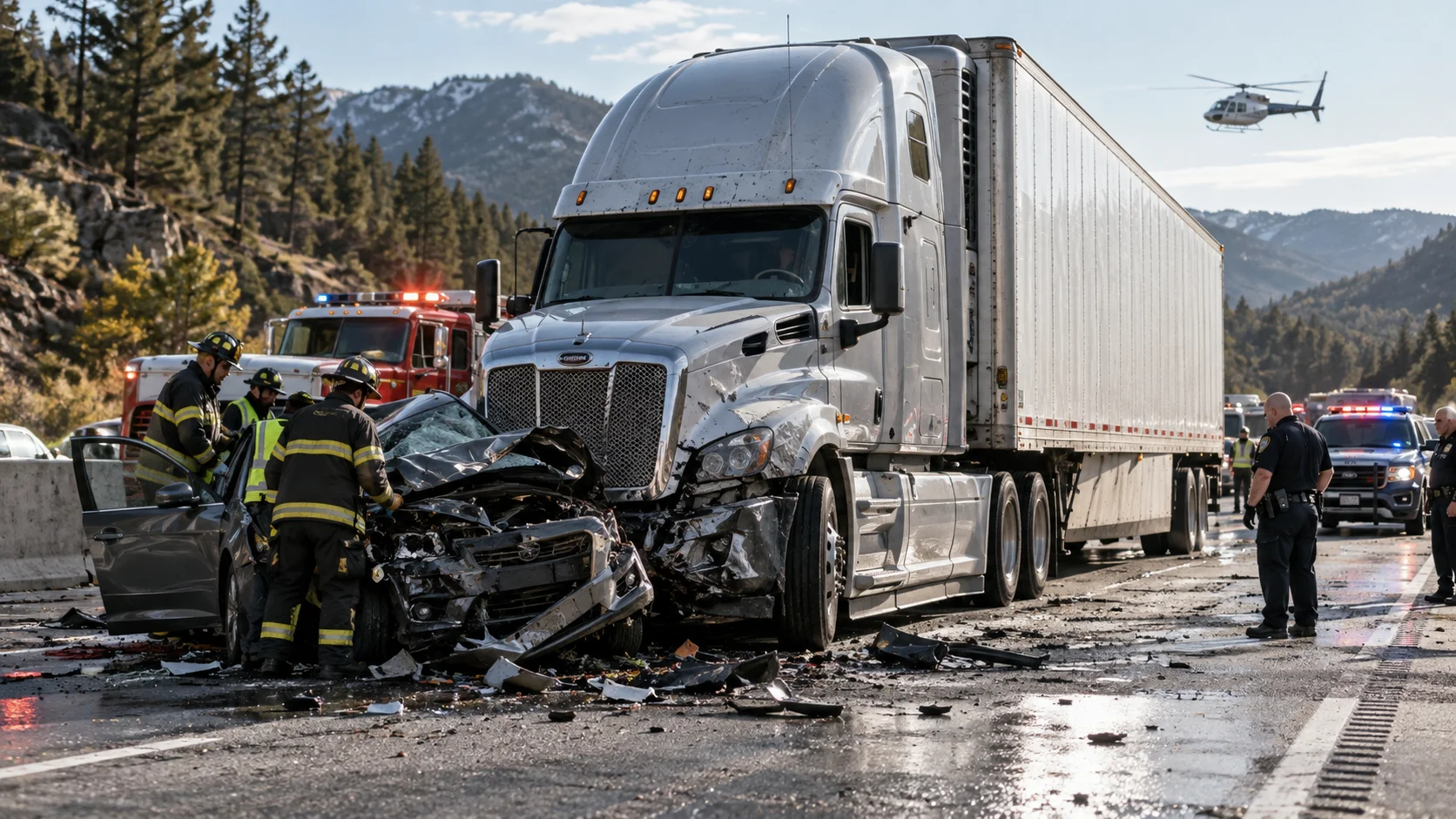
A truck wreck is rarely just about the driver. Several parties can share the blame, including the trucking company that set the schedule, the owner of the truck or trailer, the maintenance shop, the crew that loaded the cargo, and the maker of a defective part. Sorting out who did what takes digging into driver logs, the carrier's hiring and training records, maintenance history, and inspection reports. It matters because each party usually carries its own insurance, and identifying all of them can be the difference between a settlement that covers your care and one that leaves you short. Our guide to a truck accident lawsuit walks through this in depth.
What if I was partly at fault?
This is one of the most common questions we get, and the honest answer depends on where the crash happened. In Colorado, you can recover as long as you're less than 50% at fault. At 50% or more, the law bars you completely, and any award drops by your share of blame (C.R.S. 13-21-111). Washington uses pure comparative fault, so you can recover even when most of the blame lands on you, reduced by your percentage (RCW 4.22.005). Oregon lets you recover if your fault is 50% or less and bars you at 51% or more (ORS 31.600). Wyoming allows recovery when your fault is not more than half, which means at exactly 50% you still collect, reduced by your share (Wyo. Stat. 1-1-109). Insurance adjusters know these thresholds cold, and they push to pin more blame on you than you deserve. Don't take their number as the final word.
How long do I have to file?
Deadlines are not the same across our four states, and the wrongful death clock runs differently from the injury clock. In Colorado, you generally have three years to file for injuries from a motor vehicle crash, but only two years for a wrongful death claim (C.R.S. 13-80-101 and 13-80-102). In Washington, the window is three years for both injury and wrongful death, with the wrongful death period starting on the date of death (RCW 4.16.080). Oregon allows two years for injury claims and three years for wrongful death (ORS 12.110 and 30.020). Wyoming runs longer on injury, four years, but only two years for wrongful death (Wyo. Stat. 1-3-105 and 1-38-102). Miss your deadline and a court will almost certainly dismiss the case, however strong it is. A few narrow exceptions exist, so ask early if you're unsure.
If you or a loved one was injured in a crash with a commercial truck, call us at 866-377-3800 or schedule a free consultation at www.metierlaw.com.
What evidence matters, and how do we keep it from disappearing?
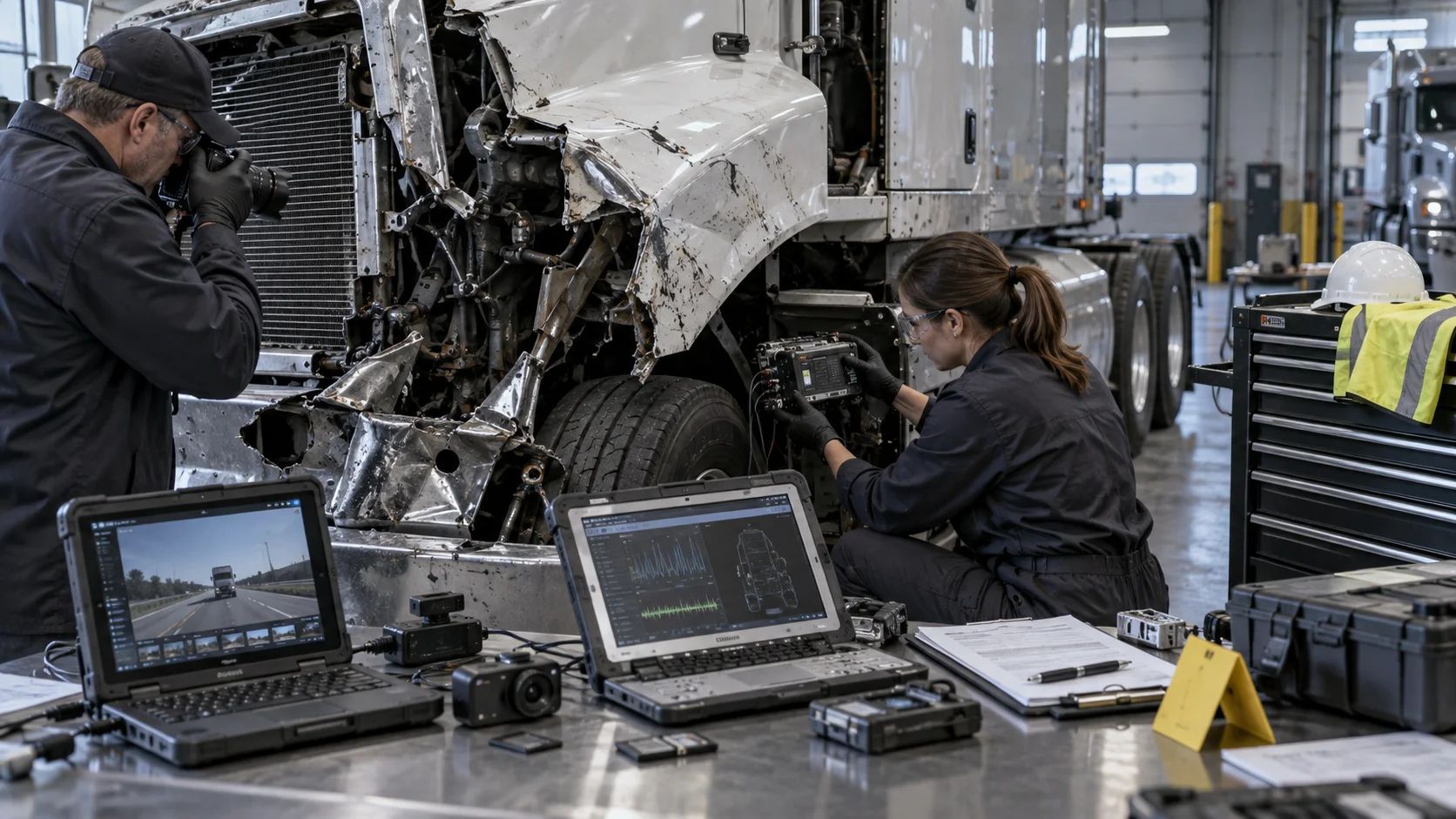
Evidence in a truck case has a short shelf life. The tractor's electronic control module, or black box, records speed, braking, and throttle in the seconds before impact. Some systems overwrite that data after a set number of engine restarts, sometimes within days. Dashcam footage running on a loop can vanish just as fast. Federal rules require motor carriers to keep records of duty status for only six months (49 CFR 395.8). Once we're on a case, we send a spoliation letter demanding the company preserve the logs, black box data, maintenance files, and any camera footage before it gets wiped or repaired away. We also inspect the truck before it goes back into service. Our breakdown of the evidence that proves truck driver negligence explains what we look for.
What is my claim worth?
No two cases carry the same value. A fair number covers your medical bills, the care you'll still need, lost income, reduced earning ability, and pain and suffering. Truck injuries tend to be severe, so future costs often make up much of the total, and that's where medical and economic experts help us determine the full extent of your damages.
Why are trucking companies so hard to fight?
Motor carriers and their insurers move fast and spend to win. They send investigators to the scene within hours and use every tactic to hold down what they pay. Expect them to dispute the police report, question how badly you're hurt, and search your medical history for another explanation. Federal safety rules from the Federal Motor Carrier Safety Administration give us a standard to hold them to, but you have to know where to look. Getting your own investigation going quickly keeps the company from shaping the record alone.
Do I really need a truck accident lawyer?
For a minor scrape, maybe not. A crash with a fully loaded commercial truck is another matter: the injuries run deeper and the defense is better funded. If you're interviewing attorneys, it helps to know the right questions to ask a truck accident lawyer before you sign anything. Look for a firm that handles these cases regularly, knows the federal rules cold, and has tried them in front of a jury rather than only settling.
Frequently Asked Questions
Can I still recover money if I was partly to blame for the truck accident?
Usually yes, though it depends on your state. Washington lets you recover no matter your share of fault, reduced by that percentage. Colorado and Oregon cut you off once you cross their thresholds, and Wyoming allows recovery as long as your fault is not more than half. In every state, your recovery shrinks by your percentage of fault.
How soon should I talk to a truck accident lawyer?
As soon as you reasonably can. Black box data and dashcam footage can be gone within days, and a lawyer can send a preservation demand before that happens.
Who pays for my medical bills after a commercial truck accident?
Several sources may apply: the carrier's liability insurance, your own coverage, and sometimes a third party like a maintenance vendor. Part of our job is finding every policy that could contribute.
Are truck accident claims different from car accident claims?
Yes. They involve federal trucking rules, several liable parties, and commercial insurers with large policies and aggressive defense teams, which makes them more complex than a typical car crash claim.
What does it cost to hire Metier Law Firm?
We work on contingency, so there are no upfront fees, and we only get paid fees if we recover for you.
Straight Answers When You Need Them Most
These are the questions people ask us first after a wreck, and you deserve clear answers. Every case turns on its own facts. Even so, understanding your rights, your deadline, and your state's fault rule early puts you in a stronger position. If these common truck accident questions are on your mind after a crash in Denver or anywhere across Colorado, Washington, Oregon, and Wyoming, we're glad to talk it through.
Call Metier Law Firm at 866-377-3800 or schedule your free consultation today at www.metierlaw.com.
Disclaimer: Past results discussed should not be considered a guarantee of your results as the factors of every case are individually unique. This content is for informational purposes only and does not constitute legal advice. Consult a qualified attorney from Metier Law Firm regarding your individual situation for legal advice.
Tell Us About Your Case – Free Case Review with a Truck Accident Lawyer
Tell Us About Your Case – Free Case Review with a Personal Injury Lawyer
(866) 377-3800Our Locations
.webp)
Do I have a Case?
How Much Should I Be Offered?
Do I Need an Attorney?
If these questions have crossed your mind, let us help. You may need a little direction or may not need an attorney at all, but you deserve to be confident knowing your options. We can provide you with information about our Attorneys of the West® accident investigations and legal services. Your confidential consultation with us is totally free.
Keep up with us!
