.svg)


TL;DR - Key Takeaways
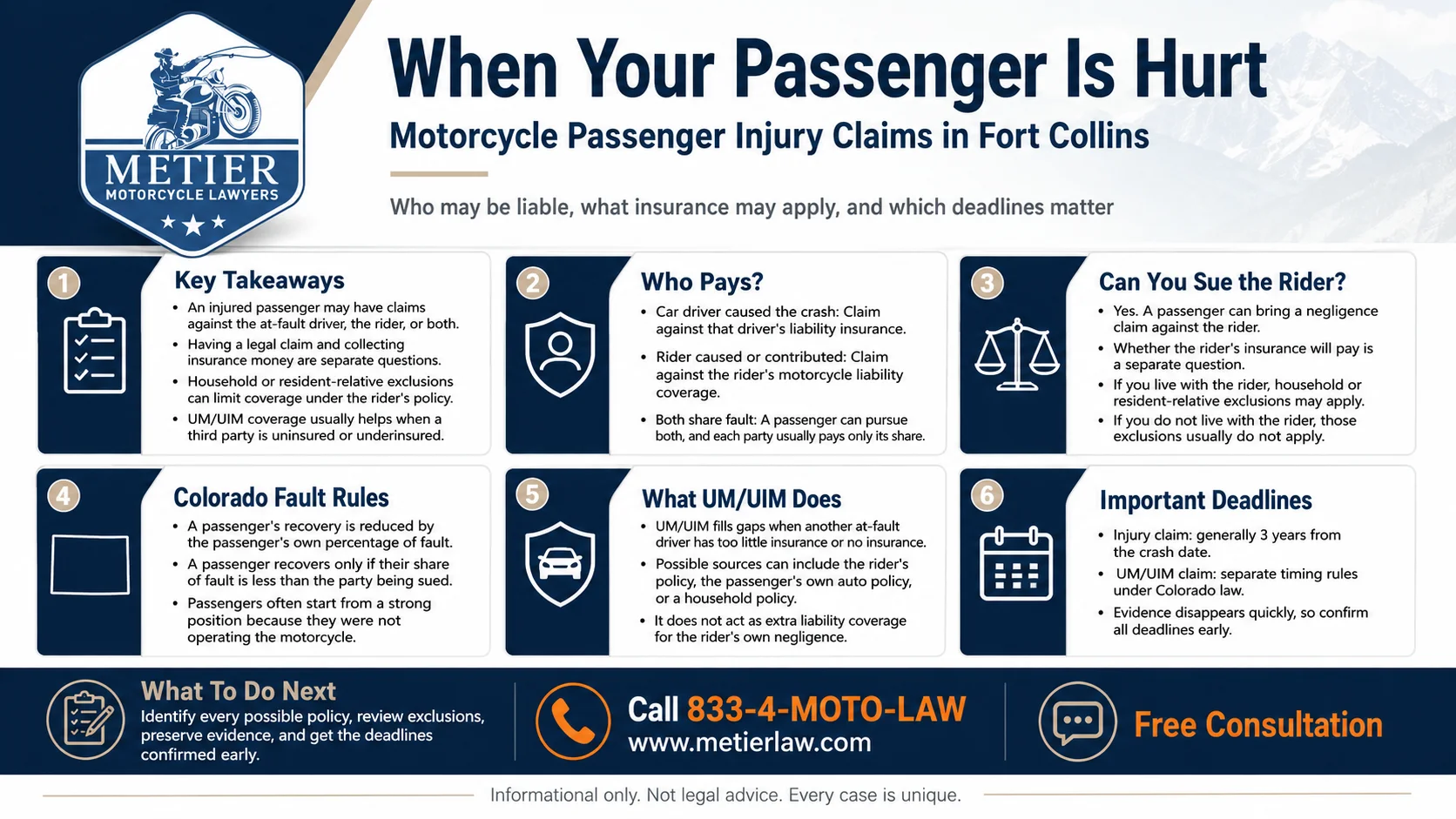
- An injured passenger can bring claims against the at-fault driver, the rider they were with, or both, depending on who caused the crash.
- Having a claim and collecting on it are separate questions. Household and resident-relative exclusions can bar or cap a claim against the rider's own liability policy.
- The rider's uninsured/underinsured motorist (UM/UIM) coverage does not pay for the rider's own negligence. It responds when a third party is uninsured or underinsured.
- Under C.R.S. § 13-21-111, a passenger recovers only if their share of fault is less than that of the party they're suing.
- Two deadlines run at once: three years from the crash for the injury claim, and a separate schedule for UM/UIM claims under C.R.S. § 13-80-107.5.
You climbed on the back of a friend's bike for a run up the Poudre Canyon, or a quick trip across Old Town after dinner. You weren't watching mirrors or working the throttle. Then a driver ran a red light, and now you're in a Fort Collins hospital bed with bills you never saw coming and a question nobody prepared you for. Who pays for this?
If you were hurt riding two-up, you probably have claims against more than one party. Whether those claims reach actual insurance money is a different question, and it decides most of these cases. I'm Patrick DiBenedetto, a partner at Metier Law Firm and a rider myself. We represent injured riders and their passengers across Larimer County.
"Passengers ask me whether they can sue. The question that actually decides the case is which policies will respond, and that can turn on something as specific as whether you and the rider share an address," I tell clients. "Those are two different answers, and the second one is where the money is."
Here's how a motorcycle passenger injury claim works in Colorado.
Who Pays When a Motorcycle Passenger Gets Hurt
Fault decides who owes you. Insurance decides what you can actually collect.
If a car driver caused the crash, your claim runs against that driver's liability policy. If the rider you were with caused it or contributed to it, your claim runs against the rider's motorcycle liability coverage. If both share the blame, you can pursue both, because a passenger claim against the at-fault driver and a claim against the rider aren't mutually exclusive.
That last point matters more than it sounds. Colorado generally follows several liability under C.R.S. § 13-21-111.5, meaning each responsible party is ordinarily liable only for the percentage of damages allocated to that party, subject to statutory exceptions. If a car driver is found 70% at fault and the motorcycle rider 30%, each is generally responsible for that share of the damages. Recovering the full amount often requires identifying every responsible party and every available source of insurance, including liability, umbrella, and UM/UIM coverage where applicable.
Riders and passengers face a substantially greater risk of serious injury than occupants of passenger vehicles because motorcycles provide little physical protection in a crash. According to the NHTSA, motorcyclists experience significantly higher rates of fatal and serious injury than passenger vehicle occupants. On the back of a bike, you have even less control over the outcome than the person driving it.
Can a Passenger Sue the Motorcycle Rider in Colorado?
Yes. If the rider's negligence caused or contributed to the crash, a passenger can bring a claim against them. Nothing in Colorado law bars that claim because of your relationship to the rider.
Whether their insurance pays it is the real question, and here the relationship matters a great deal.
Colorado motorcycle and auto policies commonly contain household or resident-relative exclusions. C.R.S. § 10-4-601(13) defines a resident relative as someone related to the named insured by blood, marriage, or adoption who lives in that household, even if temporarily living elsewhere. If you're the rider's spouse, or another resident relative living in the same household, a household or resident-relative exclusion may limit or eliminate insurance coverage under that particular policy, depending on the policy language and Colorado law. The exclusion affects available insurance coverage—it does not eliminate your underlying negligence claim against the rider. Colorado's Supreme Court has enforced these exclusions.
If you don't live with the rider, a traditional household or resident-relative exclusion generally will not apply. A friend, coworker, date, or fellow rider typically falls outside those exclusions. Even so, the entire policy and any endorsements should be reviewed because other coverage limitations or exclusions may still affect the claim. .
So the honest answer to "can I sue my husband's policy" isn't yes or no. It's that someone needs to read the actual policy, including any endorsements, before anyone tells you what your claim is worth.
If you've been hurt in a motorcycle crash and need answers, call us at 833-4-MOTO-LAW or schedule a free consultation at www.metierlaw.com.
How Colorado's Fault Rules Shape a Passenger's Recovery
Colorado uses modified comparative fault under C.R.S. § 13-21-111. In general, a passenger's recovery is reduced by the percentage of fault allocated to the passenger, and recovery may be barred if the passenger's fault meets or exceeds the level permitted under Colorado law. In cases involving multiple defendants, Colorado's comparative negligence and several-liability statutes work together to determine each party's responsibility. Your award drops by your percentage of fault, and if your share is equal to or greater than theirs, the court enters judgment for the defendant and you recover nothing.
Passengers usually start from a strong position here, because you weren't operating the motorcycle. Insurance companies may argue that a passenger's own conduct contributed to the crash, although those arguments depend on the specific facts and evidence. The arguments we see aimed at passengers are specific: that you got on knowing the rider had been drinking, or that you grabbed at the rider or shifted your weight in a way that affected control. Those are factual fights with evidence behind them, not automatic losses.
In the worst cases, where a passenger is killed, these same fault rules shape what the family recovers, and a Fort Collins wrongful death lawyer handles that claim under a different set of deadlines.
What UM/UIM Does, and What It Doesn't
Uninsured/underinsured motorist coverage fills gaps left by an at-fault party who carried too little insurance or none at all. For a passenger, it's often the difference between a partial recovery and a full one.
It also gets misdescribed constantly, so here's the limit. Uninsured/underinsured motorist (UM/UIM) coverage fills gaps left when an at-fault driver has no insurance or not enough insurance to fully compensate an injured person. It is not intended to serve as additional liability coverage for the negligence of the insured motorcycle operator.
Colorado law generally prevents UM/UIM coverage from being used simply because the motorcycle insured under the same policy caused the crash. Whether UM/UIM coverage applies depends on the policy language, the claimant's status as an insured, the applicable exclusions, and Colorado law governing those provisions.
Where UM/UIM frequently helps a passenger is when another driver causes or contributes to the crash and that driver has little or no insurance. In that situation, the rider's UM/UIM policy, the passenger's own UM/UIM policy, or another household policy may provide additional coverage depending on the policy language and the facts of the claim.
Insurers don't always make this easy, and we've written before about how they delay or deny motorcycle injury claims. Knowing which policy applies, and pushing back when an adjuster stalls, is often the difference between a bill you eat and a bill that gets paid.
Two Deadlines Run at the Same Time
Most articles give you one number. A passenger with multiple claims is working against at least two.
For the injury claim against the at-fault driver or the rider, you have three years from the date of the crash under C.R.S. § 13-80-101(1)(n), which covers tort actions arising out of the use or operation of a motor vehicle.
UM/UIM claims run under a different statute, C.R.S. § 13-80-107.5. It sets three years from when the claim accrues, and accrual there isn't automatically the crash date. It's when you knew, or should have known through reasonable diligence, both that you were hurt and what caused it. The statute also builds in alternate two-year windows tied to preserving the underlying claim against the at-fault driver first.
Evidence doesn't wait for either clock. Skid marks wash away, cameras record over footage, and witnesses forget details.
Frequently Asked Questions About Motorcycle Passenger Injury Claims
Can a passenger sue the motorcycle driver in Colorado?
Yes. If the rider's negligence caused or contributed to the crash, a passenger can bring a claim. Whether the rider's insurer pays is separate. Colorado policies often exclude or cap claims by household members and resident relatives, so a spouse or a family member living at the same address can face an exclusion that a friend would not. The policy language controls, and it needs to be reviewed before anyone estimates the claim's value.
Who pays a motorcycle passenger's medical bills after a crash?
The at-fault party's liability insurance is the primary source. That may be the driver who hit you, the rider you were with, or both, and under Colorado's pro-rata rule each pays only their own percentage. Medical payments coverage, if either policy carries it, pays regardless of fault. UM/UIM can cover shortfalls left by an uninsured or underinsured at-fault driver.
Does a passenger's own insurance matter if they weren't driving?
It can. UM/UIM coverage can follow you as a person rather than a vehicle, so your own auto policy may apply while you're a passenger on someone else's motorcycle. A policy held by a relative you live with may apply as well. Every policy within reach should be identified early.
What are a motorcycle passenger's rights in Colorado if the rider was a friend?
Your right to bring a claim doesn't depend on the relationship. The practical difference is coverage. Because household and resident-relative exclusions are tied to living in the same household, a friend you don't live with generally falls outside them, and the rider's liability coverage should respond normally.
How long does an injured motorcycle passenger in Fort Collins have to file?
Three years from the crash date for the injury claim under C.R.S. Section 13-80-101(1)(n). UM/UIM claims follow C.R.S. Section 13-80-107.5, which measures three years from when the claim accrues and adds alternate two-year windows. Because more than one deadline can apply to the same crash, get the dates confirmed early.
What an Injured Passenger in Fort Collins Should Do Next
You weren't making the decisions on the road, but you're the one with the injuries and the bills. Your position is often stronger than a rider's, because fault rarely attaches to the person on the back. Your recovery still depends on work most people can't do from a hospital bed: identifying every policy, reading the exclusions, and tracking two deadlines at once.
We ride the same Fort Collins roads you do, and we've untangled exactly this kind of multi-policy motorcycle passenger injury claim. If you were hurt on the back of a bike, a Fort Collins motorcycle accident lawyer at our firm can tell you which policies apply, which exclusions are in the way, and what your claim is realistically worth. Call Metier Motorcycle Lawyers at 833-4MOTO-LAW or schedule your free consultation today at www.metierlaw.com.
Disclaimer: Past results discussed should not be considered a guarantee of your results as the factors of every case are individually unique. This content is for informational purposes only and does not constitute legal advice. Consult a qualified attorney from Metier Law Firm regarding your individual situation for legal advice.
Tell Us About Your Case – Free Case Review with a Personal Injury Lawyer
(866) 377-3800Our Locations
.webp)
Do I have a Case?
How Much Should I Be Offered?
Do I Need an Attorney?
If these questions have crossed your mind, let us help. You may need a little direction or may not need an attorney at all, but you deserve to be confident knowing your options. We can provide you with information about our Attorneys of the West® accident investigations and legal services. Your confidential consultation with us is totally free.
Keep up with us!
