.svg)


TL;DR Key Takeaways
- Under ORS 31.600, an injured rider can recover damages if the rider's fault isn't greater than the combined fault of the others the jury compares. The award is then reduced by the rider's percentage.
- A rider found exactly 50% at fault still recovers half. In a crash with one at-fault driver, a rider found 51% or more at fault recovers nothing.
- Riding without a helmet is a Class D traffic violation under ORS 814.269. No Oregon statute sets a fixed percentage cut to a rider's damages for it.
- An Oregon motorcycle injury lawsuit must be filed within two years under ORS 12.110, and claims against a public body need notice within 180 days under ORS 30.275.
A driver turns left across Burnside without seeing you, or drifts into your lane on Powell Boulevard. Once the medical care starts, the next fight is over fault. Portland motorcycle accident comparative fault rules decide whether you recover anything and how much. We regularly see adjusters ask about rider speed, lane position, and helmet use in the first recorded call. At Metier Motorcycle Lawyers, Patrick DiBenedetto and our team handle these claims across the Portland metro, including Beaverton, Gresham, and Hillsboro.
"An adjuster's fault percentage is an opening position. Oregon law asks whether your share of fault is greater than everyone else's combined, and a jury answers that from the evidence. A helmet ticket doesn't change that question," says Patrick DiBenedetto, Partner at Metier Law Firm.
How Portland Motorcycle Accident Comparative Fault Works Under ORS 31.600
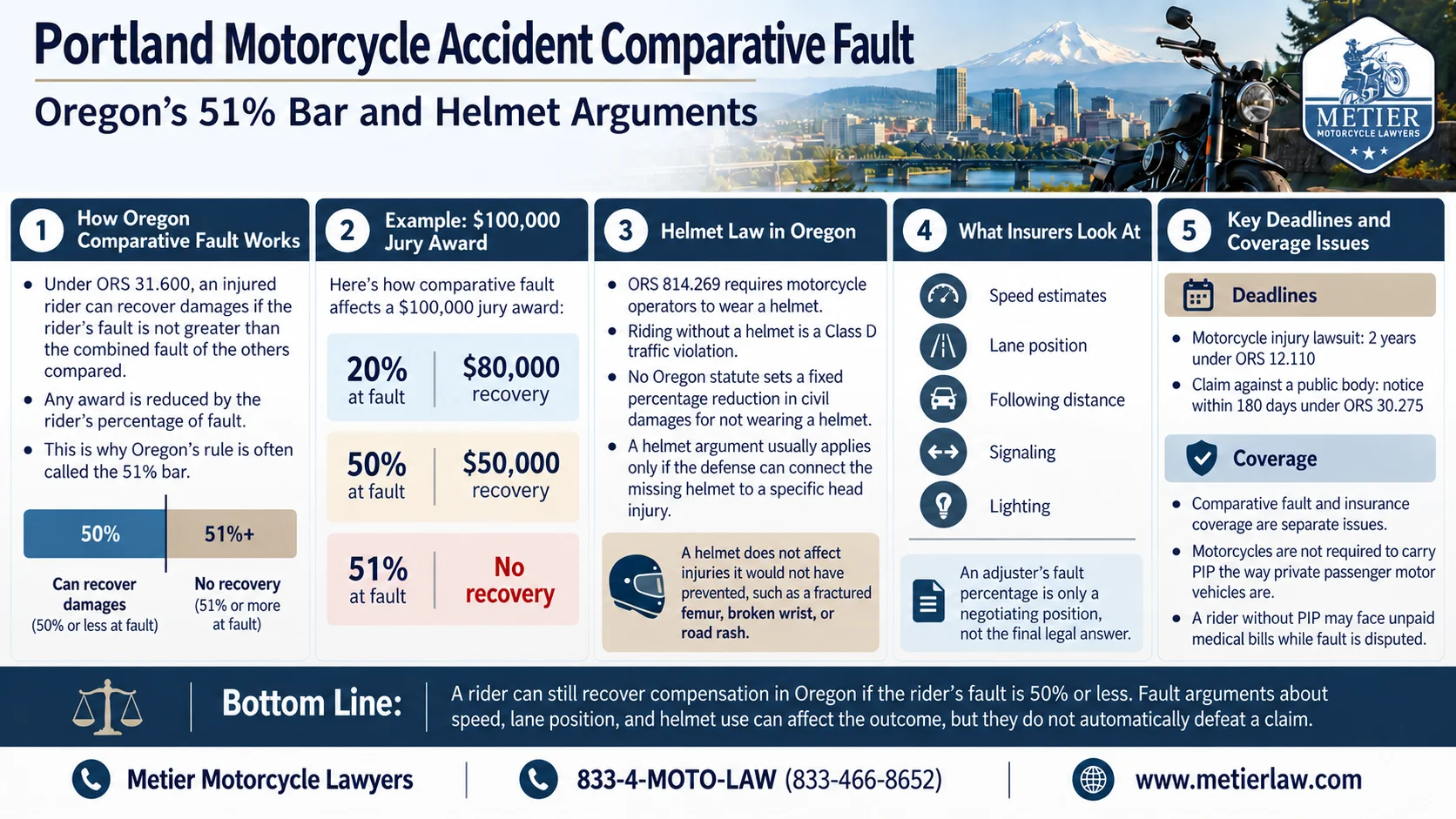
Oregon follows modified comparative fault. ORS 31.600(1) says a claimant's own negligence doesn't bar recovery if the claimant's fault "was not greater than the combined fault" of the people listed in subsection (2). Any damages are then reduced by the claimant's percentage of fault.
Take a crash with one at-fault driver and a $100,000 jury award:
- Rider found 20% at fault: recovers $80,000.
- Rider found 50% at fault: recovers $50,000.
- Rider found 51% at fault: recovers nothing.
That last result is why lawyers call Oregon's rule the 51% bar.
Whose Fault Goes Into the Comparison
Under ORS 31.600(2), the jury compares your fault with the fault of each party you're suing, any third-party defendant who's liable in tort to the claimant, and anyone you've already settled with. Apart from people you settled with, it can't compare fault with anyone who's immune from liability, outside the court's jurisdiction, or protected by a statute of limitations or repose.
That list matters in multi-vehicle crashes, because your share is measured against everyone properly in the comparison. If the defense blames a third-party defendant or someone you settled with, ORS 31.600(3) puts the burden of proving that person's fault on the defense.
When any party asks, ORS 31.605 requires the jury to state your full damages assuming you weren't at fault, along with each person's percentage of fault. ORS 31.605(2) also requires that the jury be told the legal effect of those answers.
Oregon's Helmet Law and Your Fault Percentage
Oregon requires every motorcycle operator to wear a helmet. Under ORS 814.269, riding without one is a Class D traffic violation. ORS 814.290 lists two exemptions: riding within an enclosed cab, and operating or riding a three-wheeled vehicle designed to travel at less than 15 miles per hour. There's no age or experience exemption.
ORS 814.269 sets a traffic penalty. It says nothing about reducing a rider's civil damages. Oregon does cap one comparable argument, for safety belts. Under ORS 31.760, evidence that an injured person wasn't wearing a safety belt can reduce damages by no more than 5%. That statute covers safety belts and harnesses only. Oregon has no matching statute for helmets, so there's no fixed cap or formula in either direction.
Where a Helmet Argument Fits
Expect the defense to argue that riding without a helmet made a head injury worse. To move the numbers, that argument needs medical and biomechanical evidence tying the missing helmet to a specific injury. A helmet protects your head. It does nothing for a fractured femur, a broken wrist, or road rash, and those injuries stay in the claim.
We still tell every rider to wear a helmet on every ride. NHTSA estimates helmets are 37% effective in preventing fatalities to motorcycle riders. If you were hurt without one, your claim still deserves a full review. Our Oregon motorcycle laws guide covers the rules on gear, passengers, and road conduct.
How Insurers Use Rider Conduct to Shift Fault
After a Portland crash, adjusters look for anything that moves percentage points. Speed estimates, lane position, following distance, signaling, and lighting all come up. In our cases, a reduced motorcycle settlement offer arrives with the insurer's own fault split attached.
That split has no legal force. Only a jury verdict or a settlement you sign fixes the percentages, and they move on evidence: police reports, scene photos, witness statements, vehicle data, and medical records. Your own words count too. If you estimate your speed in a recorded statement to the at-fault driver's insurer, expect the carrier to build its percentage around that number. Our guide on what to do after a motorcycle accident in Portland covers the evidence steps.
If you've been hurt in a motorcycle crash and need answers, call us at 833-4-MOTO-LAW (833-466-8652) or schedule a free consultation at www.metierlaw.com.
Fault Percentages and Coverage Gaps Are Separate Problems
Comparative fault controls how much you recover from the at-fault driver. Whether any money reaches you while that claim is open is a coverage question. ORS 742.520 requires personal injury protection (PIP) on liability policies covering a "private passenger motor vehicle," and ORS 742.518 defines that term as a four-wheel vehicle. A motorcycle policy isn't required to include PIP, so a rider without it can face unpaid medical bills during the fault dispute. Our guide to Oregon motorcycle insurance requirements explains what riders must carry.
Frequently Asked Questions
Can I recover if I was partly at fault for a Portland motorcycle crash?
Yes, as long as your fault isn't greater than the combined fault of the others the jury compares under ORS 31.600. That's the core of Portland motorcycle accident comparative fault law. Your award is reduced by your percentage, and at exactly 50% you still recover half.
Does Oregon's 51% fault bar wipe out every claim where the rider shares blame?
No. Shared fault reduces the award. The bar applies only when the rider's fault is greater than the combined fault of everyone else in the comparison. In a crash with one at-fault driver, that means 51% or more.
Does not wearing a helmet affect my claim in Oregon?
Riding without a helmet is a Class D traffic violation under ORS 814.269, and no statute attaches a set damages reduction to it. The defense can argue it worsened a head injury, but that argument needs medical evidence. Injuries a helmet wouldn't have prevented aren't part of that argument.
Is the insurance adjuster's fault percentage final?
No. It's the insurer's negotiating position. If the case goes to trial, the jury assigns each person's percentage under ORS 31.605 based on the evidence. Get legal advice before you accept the carrier's split as your own.
How long do I have to file a motorcycle injury lawsuit in Oregon?
Two years under ORS 12.110(1). If a public body is involved, such as a City of Portland vehicle, ORS 30.275 also requires notice of the claim within 180 days of the injury. Time spent arguing with an adjuster counts against both deadlines.
Your Share of Fault Is a Number You Can Challenge
Oregon draws a clear line. You recover if your fault isn't greater than the combined fault of the others in the comparison, and your award drops by your share. Helmet tickets and conduct arguments feed that fight, but they don't come with a built-in discount. Our Portland motorcycle accident lawyer team at Metier Law Firm applies ORS 31.600 as written and builds the evidence to keep your percentage where the facts put it.
Call Metier Motorcycle Lawyers at 833-4-MOTO-LAW (833-466-8652) or schedule your free consultation today at www.metierlaw.com.
Disclaimer: Past results discussed should not be considered a guarantee of your results as the factors of every case are individually unique. This content is for informational purposes only and does not constitute legal advice. Consult a qualified attorney from Metier Law Firm regarding your individual situation for legal advice.
Tell Us About Your Case – Free Case Review with a Personal Injury Lawyer
(866) 377-3800Our Locations
.webp)
Do I have a Case?
How Much Should I Be Offered?
Do I Need an Attorney?
If these questions have crossed your mind, let us help. You may need a little direction or may not need an attorney at all, but you deserve to be confident knowing your options. We can provide you with information about our Attorneys of the West® accident investigations and legal services. Your confidential consultation with us is totally free.
Keep up with us!
