.svg)


TL;DR: Key Takeaways
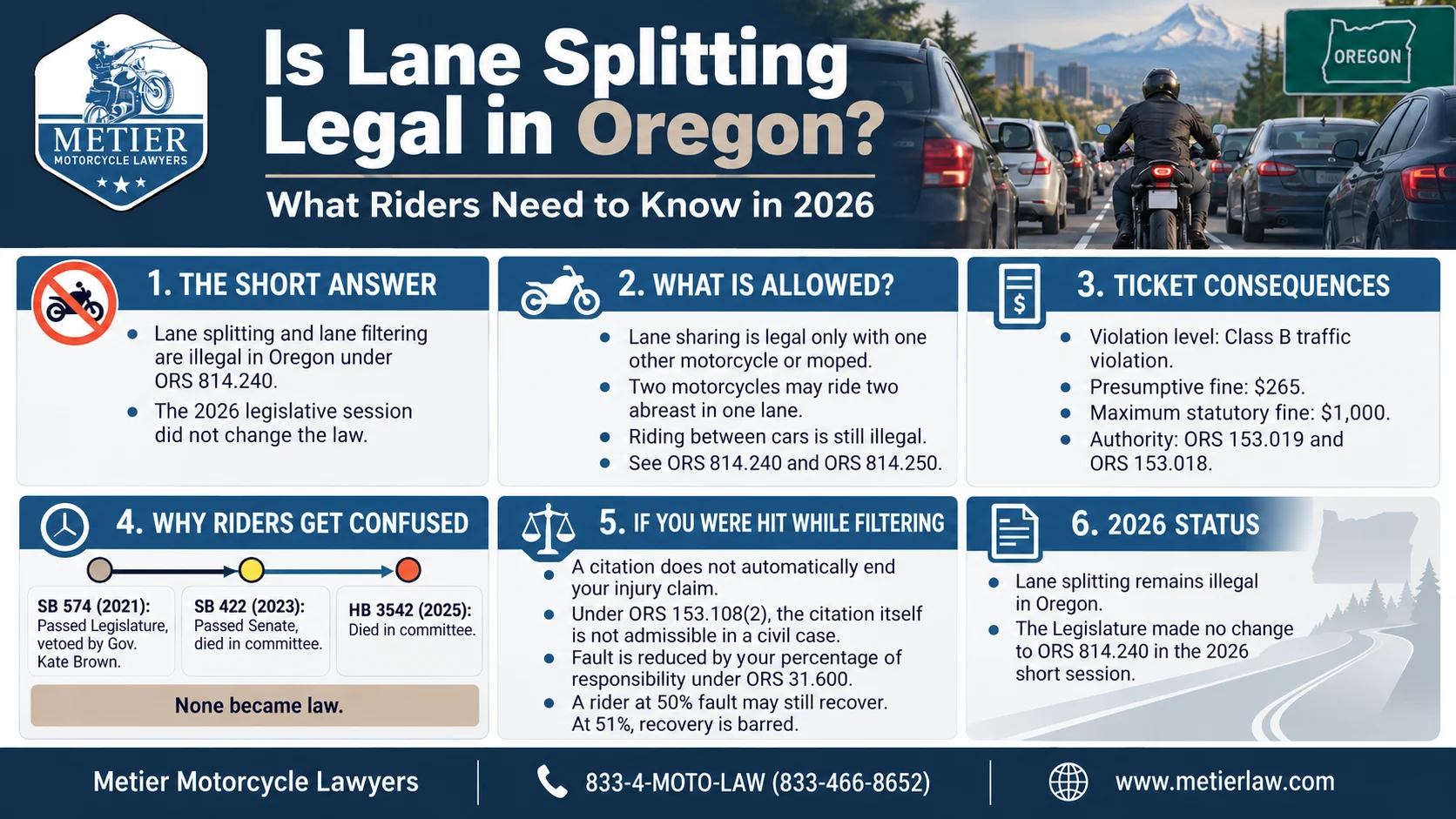
- No. Lane splitting and lane filtering are both illegal in Oregon under ORS 814.240, and the 2026 session left the statute untouched.
- The violation is Class B: a $265 presumptive fine, $1,000 statutory maximum.
- One form of lane sharing is legal. A motorcycle may share a lane with one other motorcycle or moped, never with a car.
- Three filtering bills have come close since 2021. Governor Brown vetoed the one that reached her desk; the two after it died in committee. All three applied only to roads posted 50 mph or higher.
- A citation doesn't end your injury claim, and under ORS 153.108(2) it isn't admissible in a civil case at all.
Northbound I-5 through Portland at five o'clock, traffic stops moving. You're in full gear in ninety-degree summer heat, watching a gap open between the left lane and the center lane that you think about riding into to keep moving. So, is lane splitting legal in Oregon? No. Riding between lanes is illegal here whether traffic is crawling or stopped dead, and the current statute has said so since 1983. Motorcycle riders who think otherwise have a reason: filtering bills have cleared a chamber of the Oregon legislature twice since 2021, and one reached the governor's desk. Neither became law.
Patrick DiBenedetto, Partner at Metier Law Firm, puts it this way: "Riders come to us convinced the law changed, because they watched it clear the Senate and never heard how it ended. The bigger problem shows up after a crash, when an adjuster treats a filtering citation like it settles the claim. That's not what Oregon law says."
Lane Splitting, Lane Filtering, and Lane Sharing Are Three Different Things
Working definitions, since Oregon's statute supplies none: lane splitting means passing between lanes at speed, filtering is the slower version that advances between stopped or crawling vehicles, and lane sharing describes two vehicles in one lane together.
ORS 814.240 uses none of those labels. It defines one offense, motorcycle or moped unlawful passing, committed two ways: overtaking and passing "in the same lane occupied by the vehicle the operator is overtaking, unless the vehicle being passed is a motorcycle or a moped," or operating "between lanes of traffic or between adjacent lines or rows of vehicles." Splitting and filtering both land inside that second clause, whatever you call them.
The first clause carries the exception. A rider may pass another motorcycle or moped within the same lane, and ORS 814.250 caps that at two abreast. Two riders side by side is permitted. One rider threading between two cars is not. Team Oregon puts the practical version this way: "A motorcycle may share a lane only with one other motorcycle. Lane sharing (lane splitting/filtering) with any other vehicle is illegal." Police on official duty are the only other exception.
What a Lane Splitting Ticket in Oregon Actually Costs
Unlawful passing is a Class B traffic violation. Under ORS 153.019 the presumptive fine is $265, a starting figure rather than a fixed price, and ORS 153.018 caps it at $1,000. Adjusters raise the ticket in settlement talks, though what a jury may hear about it is governed by a different statute entirely.
Why Motorcycle Riders Mistakenly Think Lane Filtering Is Legal
Oregon has taken three runs at legalizing filtering since 2021. None of them finished.
SB 574 (2021)
This one got closest. The Senate passed SB 574 on May 5, 2021, the House followed 42 to 14 on May 17, and Governor Kate Brown vetoed it on May 26, citing public safety and compliance concerns. It would have permitted filtering only when traffic was stopped or moving 10 mph or less, at no more than 10 mph above surrounding traffic, and only on highways posted 50 mph or higher. Work zones were excluded outright, school zones under specified conditions like flashing lights or children present.
SB 422 (2023)
Passed the Oregon Senate with bipartisan support on March 21, 2023, carrying SB 574's operating conditions and proposing to raise unlawful passing from Class B to Class A. It died in the Joint Committee on Transportation without a House floor vote.
HB 3542 (2025)
Chief sponsors Rep. Mark Owens and Sen. Sara Gelser Blouin. The measure carried identical conditions and the same Class A change, raising the maximum to $2,000. It died in the same committee.
All three set the floor at roads posted 50 mph or higher, not lower, so filtering at a Burnside stoplight would have stayed illegal under every one. Earlier attempts ran wider: the motorcycle lane filtering bill Oregon considered in 2015, SB 694, carried no posted-limit requirement at all.
Where Oregon Motorcycle Lane Laws Stand in 2026
The 2026 short session adjourned on March 6 without touching this. The Legislature's table of ORS sections amended or repealed that session lists nine provisions in chapter 814, and 814.240 is not among them. The Oregon lane splitting law carries one historical citation, 1983 c.338 §689, with no amendments recorded since.

Hit While Filtering: What It Does and Doesn't Do to Your Claim
Adjusters open this conversation with real law behind them. In Oregon, violating a motor vehicle statute is negligence as a matter of law unless the violating party produces evidence that they were acting as a reasonably prudent person under the circumstances. That rule comes from Barnum v. Williams, 264 Or 71 (1972), and it creates a presumption you're entitled to rebut rather than an automatic verdict against you.
Then comes the part adjusters skip. Under ORS 153.108(2), a plea, finding or judgment in a violation proceeding, and the fact the proceeding was brought at all, may not be admitted as evidence in a civil case. The ticket being waved at you over the phone is not something a jury gets to see. How you were riding stays fair game through witnesses and physical evidence. The citation itself cannot come in.
Fault allocation is the other half. Under ORS 31.600, your damages drop by your percentage of fault, and recovery disappears only when your share exceeds the combined fault of the others in the statutory comparison, a group covering the parties you sue, third party defendants liable to you in tort, and anyone you've settled with. A rider found exactly 50 percent at fault still recovers half. At 51 percent, nothing.
So a rider who was filtering when a driver changed lanes without signaling may well still have a claim. Allocation turns on lane position, signal use, mirror checks and stopping distance, and early offers tend to land before any of that is preserved or evaluated.
None of this makes filtering advisable here. It hands the defense a prepared argument and makes the fight harder than it needs to be. Harder is not over, though, and an adjuster who says the citation ends the conversation is wrong about Oregon law.
Frequently Asked Questions
Is lane splitting legal in Oregon?
No. ORS 814.240 makes it unlawful to operate a motorcycle between lanes of traffic or between adjacent lines or rows of vehicles. It's a Class B traffic violation with a $265 presumptive fine.
Is lane filtering legal in Oregon when traffic is completely stopped?
No. The statute draws no distinction based on whether traffic is moving, and the bills that would have created a stopped-traffic exception never became law.
Can two motorcycles ride side by side in the same lane in Oregon?
Yes. ORS 814.240 permits passing another motorcycle or moped in the same lane, and ORS 814.250 caps it at two abreast. Mopeds count, not just motorcycles.
What happens to my claim if I received a lane splitting ticket in Oregon and a driver hit me?
The citation doesn't defeat your claim, and under ORS 153.108(2) it isn't admissible in a civil proceeding at all. Evidence of how you were riding can still affect the negligence analysis. Recovery is reduced by your percentage of fault and barred only when that share exceeds the combined fault of the others in the ORS 31.600 comparison.
Do Oregon's other motorcycle regulations affect a filtering case?
They can. Helmet, passenger and equipment rules all surface in fault disputes, and our Oregon motorcycle laws guide covers them.
When the Statute and the Traffic Disagree
Sitting between two stopped semis on the Banfield in August makes the argument for filtering feel obvious, and the Legislature has come within one signature of agreeing. None of that changes what ORS 814.240 requires today, or what an insurer will try with a citation after you've been injured.
That's the part we handle. As a Portland motorcycle accident lawyer team that rides, Metier Motorcycle Lawyers has spent years taking apart the argument that a traffic violation ends a rider's case. Call Metier Motorcycle Lawyers at 833-4-MOTO-LAW (833-466-8652) or schedule your free consultation today at www.metierlaw.com.

Disclaimer: Past results discussed should not be considered a guarantee of your results as the factors of every case are individually unique. This content is for informational purposes only and does not constitute legal advice. Consult a qualified attorney from Metier Law Firm regarding your individual situation for legal advice.
Tell Us About Your Case – Free Case Review with a Personal Injury Lawyer
(866) 377-3800Our Locations
.webp)
Do I have a Case?
How Much Should I Be Offered?
Do I Need an Attorney?
If these questions have crossed your mind, let us help. You may need a little direction or may not need an attorney at all, but you deserve to be confident knowing your options. We can provide you with information about our Attorneys of the West® accident investigations and legal services. Your confidential consultation with us is totally free.
Keep up with us!
