.svg)


TL;DR: Key Takeaways
- Wyoming's wind is not a nuisance near Cheyenne. It is a primary cause of serious truck crashes, especially blowovers on I-80 toward Laramie and I-25 north toward Wheatland.
- WYDOT runs a Weight-based Wind Closure system that posts a minimum vehicle weight on overhead signs when gusts hit roughly 60 mph, and drivers who ignore those closures can be fined and held responsible for cleanup costs.
- Federal rule 49 CFR 392.14 requires truck drivers to slow down and, when conditions get dangerous enough, stop entirely. A schedule is never a legal excuse to keep rolling.
- When a carrier pushes a driver through posted wind warnings and someone gets hurt, that decision can become the center of a negligence claim.
- Wyoming gives you four years to file most injury claims and follows a modified comparative fault rule with a 50% bar under W.S. § 1-1-109.
- Evidence in these cases disappears fast. Dispatch records, weather data, and electronic logs all matter, and they need to be preserved early.
Wyoming's wind is not a weather inconvenience near Cheyenne. It is a major cause of serious truck crashes, and the families who live through them rarely understand how much was preventable. I’m Emily N. Benight, a partner at Metier Truck Crash Lawyers. I was raised in Wyoming and have spent years representing people hurt in commercial truck crashes along the corridors that run through and around Cheyenne. Wind truck accidents in Cheyenne Wyoming are among the types of truck accident cases we handle, and they are rarely as simple as the trucking company wants them to appear.
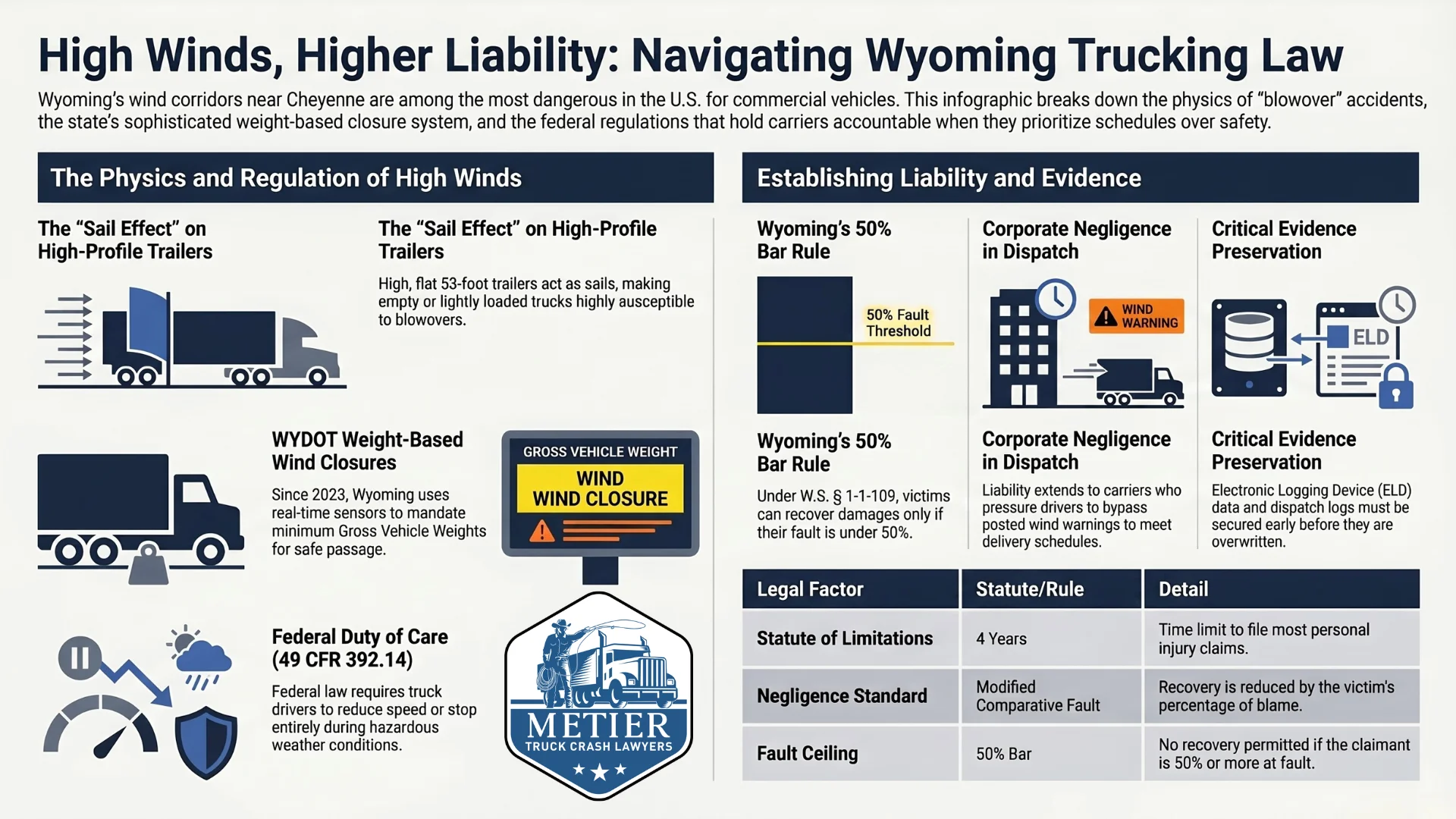
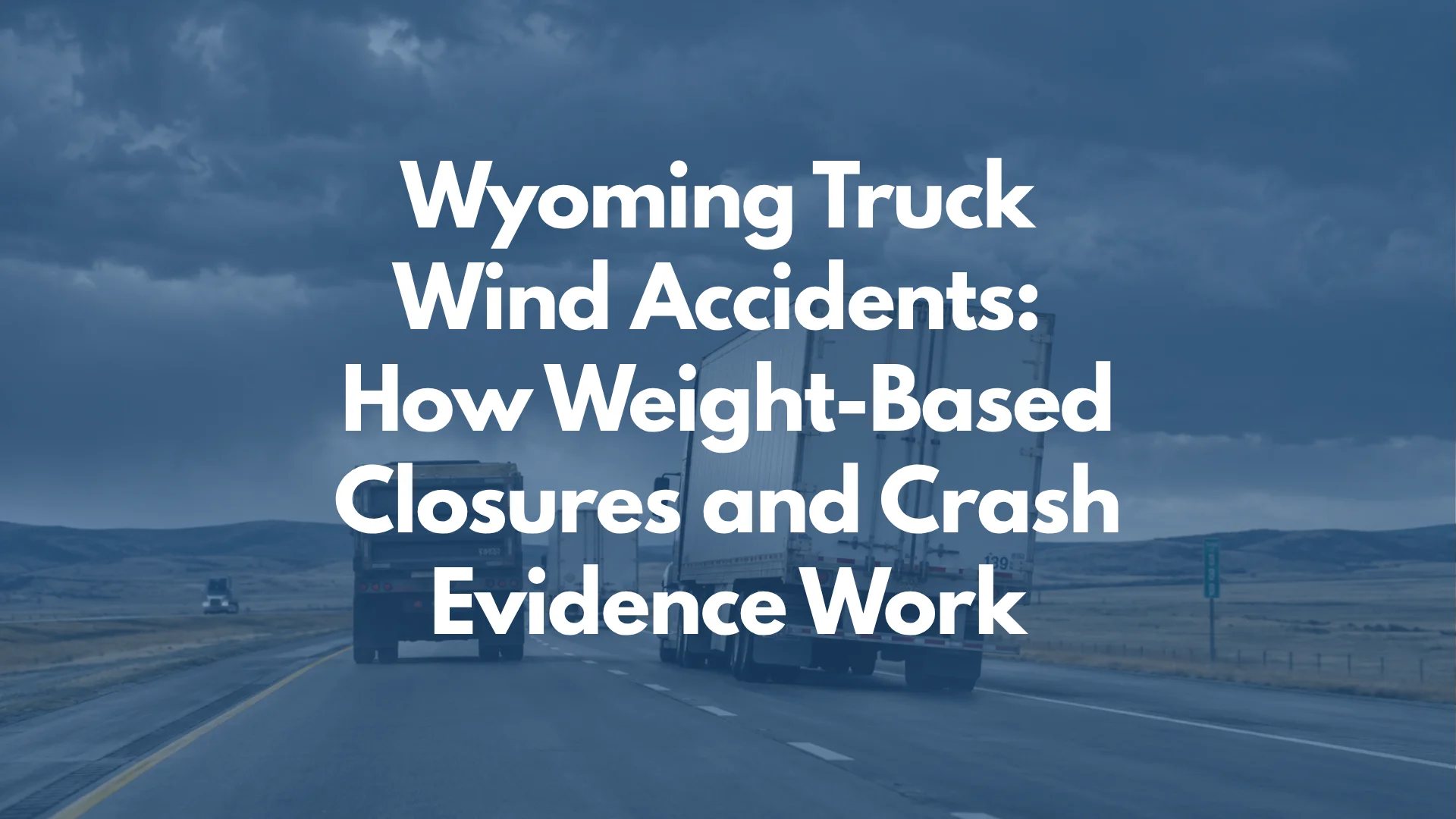
The corridors around Cheyenne are some of the windiest stretches of interstate in the country. I-80 climbing west toward the Happy Jack Road and Vedauwoo area, I-25 running north past the Archer complex toward Wheatland, and US-30 all get hammered by sustained crosswinds that a 53-foot box trailer simply cannot fight. The physics are brutal. A high, flat trailer is basically a sail, and when the wind comes in from the side at highway speed, the truck does not get a vote.
Call Metier Law Firm at 866-377-3800 or schedule your free consultation today at www.metierlaw.com
Why Wind Truck Accidents in Cheyenne Wyoming Hit Harder Than Anything on the Road
A passenger car can get pushed around in a strong gust. A semi gets picked up. The difference is surface area and center of gravity. Empty and lightly loaded trailers are the worst offenders, because there is no weight holding them down against the broad side of the trailer. WYDOT's own experience shows that enclosed box trailers, reefers, doubles, and cattle haulers are the vehicles most likely to go over.
This is why the Cheyenne area produces so many blowover crashes. The land is open, the grades funnel the wind, and the freight never stops moving. Drivers coming through from out of state often have no idea how fast conditions change once they crest the hill west of town.
How WYDOT Decides to Close the Road
Wyoming runs one of the more sophisticated wind closure systems in the country. WYDOT has been closing highways to light, high-profile vehicles since 2011, and in 2023 it rolled out a Weight-based Wind Closure system after research from the University of Wyoming helped the agency assign actual weight limits to those restrictions. The weight-based wind closure system started in 2023. Wyoming Department of Transportation
Here is how it works in plain terms. When winds climb, WYDOT posts a minimum Gross Vehicle Weight on overhead message boards. The weight listed is based on Gross Vehicle Weight, which is the total weight of the truck and payload including persons and all contents of the tractor and trailer. If your rig weighs less than that number, you are not allowed to proceed. The agency updates those figures in real time based on current and forecasted conditions. Wyoming Department of Transportation
WYDOT is candid that the system is not foolproof. Winds can be unpredictable, sensors may not sit in the spots with the strongest gusts, and drivers above the listed weight still assume their own risk. The agency's standing advice is blunt: if strong winds make it hard to keep control of your vehicle, regardless of its weight or shape, pull over in a safe location and wait for the winds to subside. You can see the current restrictions and live wind speeds anytime at WYDOT's wind page. Wyoming Department of TransportationWyoming Department of Transportation
Ignoring a posted closure is not a gray area. Wyoming law backs these restrictions, and drivers who blow past them and crash can face fines and get stuck paying for roadway cleanup and damage. For a commercial carrier, that is also a giant flashing sign of negligence.
Call Metier Law Firm at 866-377-3800 or schedule your free consultation today at www.metierlaw.com
What Federal Law Requires of Truck Drivers in Wind
Federal regulations do not let a trucking company treat weather as optional. Under 49 CFR 392.14, extreme caution must be exercised when hazardous conditions adversely affect visibility or traction, speed must be reduced, and if conditions become sufficiently dangerous the operation of the truck must be discontinued until it can be operated safely. eCFR
Now, the rule lists conditions like snow, ice, and dust, and it does not name wind by itself. That matters, and I am not going to pretend otherwise. But high wind almost never travels alone out here. It comes with blowing snow, blowing dust, and ice, and it absolutely affects a driver's ability to control the vehicle. Courts have treated this standard as a heightened duty for commercial drivers, not the ordinary care expected of a regular motorist. When a driver keeps rolling a near-empty trailer into a posted blowover zone, that is the kind of decision this rule was written to prevent.
If you or a loved one was injured in a crash with a commercial truck, call us at 866-377-3800 or schedule a free consultation at www.metierlaw.com.
When the Trucking Company Is the Problem
In a lot of these cases, the driver is not the only one at fault, and sometimes not even the main one. Dispatchers track the weather. Carriers know about Wyoming's wind closures. When a company pressures a driver to keep a delivery on schedule through a posted warning, the responsibility moves up the chain.
That is where the investigation matters. A handful of records can show exactly what happened and who made the call.
Electronic logging device data
This shows where the truck was, how fast it was moving, and whether the driver was pushing through hours they should have been resting.
Dispatch messages
These show what the driver was told and whether the company sent them into a posted wind warning anyway.
Weather and WYDOT closure logs
Closure logs should show the exact conditions and restrictions in place at that mile marker at the moment of the crash.
Driver qualification and maintenance files
These files can show if the carrier put a properly trained driver in a properly maintained rig, or cut a corner that mattered.
We have handled crashes across these same corridors, including the kind of pileups that happen when wind and ice combine, which we covered in detail in our look at why 2026 has been one of Wyoming's deadliest years on the road.
Wind crashes are not the only danger on these routes either. The geometry of the I-25 and I-80 interchange itself creates its own set of hazards, separate from the weather, and a sideways trailer in a gust is a different problem than a jackknife on an icy grade, though strong wind can trigger either one.
Call Metier Law Firm at 866-377-3800 or schedule your free consultation today at www.metierlaw.com
Your Rights as a Wyoming Crash Victim
Wyoming gives you four years from the date of the crash to file most personal injury claims. The state also follows modified comparative fault with a 50% bar under W.S. § 1-1-109, which means you can recover as long as you are not 50% or more at fault, though your recovery drops by your share of the blame. Those rules sound simple until a trucking company's insurer starts trying to pin the wind on you, the victim. That is a fight worth having a real truck crash lawyer for.
Do not let that four-year window fool you. The trucking company starts building its defense the day of the crash, sometimes before the wreckage is even cleared. Their investigators are on scene fast, their lawyers are working the file early, and the evidence that proves your case does not wait for you. Skid marks get paved over. Electronic data gets overwritten on a set schedule. Witnesses move and memories fade. Every day that passes is a day the other side uses to its advantage. The sooner you have a qualified truck accident lawyer in your corner, the better your odds of preserving what actually happened out there.
Frequently Asked Questions
What wind speed closes I-80 to trucks in Wyoming?
WYDOT generally moves toward restrictions when gusts approach 60 mph, and it posts a minimum vehicle weight on overhead signs rather than a single fixed wind number. The exact threshold varies by location and current conditions, so always check WYDOT's live wind page before traveling.
Can a trucking company be liable for a wind blowover near Cheyenne?
Yes. If the carrier or driver ignored a posted closure, drove a near-empty trailer into a known blowover zone, or failed to slow down under federal rules, that can be negligence. Liability often reaches past the driver to the company that scheduled the run.
Is wind a legal excuse for a semi truck accident in Cheyenne?
No. Wind is a known and predictable hazard in this part of Wyoming. Federal law requires drivers to reduce speed and stop when conditions get dangerous, so a crash blamed on wind usually points back to a choice someone made.
How long do I have to file a truck accident claim in Wyoming?
Most personal injury claims must be filed within four years of the crash. Some related claims have shorter deadlines, so it is smart to talk to a lawyer early before evidence disappears.
Do I need a truck accident lawyer for a wind-related crash?
These cases turn on records most people never see, like dispatch logs and electronic data. A truck accident lawyer in Cheyenne who knows how to pull and read those records gives you a real shot at holding the right party accountable.
Talk to a Cheyenne Truck Crash Lawyer Before the Evidence Is Gone
Wind crashes look like accidents and often are not. They are the result of choices, by a driver, a dispatcher, or a company that decided a delivery mattered more than the warning signs flashing on the interstate. Wind truck accidents in Cheyenne Wyoming come down to those choices, and we know how to prove them. We know these roads, we know the rules that govern the trucks on them, and we know how to dig out the proof. If you were hurt in a wind-related truck crash anywhere around Cheyenne, you deserve someone in your corner who has actually driven these corridors and fought these cases.
Our truck accident attorneys bring that same experience to every wind-related crash we investigate, and as a Cheyenne truck accident attorney team, we know these specific corridors and the carriers that run them. If a crash like this proves fatal, a wrongful death lawyer in Cheyenne from our team stands with the family through everything that follows.
Call Metier Law Firm at 866-377-3800 or schedule your free consultation today at www.metierlaw.com.
Disclaimer: Past results discussed should not be considered a guarantee of your results as the factors of every case are individually unique. This content is for informational purposes only and does not constitute legal advice. Consult a qualified attorney from Metier Law Firm regarding your individual situation for legal advice.
Tell Us About Your Case – Free Case Review with a Truck Accident Lawyer
Tell Us About Your Case – Free Case Review with a Personal Injury Lawyer
(866) 377-3800Our Locations
.webp)
Do I have a Case?
How Much Should I Be Offered?
Do I Need an Attorney?
If these questions have crossed your mind, let us help. You may need a little direction or may not need an attorney at all, but you deserve to be confident knowing your options. We can provide you with information about our Attorneys of the West® accident investigations and legal services. Your confidential consultation with us is totally free.
Keep up with us!
