.svg)


TL;DR - Key Takeaways
- Most motorcycle claims settle, but the leverage comes from being ready to file a motorcycle accident lawsuit before your deadline.
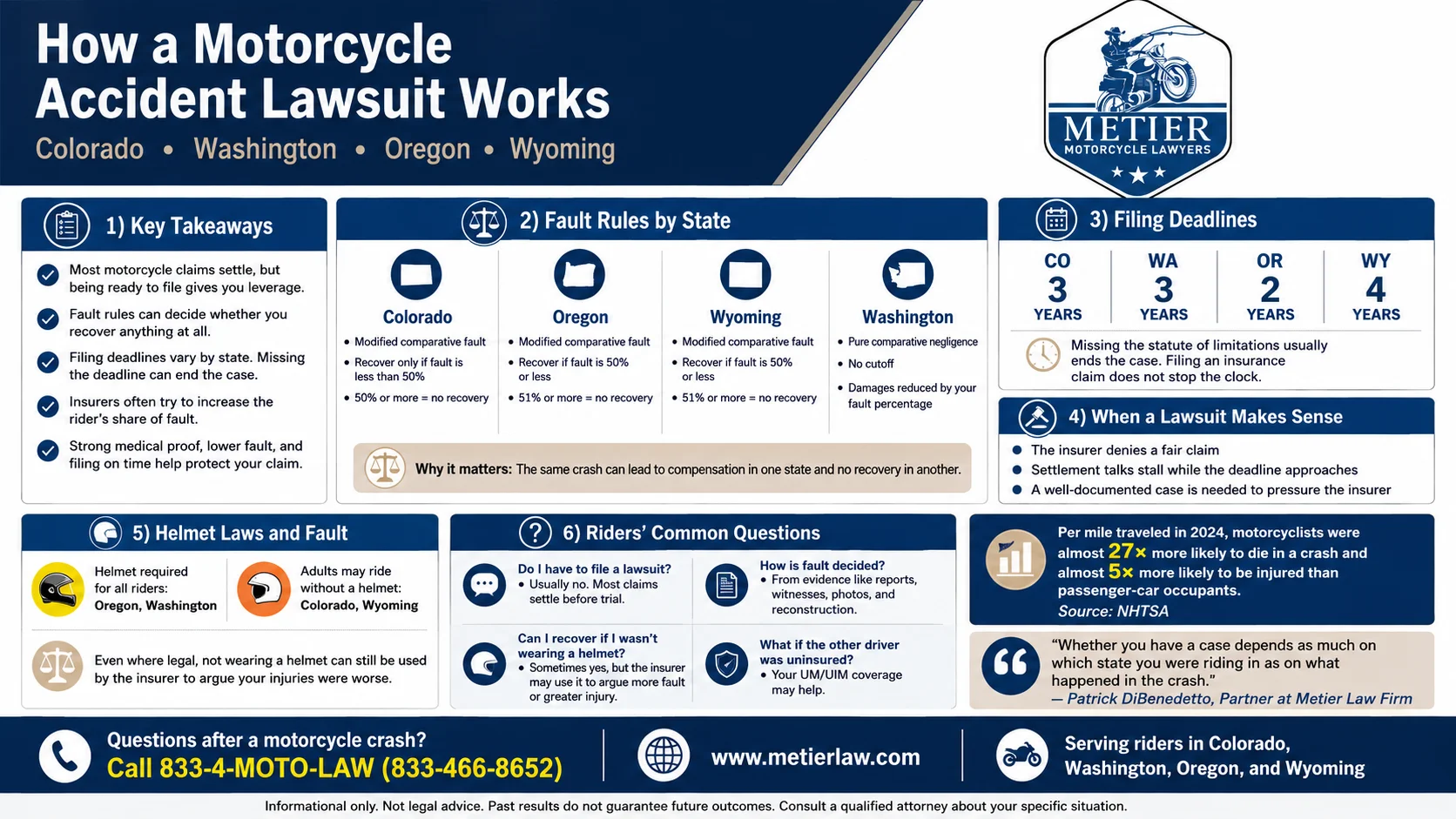
- Fault rules decide whether you recover at all: Colorado bars recovery at 50 percent, Oregon and Wyoming at 51 percent, and Washington places no cutoff on partial fault.
- Your filing deadline ranges from two years in Oregon to four years in Wyoming, and missing it ends the case no matter how strong it is.
- The at-fault driver's insurer will push to raise your share of fault, because three of our four states cut off recovery once it passes a set threshold.
- Strong medical records, a low fault share, and filing on time do the most to protect your claim.
A rider can have a strong case and still walk away with nothing. The reason usually isn't the crash. It's a percentage, a deadline, or a recorded statement that sounded harmless at the time. Per mile traveled in 2024, motorcyclists were almost 27 times more likely than people in passenger cars to die in a crash and almost five times more likely to be injured, according to the National Highway Traffic Safety Administration. Your injuries are often serious, and so is the money at stake. The same crash can be worth full compensation in one state and nothing in another, and the deciding factor is often just where it happened.
"Whether you have a case depends as much on which state you were riding in as on what happened in the crash," says Patrick DiBenedetto, Partner at Metier Law Firm and a rider himself. "The same facts play out differently in Colorado, Washington, Oregon, and Wyoming, and the insurance companies count on riders not knowing the difference."
We represent injured riders in all four, and the rules that shape a motorcycle accident lawsuit change from state to state.
When a motorcycle accident lawsuit makes sense
Most motorcycle accident claims settle through negotiation, not in a courtroom. A claim and a lawsuit aren't the same thing. The claim is the demand you make on the insurance company. The lawsuit is the formal case you file in court when the company won't pay what your injuries are worth. You often don't need to file one to get paid. But when a well-documented case can still reach court before the deadline, adjusters negotiate differently. The scene itself matters too, and our guide on what to do after a motorcycle accident walks through those first steps in detail.
How fault decides whether you recover anything
The single biggest variable in your claim is comparative fault, the rule each state uses to split blame when more than one person contributed to the crash. Three of our four states cut off your recovery entirely once your share crosses a line. One won't. Which rule applies can decide whether a motorcycle accident lawsuit is worth pursuing at all.
Colorado bars recovery at 50 percent
Under C.R.S. § 13-21-111, you can recover only if your share of fault is less than 50 percent. At 50 percent or more, you recover nothing. A rider found 30 percent at fault on a 100,000 dollar claim recovers 70,000 dollars. At 50 percent, that same rider collects nothing.
Oregon and Wyoming bar recovery at 51 percent
Oregon under ORS 31.600 and Wyoming under W.S. § 1-1-109 are a shade more forgiving. You can recover as long as your fault isn't more than 50 percent, so a rider found exactly 50 percent at fault still collects half. Cross to 51 percent and the recovery ends.
Washington sets no cutoff
Washington uses pure comparative negligence under RCW 4.22.005. Your award drops by your share of fault, but it never disappears. Even a rider found 80 percent at fault can still recover 20 percent of the damages.
That single percentage is why insurers fight so hard to blame the rider, often leaning on an old bias that anyone on two wheels was riding recklessly. If you want a sense of how fault and injuries drive the dollars, our breakdown of what drives a motorcycle accident settlement in Colorado lays out the factors.

If you've been hurt in a motorcycle crash and need answers, call us at 833-4MOTO-LAW (833-466-8652) or schedule a free consultation at www.metierlaw.com.
Your filing deadline, state by state
Every state sets a hard filing deadline, the statute of limitations. Miss it, and the court will dismiss even a strong case, no matter the facts. For a motorcycle crash, the injury deadlines are three years in Colorado under C.R.S. § 13-80-101(1)(n), three years in Washington under RCW 4.16.080, two years in Oregon under ORS 12.110, and four years in Wyoming under W.S. § 1-3-105. Oregon's two-year window is the one that catches riders off guard. Wrongful death and government-vehicle claims can run on shorter clocks, so don't assume the longest deadline is yours. Filing an insurance claim does not stop this clock. Only filing a motorcycle accident lawsuit in court does.
Helmets, fault, and a common myth
A lot of riders believe helmets are required everywhere. They aren't. Oregon and Washington require every rider and passenger to wear one, while Colorado and Wyoming only require helmets for riders under 18. Our state-by-state helmet law guide covers the details. Where an adult can legally ride without one, riding without a helmet doesn't bar your claim. Expect the insurer to argue anyway that a missing helmet made your head or neck injuries worse, and to fold that into your fault percentage. It's an argument we're ready for.

Common questions riders ask
Do I have to file a motorcycle accident lawsuit to get compensation?
Usually not. Most motorcycle accident claims settle with the insurer. Filing a motorcycle accident lawsuit becomes necessary when the company denies a fair claim or drags out payment while your deadline approaches. Even then, most filed cases still settle before trial.
How is fault decided after a motorcycle crash?
An insurance adjuster assigns fault first, during negotiations. If the case reaches court, a judge or jury sets the percentages from the evidence: the police report, witness accounts, photos, and sometimes crash reconstruction. Your state's comparative fault rule then controls what those percentages mean, and a few points can be the difference between a full recovery and nothing in Colorado, Oregon, and Wyoming.
How long do I have to file in my state?
The statute of limitations runs two years in Oregon, three in Colorado and Washington, and four in Wyoming for most injury claims. Wrongful death and government-vehicle claims can be shorter. Talk to a lawyer early, because evidence fades long before the deadline does.
Can I still recover if I wasn't wearing a helmet?
In Colorado and Wyoming, adults can ride without a helmet legally, so it doesn't automatically bar recovery. The insurer may still argue your injuries were worse because of it. In Oregon and Washington, where helmets are required for everyone, riding without one is a violation the insurer can use to push more fault onto you.
What if the at-fault driver was uninsured?
Your own uninsured or underinsured motorist coverage can step in to pay for your injuries. These claims carry their own deadlines and rules, and they're often where an experienced motorcycle accident lawyer matters most.
Four states, one standard for your case
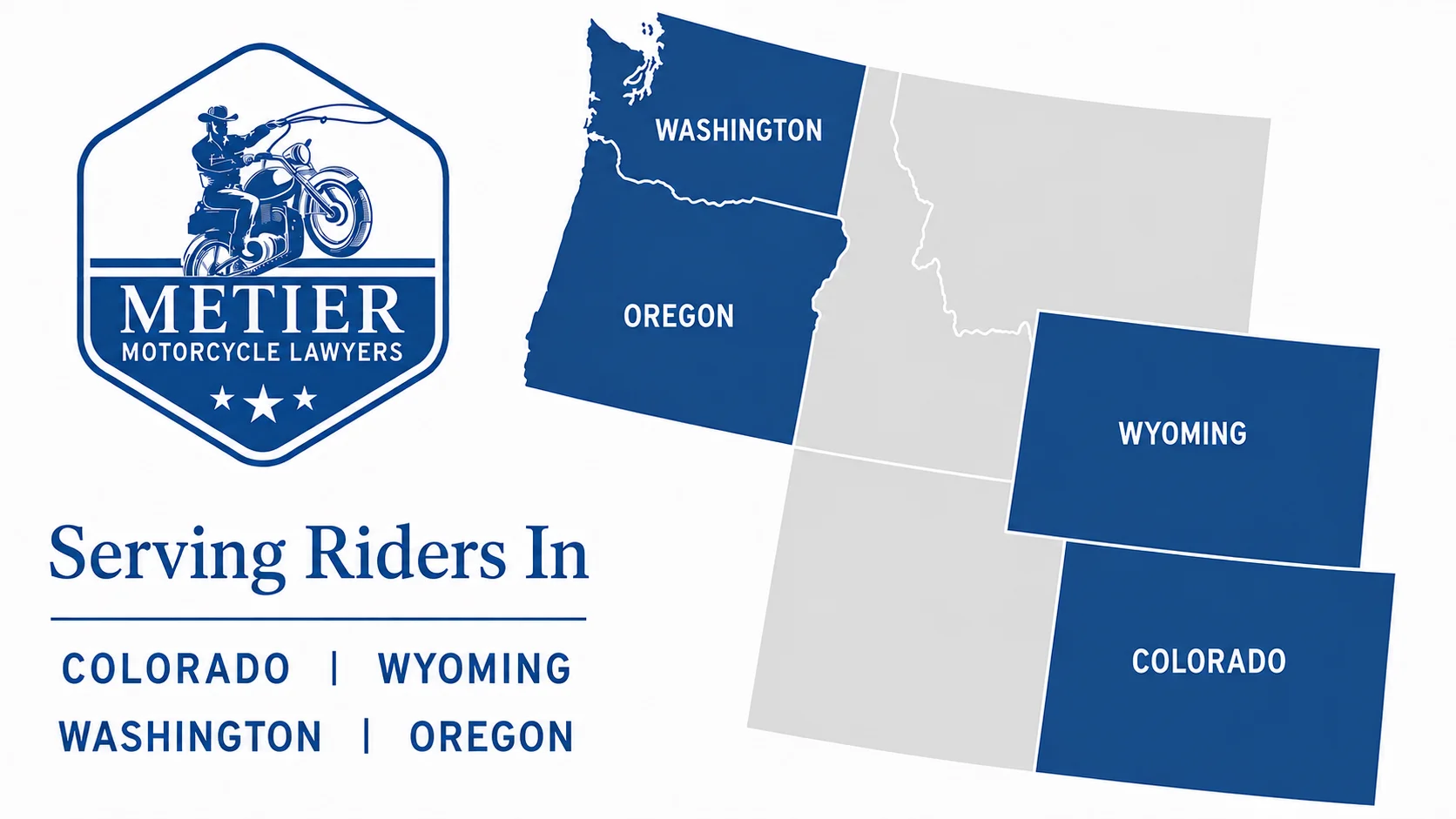
The crash is the same on any road. The law that follows it isn't, and a rule you didn't know about shouldn't be the reason you go uncompensated. At Metier Motorcycle Lawyers, we handle motorcycle injury claims across Colorado, Washington, Oregon, and Wyoming. Whether your case settles or becomes a motorcycle accident lawsuit, we know where each state's rules help you and where they can hurt you.

Disclaimer: Past results discussed should not be considered a guarantee of your results as the factors of every case are individually unique. This content is for informational purposes only and does not constitute legal advice. Consult a qualified attorney from Metier Law Firm regarding your individual situation for legal advice.

Tell Us About Your Case – Free Case Review with a Personal Injury Lawyer
(866) 377-3800Our Locations
.webp)
Do I have a Case?
How Much Should I Be Offered?
Do I Need an Attorney?
If these questions have crossed your mind, let us help. You may need a little direction or may not need an attorney at all, but you deserve to be confident knowing your options. We can provide you with information about our Attorneys of the West® accident investigations and legal services. Your confidential consultation with us is totally free.
Keep up with us!
