.svg)


TL;DR: Key Takeaways
- Negligence in a Portland truck accident comes down to four elements: duty, breach, causation, and damages. You have to prove all four.
- A truck driver and the trucking company both owe you a duty of care, and either can breach it through fatigue, speeding, bad hiring, or skipped maintenance.
- Liability can reach past the driver to the carrier, a cargo loader, a maintenance contractor, or a parts manufacturer.
- A violation of FMCSA rules, like the federal hours-of-service limits, can serve as direct evidence that a duty was breached.
- Oregon uses modified comparative negligence under ORS 31.600, so you can still recover if your share of fault is 50% or less, and you have two years to file under ORS 12.110.
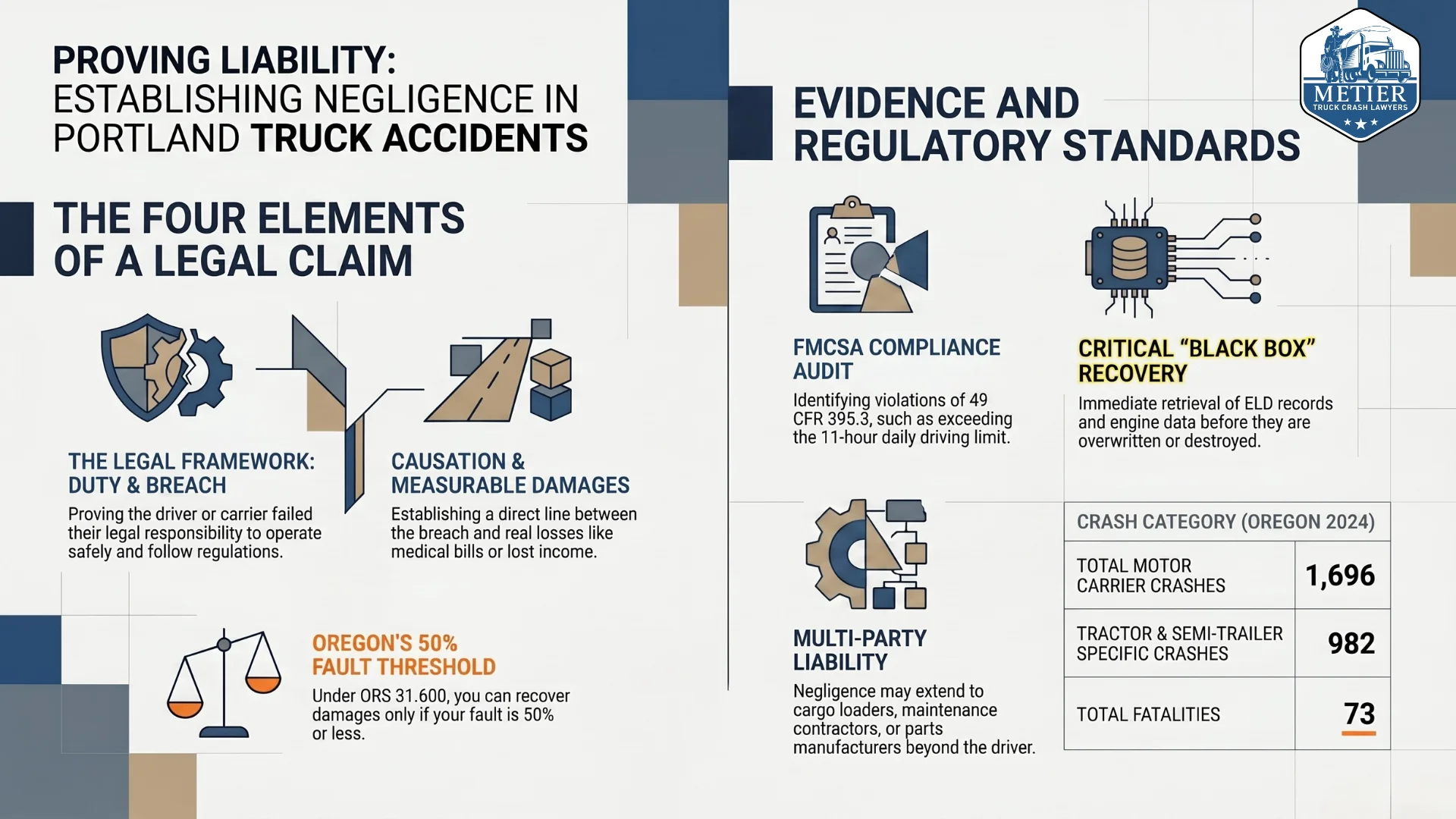
A loaded semi can weigh up to 80,000 pounds. When one hits a passenger car, the people in the smaller vehicle almost always pay for it. In 2024, ODOT recorded 1,696 motor carrier crashes on Oregon roads, and 73 people were killed, with tractor and semi-trailers involved in 982 of them. If you were hurt in one of these wrecks here in Portland, the question that decides your case is whether someone was negligent and whether you can prove it.
I'm Mike Chaloupka, managing partner at Metier Law Firm. I hold a Class A Commercial Driver's License, I'm licensed in Oregon, and our team has spent years representing truck crash victims across the western U.S.. In a courtroom, negligence has a precise meaning, and proving it takes more than saying the truck driver messed up. Here is how negligence in a Portland truck accident gets established.
Call Metier Law Firm at 866-377-3800 or schedule your free consultation today at www.metierlaw.com
What Is Negligence in a Truck Accident Case
Negligence is a legal failure to act with reasonable care. To win, we have to prove four elements, and a gap in any one can sink the case.
Duty
The driver and the trucking company both had a legal responsibility to operate safely. The driver follows traffic laws and federal trucking rules; the carrier maintains its trucks and hires qualified people.
Breach
Someone failed that responsibility. Maybe the driver stayed on the road past the legal limit, or the company sent out a rig it knew had bad brakes.
Causation
That breach is what actually caused your injuries. There has to be a clear line from the wrong to the harm, not just timing.
Damages
You were actually hurt and lost something real, like medical bills, lost income, or a permanent injury. Without measurable harm, there is no claim.
Get all four on the record and you have established negligence. Miss one and the defense will aim straight at it.
Call Metier Law Firm at 866-377-3800 or schedule your free consultation today at www.metierlaw.com
Common Examples of Truck Driver and Company Negligence
Most truck crashes trace back to a decision someone made before the wreck. The driver-side patterns are consistent. ODOT's 2024 data lists speed, following too close, and sleep or fatigue among the top at-fault errors for truck drivers in the state. We see the same things in our case files: a driver pushing through exhaustion to meet a delivery window, tailgating on a wet stretch of I-5, drifting out of a lane near the Rose Quarter merge, or looking at a phone.
Company negligence is quieter but often matters more. A carrier that hires a driver with a bad record, skips required inspections, or pressures drivers to run past the federal hours-of-service limits has breached its own duty of care. When a company's choices set the crash in motion, it is liable too, not just the driver.
Other Parties That Can Be Held Responsible for Negligence
What surprises people about a truck accident is how many parties can share the blame. A cargo loader that secured a load improperly can be responsible when it shifts and causes a rollover. A maintenance contractor that signed off on a brake job it never did can be liable when those brakes fail. A parts manufacturer can face a product liability claim when a defective tire causes the wreck. Figuring out who owed you a duty, and who breached it, is a big reason these cases are harder than a standard car crash.
How FMCSA Violations Support a Negligence Claim
This is where commercial truck cases part ways with ordinary car wrecks. Trucking runs on federal law. The Federal Motor Carrier Safety Administration sets rules in 49 CFR covering driving hours, maintenance, and cargo securement.
The hours-of-service rules are a good example. Under 49 CFR 395.3, a property-carrying driver can drive a maximum of 11 hours after 10 straight hours off duty, cannot drive past the 14th hour of a shift, has to take a 30-minute break after 8 hours of driving, and cannot drive after 60 hours in 7 days or 70 in 8. When a driver blows past those limits and causes a crash, the violation itself can stand as evidence the duty of care was breached. The same goes for skipped inspections, falsified logs, and overweight loads. We do not have to argue whether the conduct was unreasonable when a federal rule already drew the line and the driver crossed it.
If you or a loved one was injured in a crash with a commercial truck, call us at 866-377-3800 or schedule a free consultation at www.metierlaw.com.
Evidence Used to Prove Fault in Truck Accidents
Establishing negligence is only as strong as the evidence behind it. The proof in these cases includes the truck's black box data, electronic logging device records, the driver's qualification file, maintenance and inspection logs, dispatch messages, and the police report. Some of this gets overwritten within weeks of a crash, which is why moving fast matters. We have written more on what evidence proves truck driver negligence and on the crash zones along Portland's I-5 corridor, if you want to go deeper.
Frequently Asked Questions
How is negligence established in a Portland truck accident?
You prove four elements: that the driver or company owed you a duty of care, that they breached it, that the breach caused your injuries, and that you suffered real damages. Federal rule violations, like an hours-of-service breach, often supply direct proof of that second element.
Can I recover if I was partly at fault?
Yes, within limits. Oregon follows modified comparative negligence under ORS 31.600. You can recover as long as your fault is not greater than the combined fault of everyone else, which works out to 50% or less, and your award is reduced by your percentage. Insurers fight to push that number up, because every point lowers what they pay.
How long do I have to file a truck accident claim in Oregon?
Two years from the date of the crash under ORS 12.110. That window can be shorter when a government entity is involved, so it is worth getting advice early.
Contact a Portland Truck Accident Lawyer With Metier Law Firm
Proving negligence in a Portland truck accident is not something to take on alone while you heal. The trucking company had its team working the moment the crash happened, and you should have yours too. We know what that driver was supposed to do before leaving the yard, what the logs should show, and where carriers cut corners, and we use that to build the strongest case the facts allow, whether your crash happened on I-5, I-84, or the freight routes around the Port of Portland.
A truck accident lawyer from our firm can start that investigation right away, and as a Portland truck accident lawyer team, we know these specific routes and the carriers that run them. If a crash like this proves fatal, a wrongful death lawyer in Portland from our team stands with the family through everything that follows.
Call Metier Law Firm at 866-377-3800 or schedule your free consultation today at www.metierlaw.com.
Disclaimer: Past results discussed should not be considered a guarantee of your results as the factors of every case are individually unique. This content is for informational purposes only and does not constitute legal advice. Consult a qualified attorney from Metier Law Firm regarding your individual situation for legal advice.
Tell Us About Your Case – Free Case Review with a Truck Accident Lawyer
Tell Us About Your Case – Free Case Review with a Personal Injury Lawyer
(866) 377-3800Our Locations
.webp)
Do I have a Case?
How Much Should I Be Offered?
Do I Need an Attorney?
If these questions have crossed your mind, let us help. You may need a little direction or may not need an attorney at all, but you deserve to be confident knowing your options. We can provide you with information about our Attorneys of the West® accident investigations and legal services. Your confidential consultation with us is totally free.
Keep up with us!
