.svg)


TL;DR - Key Takeaways
- In Oregon, the statutory speed limit for a loaded semi (a motor truck over 10,000 pounds or a truck tractor over 8,000 pounds) is 55 mph on most highways unless a higher speed is posted.
- The Oregon Department of Transportation posts many rural interstate stretches at 60 mph for these trucks.
- The fastest a semi can legally travel in Oregon is 65 mph, and only on designated eastern Oregon segments like I-84 east of The Dalles and I-82.
- Cars get higher limits than trucks on those eastern stretches, so a truck doing 70 there is breaking the law even when the traffic around it is not.
- Limits drop further in cities, work zones, mountain passes, and bad weather, and when a speeding truck causes a crash, both the driver and the trucking company can be held responsible.
A fully loaded semi can weigh 80,000 pounds. A passenger car weighs around 4,000. When something that heavy is moving fast and the driver needs to stop, physics does not care about the schedule. That gap in weight is why Oregon treats truck speed differently than car speed, and it is why so many people ask how fast a semi can legally go in Oregon after a crash on I-5 or I-84.
We are Metier Truck Crash Lawyers, and we represent people hurt in commercial truck crashes across Oregon, from Portland through Salem and Eugene to the Columbia River Gorge. We have handled truck accident injury cases for years, so we know how these trucks behave and what the rules require. Most folks are surprised by how low the legal limit for a big rig really is.
Call Metier Law Firm at 866-377-3800 or schedule your free consultation today at www.metierlaw.com
Oregon Speed Limits for Semi Trucks
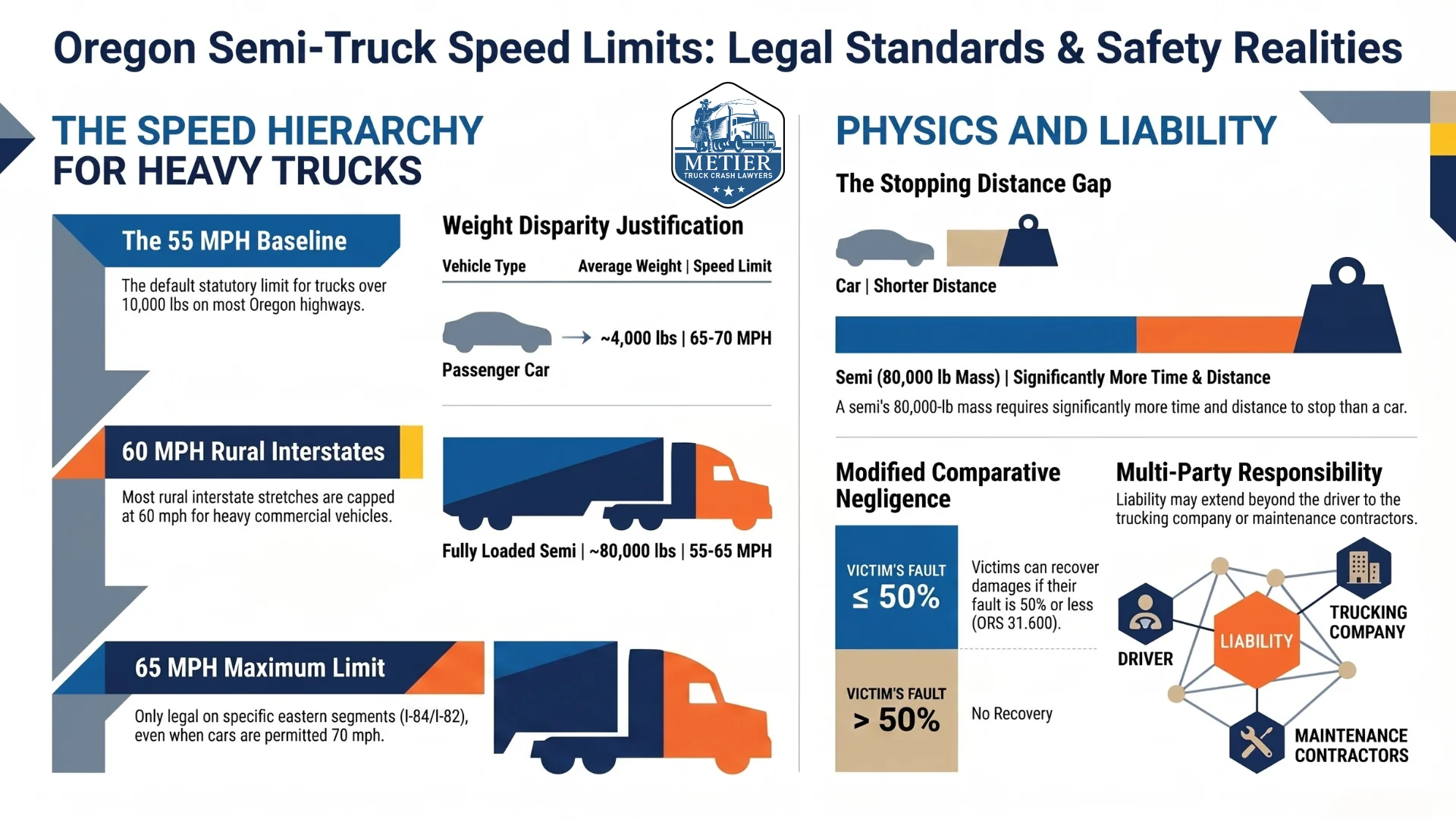
Oregon sets a lower speed limit for heavy trucks than for cars. Under ORS 811.111, a motor truck with a gross vehicle weight rating over 10,000 pounds, or a truck tractor over 8,000 pounds, cannot drive faster than 55 mph on any highway unless a different speed is posted. Cars, by comparison, get 65 mph on interstates by default.
Here is how it breaks down on the road:
- 55 mph: the baseline for heavy trucks on most Oregon highways, unless signs say otherwise.
- 60 mph: the posted truck limit on many rural interstate stretches, set by ODOT under administrative rule.
- 65 mph: the highest legal speed for a semi in Oregon, only on specific eastern segments including I-84 from The Dalles east to the Idaho line and I-82 between the Washington line and I-84.
- Lower: inside cities, through work zones, on mountain passes like Siskiyou Summit on I-5, and any time weather turns bad.
That eastern Oregon detail trips people up. On I-84 past The Dalles, cars are allowed 70 mph but trucks are still capped at 65, so a rig running with traffic at 70 out there is speeding even though the cars next to it are not. We have seen trucking companies lean on that confusion to defend a driver.
Call Metier Law Firm at 866-377-3800 or schedule your free consultation today at www.metierlaw.com
Why Speed Limits Differ for Commercial Vehicles
The lower limit is not arbitrary. A loaded semi needs much more room to stop than a car, and that distance grows as speed climbs. Wet pavement, a downgrade, or worn brakes stretch it further. Mountain terrain makes it worse: long descents off the Cascades or into the Gorge put real strain on a truck's brakes, and a driver carrying too much speed into one of those stretches can lose braking power entirely.
Weight is the other half of it. A few extra miles per hour does not feel like much in the cab, but it changes how hard the truck hits and how little time anyone has to react. For a closer look at where these crashes cluster in the metro area, we broke down the most dangerous freight corridors around Portland's I-5 in a separate post.
How Speeding Contributes to Truck Accidents
Speed rarely acts alone. It pairs with fatigue, tight delivery windows, and worn equipment. But a truck moving too fast for conditions removes the one thing a driver needs most in an emergency: time.
Truck crashes do enormous damage even when speeding is not the headline. In 2023, 5,472 people were killed in crashes involving large trucks, according to the National Highway Traffic Safety Administration, and most of those killed were people in other vehicles. When speed is part of the picture, it usually means a harder impact and worse injuries.
Speed also matters for who pays. Oregon uses a modified comparative negligence rule under ORS 31.600. You can still recover as long as your share of fault is 50 percent or less, and your award is reduced by your percentage of fault. If a truck driver was speeding and that speed contributed to the crash, it shifts fault toward the trucking side, which can change what an injured person recovers.
Liability often reaches past the driver. Others who may share responsibility include:
- The truck driver, for driving too fast for conditions.
- The trucking company, if it pushed an unrealistic schedule or ignored a driver's history.
- A maintenance contractor or cargo loader, if bad brakes or a shifting load played a role.
If you or a loved one was injured in a crash with a commercial truck, call us at 866-377-3800 or schedule a free consultation at www.metierlaw.com.
Federal and State Regulations for Truck Drivers
Truck drivers answer to two layers of rules. Oregon's posted limits set the ceiling on any given road. On top of that, federal law requires every commercial vehicle to follow the traffic laws of wherever it operates. That rule, 49 CFR 392.2, makes a posted speed limit a federal obligation, not a suggestion. Federal regulations also bar a carrier from scheduling a run so tight that the only way to make it is by speeding.
That point matters in our cases. When a driver was speeding to hit an impossible deadline, the company that set the deadline often shares the blame. We pull driver logs, dispatch records, and the truck's electronic data to see how fast it was really going and why. Deadlines and empty backhauls both push drivers to take chances, which is one reason we wrote about how deadhead trucking affects crash liability.
Frequently Asked Questions
How fast can semi trucks go in Oregon on the interstate?
On most Oregon interstates, heavy trucks are limited to 55 or 60 mph depending on what is posted. The top legal truck speed is 65 mph, and that only applies on designated eastern Oregon stretches like I-84 east of The Dalles and I-82.
Is a truck speeding if it goes 70 mph in eastern Oregon?
Usually yes. On the eastern segments where cars are allowed 70 mph, trucks are still capped at 65 mph, so a truck at 70 there is over the limit even if the cars around it are not.
What should I do if a speeding truck hit me in Oregon?
Get medical care, then preserve evidence. Photos, the police report, and witness contacts all help, since speed evidence disappears fast. Oregon's filing deadline is covered in our post on the Oregon personal injury statute of limitations.
Can I still recover money if I was partly at fault?
Yes, as long as your fault is 50 percent or less. Your recovery is reduced by your share of fault under Oregon's comparative negligence rule.
Talk to Our Oregon Truck Accident Lawyers Today
Knowing the legal speed for a semi in Oregon is the easy part. Proving a truck was speeding, and showing how that speed caused your injuries, takes evidence the trucking company would rather you never see. That is the work we do. We move fast to lock down the data, and we know the questions to ask because we understand these trucks from the driver's seat out. If a speeding commercial truck hurt you anywhere in Oregon, our Portland truck accident lawyers are ready.
Our truck accident lawyers bring that same investigative approach to every speeding case we take on. When a crash like this proves fatal, our wrongful death attorney in Portland stands with the family through everything that follows.
Call Metier Law Firm at 866-377-3800 or schedule your free consultation today at www.metierlaw.com.
Disclaimer: Past results discussed should not be considered a guarantee of your results as the factors of every case are individually unique. This content is for informational purposes only and does not constitute legal advice. Consult a qualified attorney from Metier Law Firm regarding your individual situation for legal advice.
Tell Us About Your Case – Free Case Review with a Truck Accident Lawyer
Tell Us About Your Case – Free Case Review with a Personal Injury Lawyer
(866) 377-3800Our Locations
.webp)
Do I have a Case?
How Much Should I Be Offered?
Do I Need an Attorney?
If these questions have crossed your mind, let us help. You may need a little direction or may not need an attorney at all, but you deserve to be confident knowing your options. We can provide you with information about our Attorneys of the West® accident investigations and legal services. Your confidential consultation with us is totally free.
Keep up with us!
